
Kubernetes Training and Workshops for Teams
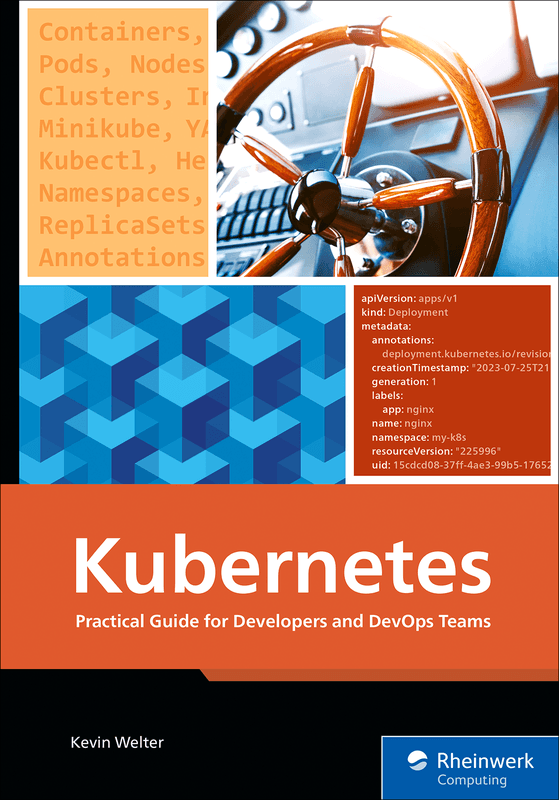
I train development and operations teams in Kubernetes, from the fundamentals to running it in production. As a Kubestronaut with all five CNCF certifications and author of the Kubernetes practical guide published by Rheinwerk Computing, I combine exam knowledge with what really matters when you run clusters yourself. We tailor content and depth to your team: as a training that teaches the fundamentals in a structured way, or as a workshop around your own questions and manifests, on site at your company or remotely.
Who trains you
I am Kevin Welter. I have worked with containers in Kubernetes since 2017, and today I run my own services, including this website, on a highly available k3s cluster on Hetzner Cloud: three locations, everything as code, rolled out via GitOps. What I show in the training comes from that operation, not just from the documentation.
- Kubestronaut: all five CNCF Kubernetes certifications: KCNA, KCSA, CKA, CKAD, and CKS
- Author: "Kubernetes: Practical Guide for Developers and DevOps Teams" (Rheinwerk Computing); German edition "Kubernetes: Das Praxisbuch für Entwickler und DevOps-Teams", Rheinwerk Computing 2024, 427 pages
- Operations: my own production cluster with k3s, Terraform, ArgoCD, Prometheus, and Grafana
Which teams the training is for
Development teams that will deploy their applications on Kubernetes and want to understand what happens between
kubectl applyand the running pod.Operations and DevOps teams that take over or build a cluster and need to stay on top of security, monitoring, backups, and upgrades.
Mixed teams before an introduction that need a shared language before the first decisions are made.
It is not meant as a pure lecture without exercises: you learn Kubernetes on a cluster. Whether we use a practice cluster or your test cluster, we agree beforehand.
Topics to choose from
The topics follow the structure of my book and my own operations. You can request a single topic or combine several; we agree on scope and depth beforehand.
- Kubernetes fundamentals
- architecture, local cluster,
kubectl, pods, labels, deployments, Services, and Ingress: the shared starting point before development and operations go deeper. - Kubernetes for developers
- How your application gets into the cluster: container images, deployments, ConfigMaps and Secrets, probes, requests and limits, Helm and Kustomize, troubleshooting from a developer's point of view.
- Kubernetes for operations and platform teams
- Building and running clusters: high availability, upgrades, storage and backups, monitoring and logging, ingress traffic with Ingress and the Gateway API.
- Security and governance
- RBAC, Pod Security, admission policies, network policies, and handling Secrets so the rules hold up in daily work.
- GitOps and everything as code
- declarative configuration, version control, CI/CD, Helm, Kustomize, and rollouts with ArgoCD.
- Stateful workloads and operators
- StatefulSets, persistent volumes, Jobs and CronJobs, CRDs, and operators.
- Kubernetes for decision-makers
- An overview without the command line: what Kubernetes solves and what it does not, operating models from managed Kubernetes to your own cluster, effort, costs, and what the team needs to know.
- Certification
- preparation for CKA, CKAD, or CKS, on request.
Training or workshop
Training
I teach the selected topics in a structured way, with exercises on a practice cluster. Good for teams that want to get to the same level together.
Workshop
We work on your own questions, manifests, or test cluster, for example on a rollout concept, on RBAC rules, or on why pods keep restarting. Good for teams that already work with Kubernetes and are stuck at specific points.
- Duration
- by arrangement, depending on topics and prior knowledge
- Format
- on site at your company or remotely
- Group size
- by arrangement
- Language
- German, English on request
- Price
- on request
How a training works
- 1
Initial call
We clarify who takes part, what the team already knows, and what it should be able to do afterwards.
- 2
Tailoring
I put the topics together and prepare exercises, for a workshop based on your own examples.
- 3
Delivery and follow-up
Training or workshop in the agreed format, then answers to open questions.
What the training is not
The training gets your team ready for Kubernetes. It is not a project in which I build your cluster or move applications for you. If you want a second opinion on your cluster after the training or need support in operations, my page Kubernetes Expert: Consulting and Operations explains what I offer. If you want to learn Kubernetes on your own, the path is in Learn Kubernetes: Kubestronaut Roadmap.
Frequently asked questions
How long does a Kubernetes training take?
That depends on the topics and your team's level. In the initial call, I suggest a duration that fits your goals.
Is the training on site or remote?
Both are possible: I come to you, or we work remotely. Much of it happens remotely, and I am happy to offer on-site dates. We clarify location and travel in the initial call.
What prior knowledge does my team need?
For the fundamentals, experience with the command line and a basic understanding of containers, for example with Docker, is enough. For the operations and security topics, the team should know the fundamentals. We clarify where you stand in the initial call.
Do we work on our own cluster?
In a workshop, happily on your test cluster or your manifests. For exercises in the training we use a practice cluster so nobody changes anything in production by accident. How we provide it, we clarify in the initial call.
Does the training prepare for a certification?
On request, yes, as a separate topic for CKA, CKAD, or CKS. I have passed all five CNCF Kubernetes exams myself; how the exams are structured is described in Kubernetes Certifications: CKA, CKAD & More.
What does a Kubernetes training cost?
I quote the price after the initial call, depending on duration, group size, and format.
Request training for your team
Tell me who should take part, what your team already knows, and which topic interests you. I will get back to you with a proposal for topics and format.
Prefer email? Write directly to humanity@humanity-it.com