
My AI Workforce: Eight Employees
Eight AI employees run my business: leads, websites, inbox, ads, content, video, HR, and bookkeeping. Who does what, and what I still do myself.
Read the articleYour first AI employee
Within one hour you hold its first work result in your hands. With Claude, without a single line of code. Not a chatbot you prompt, but an employee you manage.
An AI employee is an AI you manage like an employee: it has a clearly defined job, knows your business from its personnel file, and reliably delivers finished work. The difference from a chatbot: you don’t write a new prompt for every task. You brief it once properly, onboard it, and delegate from then on.
That is exactly why the language of a real hire works: there is an onboarding conversation, a trial task, and a permanent position once the job runs repeatably. It may sound like a gimmick, but it is the core idea: treat your AI like an employee and you get results like an employee’s.
| Chatbot | AI agent | AI employee | |
|---|---|---|---|
| How you work with it | You prompt every task from scratch | You build a workflow and maintain it | You brief once, give feedback, delegate |
| Knowledge about your business | Forgets after every chat | Scattered across the workflow | Personnel file: collected, maintained, grows with you |
| Result | Text you rework yourself | Automated single steps | Finished work ready for approval |
| When something changes | You prompt differently | You rebuild the flow | You tell it, like you would an employee |
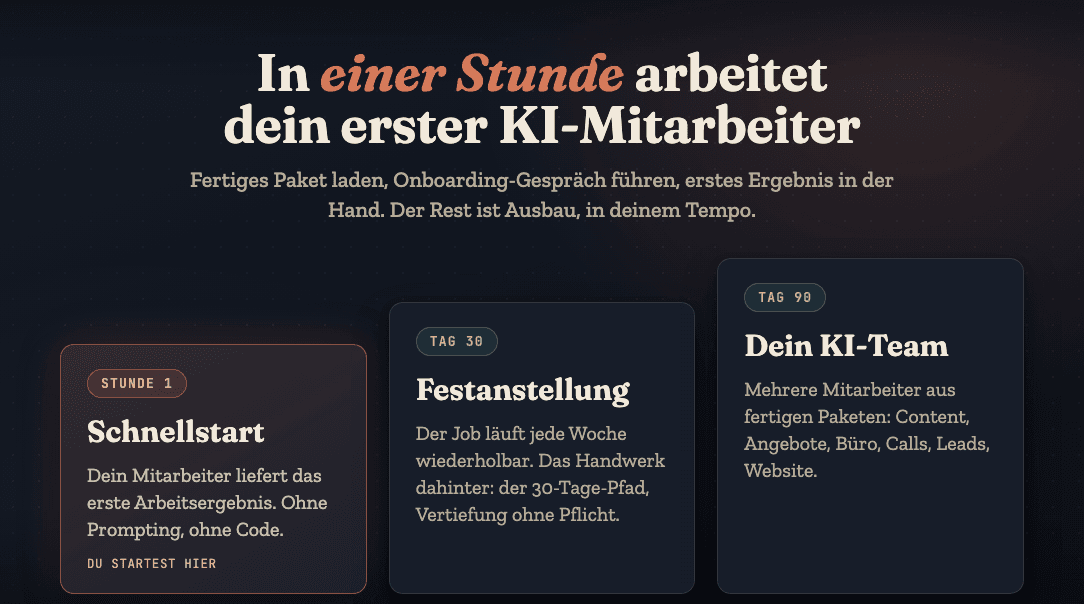
No prompting course, no learning buffet. You start with a ready-made package and go deeper at your own pace.
HOUR 1
Load the package, hold the onboarding conversation, first work result in your hands. Your employee asks on its own what it needs to know.
DAY 30
The job runs repeatably every week. The craft behind it comes from the 30-day path: deeper learning, never mandatory.
DAY 90
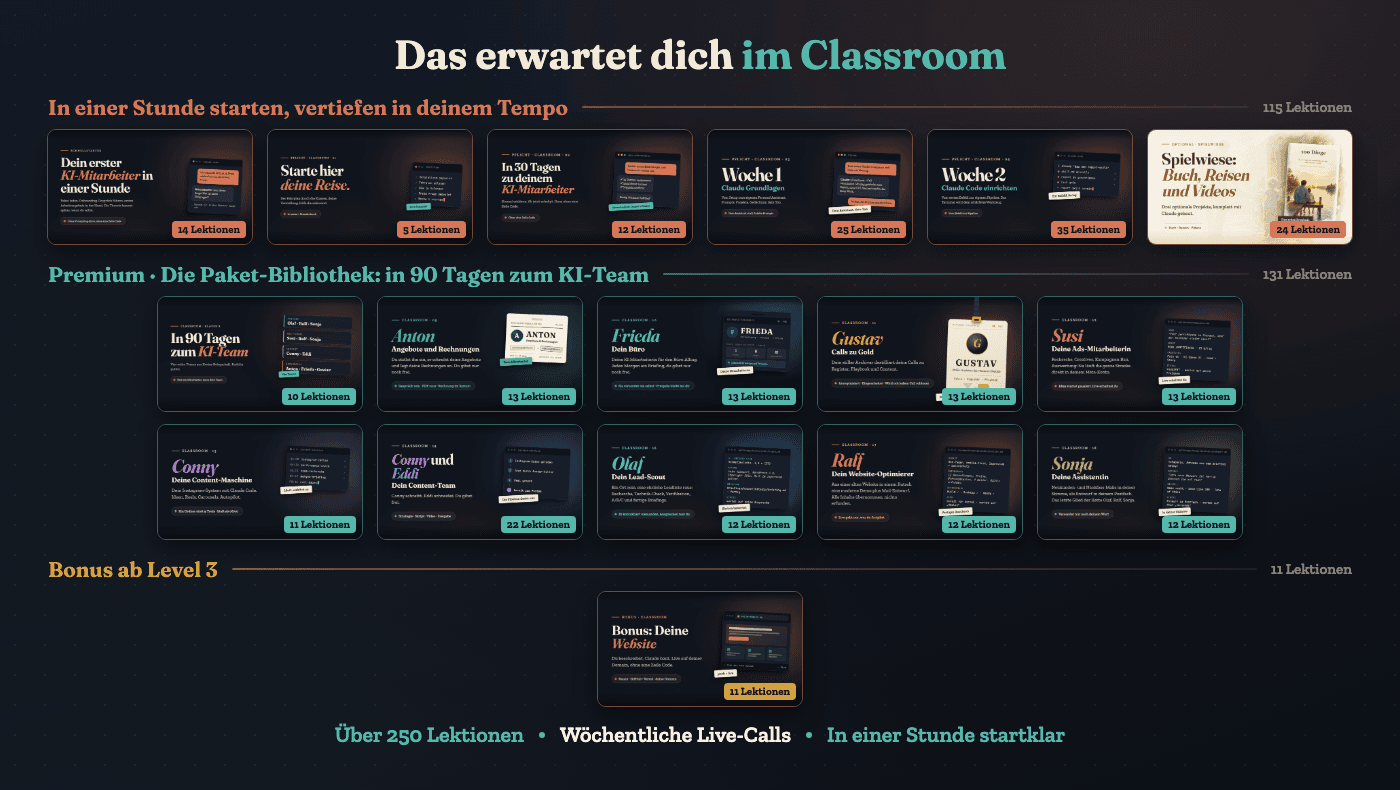
Several employees from ready-made packages: content, proposals, office, calls, leads, website.

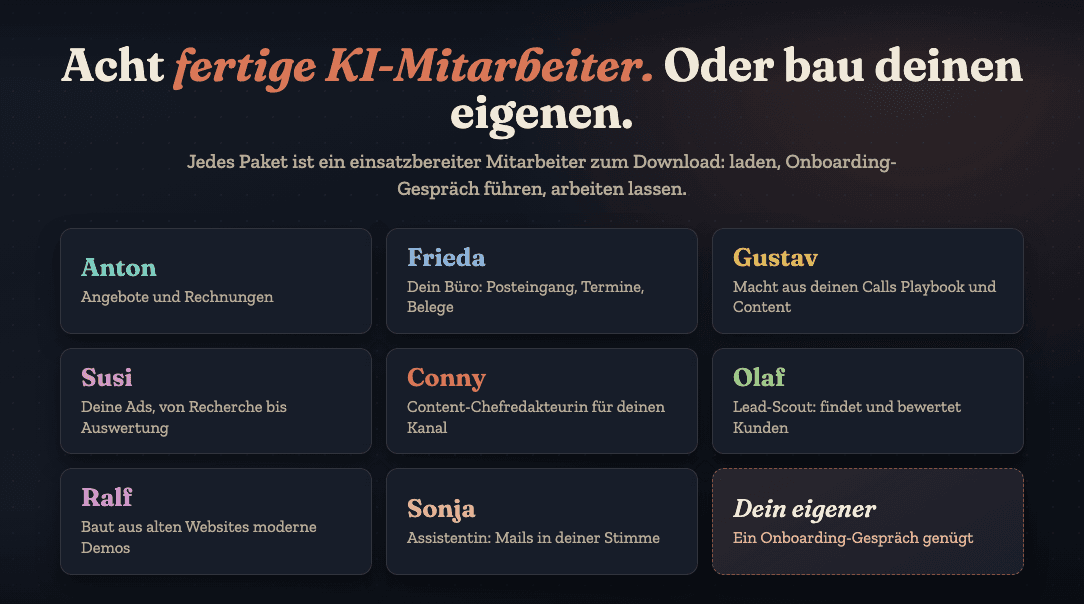
Every package is a ready-to-work employee you simply load: hold the onboarding conversation, let it work.
Proposals and invoices
Your office: inbox, appointments, receipts
Turns your calls into playbooks and content
Your ads, from research to reporting
Content editor-in-chief for your channel
Lead scout: finds and qualifies clients
Turns outdated websites into modern demos
Assistant: emails in your voice
My own business runs on an AI workforce of eight employees. They handle content, receipts and client projects. Everything I show in the community runs here in my daily work first.
Over 250 lessons, weekly live calls and ready-made employee packages. Ready to go within an hour, deepen at your own pace.


I’m Kevin, developer and IT architect. I have written technical books on Kubernetes and cloud infrastructures, I speak at conferences, and for more than ten years I have looked after the systems of companies, from family businesses to large corporations.
For the past 1.5 years I haven’t written a single line of code myself. My AI workforce takes over the repeatable jobs, and I manage them: briefing, onboarding, giving feedback. That is exactly the craft I pass on in the community.
You can find more about my work as an IT architect on the home page.
Every question answered briefly on this page has its own article on the blog: from the fundamentals to costs and data protection to a look behind the scenes of my own workforce.
Eight AI employees run my business: leads, websites, inbox, ads, content, video, HR, and bookkeeping. Who does what, and what I still do myself.
Read the articleAgencies charge 1,500 to 25,000 euros for AI agents. The honest math: a Claude subscription, your onboarding time, and when an agency is worth it.
Read the articleWhich AI employees pay off for consultants and agencies: research, proposals, follow-ups, content, reporting, inbox. With an honest assessment.
Read the articleFrom empty chat to permanent AI hire: pick the task, create the personnel file, run the onboarding interview, do the trial task, make it permanent.
Read the articleCreate an AI employee without code: pick a task, set up the personnel file, run the onboarding. Your first real work result in about an hour.
Read the articleThe GDPR fear is valid but solvable: three checks before every input, clear rules in the personnel file, and you decide what the AI sees.
Read the articleHire a VA or an AI employee? An honest comparison by task type: where the human clearly wins, where the AI wins, and how the two work together.
Read the articleA delegation framework like for human employees: which tasks are a fit for AI, which stay with the boss, and the three to start with.
Read the articleAn AI employee is an AI with a clear job, a personnel file, and repeatable results. What sets it apart from chatbots and AI agents.
Read the articleBuilding your own AI doesn't mean training a model. It means giving a ready model your knowledge. Three no-code paths compared.
Read the articleAn AI employee is an AI you manage like an employee: it has a clearly defined job, knows your business from its personnel file, and reliably delivers finished work. You don't write a new prompt for every task. You brief it once properly and delegate from then on.
An AI agent is a technical building block: an automated process that operates tools. An AI employee is the management perspective on top of it: a permanent role with a name, a personnel file, onboarding and feedback. The technology underneath can be an agent. What matters is that you manage it like an employee instead of operating it like a tool.
No. Your first AI employee is created directly in the Claude app: you load a ready-made package, hold an onboarding conversation, and your employee asks on its own what it needs to know about your business. Without a single line of code.
Anything with a repeatable process: preparing proposals and invoices, sorting your inbox, matching receipts, analyzing calls, drafting content, researching ads, finding and qualifying leads, or building website drafts. Final approval always stays with you.
You hold the first work result in your hands after about an hour. After that comes onboarding at your own pace: after 30 days the job runs repeatably, which I call the permanent position. If you keep going, you have a small AI team after 90 days.
On Claude by Anthropic. You start in the Claude app and expand via Claude Code once your employee should connect to your systems and files.
An AI employee takes over the repeatable jobs that cost you hours every week as a solo business owner. You stay the boss: you brief, give feedback and approve. The point is that your business no longer depends entirely on you as a person.
Load a ready-made package, hold the onboarding conversation, first result in your hands. The rest is expansion, at your own pace.
Join the community now