Germany's e-invoicing obligation arrives in two stages, and the first one has been running for a while. Receiving e-invoices has been mandatory since 1 January 2025 for every business established in Germany, small businesses included, and an ordinary email inbox is enough for it. Sending is phased in: for supplies carried out up to the end of 2026 you may still send paper or, with the recipient's consent, a PDF. For supplies from 2027 onwards that grace period only applies if your total turnover in 2026 was no more than 800,000 euros, and for supplies from 1 January 2028 it applies to nobody (section 27 (38) of the German VAT Act, UStG). The duty exists only between businesses that are both established in Germany (section 14 (2) sentence 2 no. 1 UStG): nothing changes for private customers or for cross-border invoices. Invoices up to 250 euros, transport tickets and invoices issued by small businesses stay exempt (section 33 sentence 4, section 34 (1) sentence 2 and section 34a sentence 4 of the VAT Implementing Regulation, UStDV). An e-invoice is not a PDF, it is a structured data set based on the EN 16931 standard, in Germany usually XRechnung or ZUGFeRD from version 2.0.1. And that is the real reassurance: you do not have to build any of it, common invoicing tools already output both formats according to their own help pages.
That is why no invoice here starts life as a loose PDF on a desk any more. It always starts in the invoicing tool, because that is where the sequential number, the immutability and the invoice format come from. What the path from inbox to finished draft looks like in my own business is in AI Agent for Bookkeeping and Inbox, and the wider concept is on Hiring AI employees. Everything that follows is the legal position as set out in the provisions cited below and in the Federal Ministry of Finance letter, and it is not tax advice for your particular case.
Receiving and sending are two different duties
The most common misunderstanding here: the transition periods everyone talks about only cover issuing and sending. There is none for receiving.
Since 1 January 2025, every business established in Germany has had to put the technical conditions in place to accept an e-invoice. The Federal Ministry of Finance makes three points that shrink the effort considerably:
It applies to small businesses too. The special rule in section 19 UStG exempts you from issuing, not from receiving.
No separate inbox is required. If you receive by email, the mailbox you already have is enough.
Refusing does not help. A business that cannot receive an e-invoice, or refuses to accept one, has no claim to a paper or PDF invoice instead. As the sender, you have met your VAT obligations once you have demonstrably made an effort to deliver it, with a transmission log for instance.
The reverse also holds: where the duty applies, sending an e-invoice no longer needs the recipient's consent (section 14 (1) sentence 5 UStG). A PDF still does, for as long as you are relying on a transition period.
The deadlines: who has to send from when
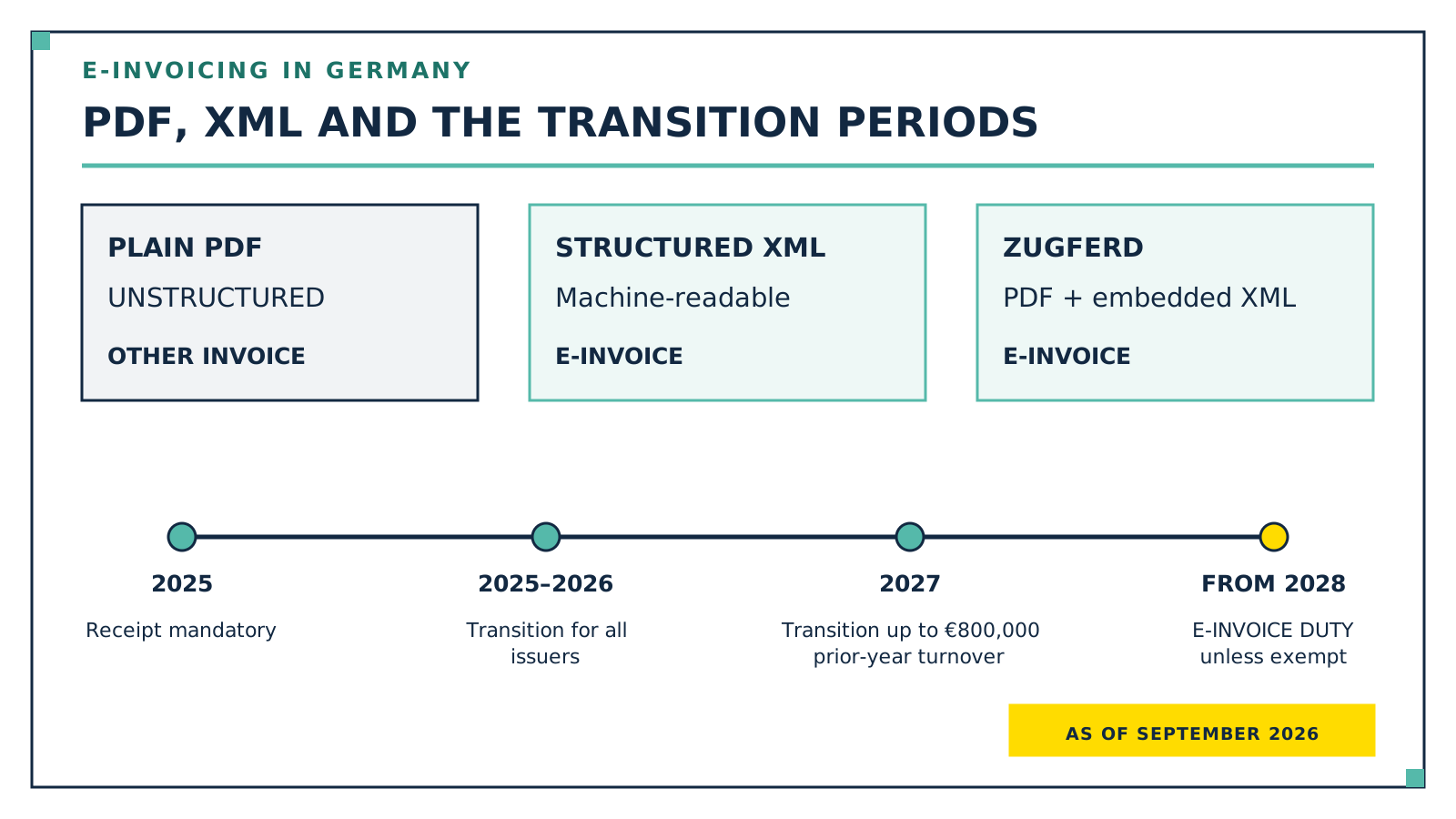
What matters is not when you write the invoice but when the supply was carried out. The staged rule is in section 27 (38) UStG.
Supply carried out
Paper or PDF still allowed?
Provision
2025 and 2026
Yes, for everyone. Paper always, another electronic format only with the recipient's consent
Section 27 (38) no. 1 UStG
2027
Only if your total turnover in 2026 was 800,000 euros or less
Section 27 (38) no. 2 UStG
2027, EDI procedures
Yes, with the recipient's consent, even above the turnover threshold
Section 27 (38) no. 3 UStG
From 2028
No, e-invoice for domestic B2B unless a statutory exemption applies
Section 14 (2) sentence 2 no. 1 UStG
Two details matter day to day. The turnover figure is the total turnover within the meaning of section 19 (2) UStG, meaning yours, not your customer's. And the older deadline runs alongside it: where you are obliged to issue an invoice, you have to do so within six months of carrying out the supply (section 14 (2) sentence 2 UStG).
Who is covered, and who is not
The e-invoicing duty applies when you supply another business for that business's own purposes and both sides are established in Germany. Established means, under section 14 (2) sentence 3 UStG: seat, place of management, a fixed establishment involved in the supply, or, absent a seat, residence or habitual abode in Germany.
The duty also applies where
your customer is themselves a small business, a farmer under the flat-rate scheme, or makes only exempt supplies, a residential landlord for instance,
the recipient owes the tax under section 13b UStG and both sides are established in Germany,
a special scheme applies, meaning flat-rate farming (section 24 UStG), travel services (section 25 UStG) or margin taxation (section 25a UStG),
billing runs through a self-billed invoice (section 14 (2) sentence 5 UStG),
only part of what you are billing falls under the duty at all.
The duty does not apply if at least one of the two sides is not established in Germany, and it does not apply towards private individuals. You may only send a private customer an e-invoice with their consent, because the general rule in section 14 (1) sentence 5 UStG then applies. The same goes for invoices to a legal person that is not a business, a club acting outside any business activity for example.
If you could not have recognised with the care of a prudent merchant that the other side was acting as a business, a breach is not treated as one. A VAT identification number is, according to the Federal Ministry of Finance, an indication that someone is acting as a business.
The exemptions in detail
Four groups stay outside the duty. The direction matters: these are freedoms, not prohibitions. You may keep billing on paper or as a PDF, and you may just as well send an e-invoice.
Small-amount invoices up to 250 euros. Section 33 sentence 4 UStDV expressly allows an invoice whose total does not exceed 250 euros to always be sent as an ordinary invoice. One caveat: the section 33 UStDV relief does not apply at all to supplies under sections 3c, 6a and 13b UStG, which covers intra-community distance sales, intra-community supplies and the reverse charge among others.
Transport tickets. Tickets issued for carrying passengers may always be issued as an ordinary invoice under section 34 (1) sentence 2 UStDV. The same applies to documents for accompanied luggage.
Invoices from small businesses. If you bill under section 19 UStG, section 34a sentence 4 UStDV lets you always issue and send your invoices as ordinary invoices. What such an invoice has to contain as a minimum is in section 34a sentence 1 UStDV, and how to get the exemption note into the quote in the first place is in How to Write a Quote That Convinces.
Supplies exempt under section 4 nos. 8 to 29 UStG. There is no duty to issue an invoice at all here, so no duty to issue an e-invoice either. This is the exemption with the sharpest edge: for supplies exempt under section 4 nos. 1 to 7 UStG the e-invoicing duty very much does apply.
XRechnung and ZUGFeRD: what separates the formats
An e-invoice is an invoice issued, transmitted and received in a structured electronic format that allows electronic processing (section 14 (1) sentence 3 UStG). Everything else, a PDF by email included, is an ordinary invoice (sentence 4). In Germany, virtually every route runs through one of two formats.
XRechnung
ZUGFeRD
Structure
purely structured, a single XML file
hybrid: a PDF with an embedded XML file
Human-readable view
only through a visualisation tool
the PDF is directly readable
Your own design
not provided for
possible, the PDF is your layout
Condition
matches EN 16931 and section 14 (1) sentence 6 no. 1 UStG
from version 2.0.1, excluding the MINIMUM and BASIC-WL profiles
Typical use
invoices to public authorities and larger companies
customers who expect the familiar invoice look
The Federal Ministry of Finance names both as permissible. National formats are not mandatory: any European format that matches the EN 16931 standard is equally allowed, and under section 14 (1) sentence 6 no. 2 UStG two parties may agree on a different format, an EDI procedure for instance, as long as every detail required for VAT purposes can be extracted without loss. Which format you settle on is, per the ministry, a civil-law question between the two of you, not a tax question.
For filing, the GoBD amendment of 14 July 2025 applies: what you have to retain is the structured part. You only have to keep the human-readable part of a hybrid invoice if it carries additional information of relevance for tax. How long and how that works overall is in Bookkeeping Basics for the Self-Employed.
E-invoicing formats and transition periods as of September 2026. Grafik: HumanITy
What to actually do now
Here is the good news about this topic: the implementation is smaller than the legal position. Four steps, in this order.
Secure the receiving side. Decide which address e-invoices go to and who looks at it daily. A dedicated mailbox is not required, and neither is a particular folder: what the law prescribes is retention, not filing. Because invoices have to stay findable for eight years (section 14b (1) UStG), a fixed storage location is still the advice I give everyone.
Check your invoicing software. Many current invoicing and bookkeeping tools already produce XRechnung and ZUGFeRD. The help pages of Lexware Office, sevDesk and Papierkram all name both formats for their own product. So you do not have to hand-build an XML file or put a service provider in the middle. What all three do ask for is the same two things: switch the function on once and fill in the master data, with sevDesk and Papierkram naming the VAT identification number explicitly.
Tidy up master data and templates. A structured format forgives nothing: if a mandatory field is missing, or the tax rate and tax amount contradict each other, the file is faulty. Walk through your quote and invoice templates once, ask business customers for the reference they need on the invoice and store it with the contact.
Work out the turnover threshold. If your total turnover in 2026 was above 800,000 euros, you switch on 1 January 2027. Below it you have until the end of 2027, and no longer.
Steps one and two usually come down to the same question: what can my software already do, and where do the files end up? You do not have to answer that on your own. It is exactly the kind of question we work through together in a community call or under a posting.
When the draft is created in the invoicing tool
The format question barely arises once the invoice is created where it belongs anyway: in the invoicing tool; which accounting software for small businesses can do that at what price is in the comparison.
That is exactly where Anton, my AI employee for quotes and invoices works. He builds the quote PDF in my design out of an analysed first conversation, and once the client says yes he creates the contact, the quote and the invoice as drafts in Lexware Office, the invoicing tool he is connected to here. So he does not write an invoice, he prepares one in the right place; what that whole route of quotes and invoices with AI looks like is in its own post. The sequential number, the immutability and the e-invoice formats come from the tool, not from the AI, and that is deliberate.
Two limits are hard-wired. First: he drafts, I approve. Nothing is finalised until I have said yes explicitly, and if told to hurry he states the consequences first, the then final invoice number for example. Second: no price without a source. If he finds two different prices for the same service, he lists both with their source and asks, rather than averaging. The interesting part here is not the format but the draft before it. How that fits into a small business is in Bringing AI to a Small Business.
Frequently asked questions
From when does the e-invoicing duty apply to me?
Receiving has been mandatory since 1 January 2025, with no transition period. Sending becomes mandatory from 2027 if your 2026 total turnover was above 800,000 euros, otherwise from 2028. Under section 27 (38) UStG what counts is the date of the supply, not the invoice date.
Does the e-invoicing duty apply to small businesses?
For receiving yes, for issuing no: section 34a sentence 4 UStDV lets small businesses send their invoices as ordinary invoices, meaning PDF or paper. You still have to put the technical conditions for receiving in place.
Is a PDF an e-invoice?
An ordinary PDF is not. Under section 14 (1) sentence 4 UStG it is an ordinary invoice, because it lacks the structured format. ZUGFeRD from version 2.0.1 is the exception: an XML file sits inside the PDF, and that file is what counts. From the outside it looks like the invoice PDF you are used to.
Do I have to send private customers e-invoices?
No, the duty exists only between businesses established in Germany. You may in fact only send a private individual an e-invoice with their consent (section 14 (1) sentence 5 UStG). That consent is informal and can be given tacitly.
What if the file has a format error?
Then for VAT purposes it is not an e-invoice but an ordinary invoice in another electronic format. In its letter of 15 October 2025 the Federal Ministry of Finance distinguishes format errors from breaches of business rules and recommends checking the file with a suitable validation tool.
Where to go from here
Take twenty minutes for two things: check in your invoicing software's settings whether e-invoicing is switched on, and measure your 2026 total turnover against the 800,000 euro threshold. After that you know whether you have a project or just a switch to flip.
If the real work afterwards is still the writing rather than the format, look at the step before it: Which Tasks You Can Hand Off to AI sorts out what is suitable at all, and AI for Freelancers: What Pays Off shows it from a one-person business's point of view. The finished quote and invoice employee, course included, is in my community Claude Practitioners.
Kevin Welter
Developer, IT architect, author of technical books (Kubernetes, cloud infrastructures) and speaker. Runs his business with an AI workforce of fourteen AI employees and shows solo business owners in his community how to hire their first AI employee.