My house formula for testable ad copy has three parts: promise, proof, next step. It is not a universal Meta rule, but a clear editorial framework to test against the product, funnel stage and campaign data. Meta recommends short copy and generally one call to action for most placements; the character figures are recommendations, not universal technical maximums. Separate ads provide granular reporting rows. A robust causal comparison requires Meta's A/B test, a hypothesis defined in advance, equal budget logic and non-overlapping segments.
I run my business with a workforce of AI employees, each with its own role and its own personnel file. If you want to see the whole crew: My AI Workforce, and I collect everything on the topic on the AI Employees page. How all of this ends up inside Ads Manager is covered in Creating Meta Ads With AI: A Guide.
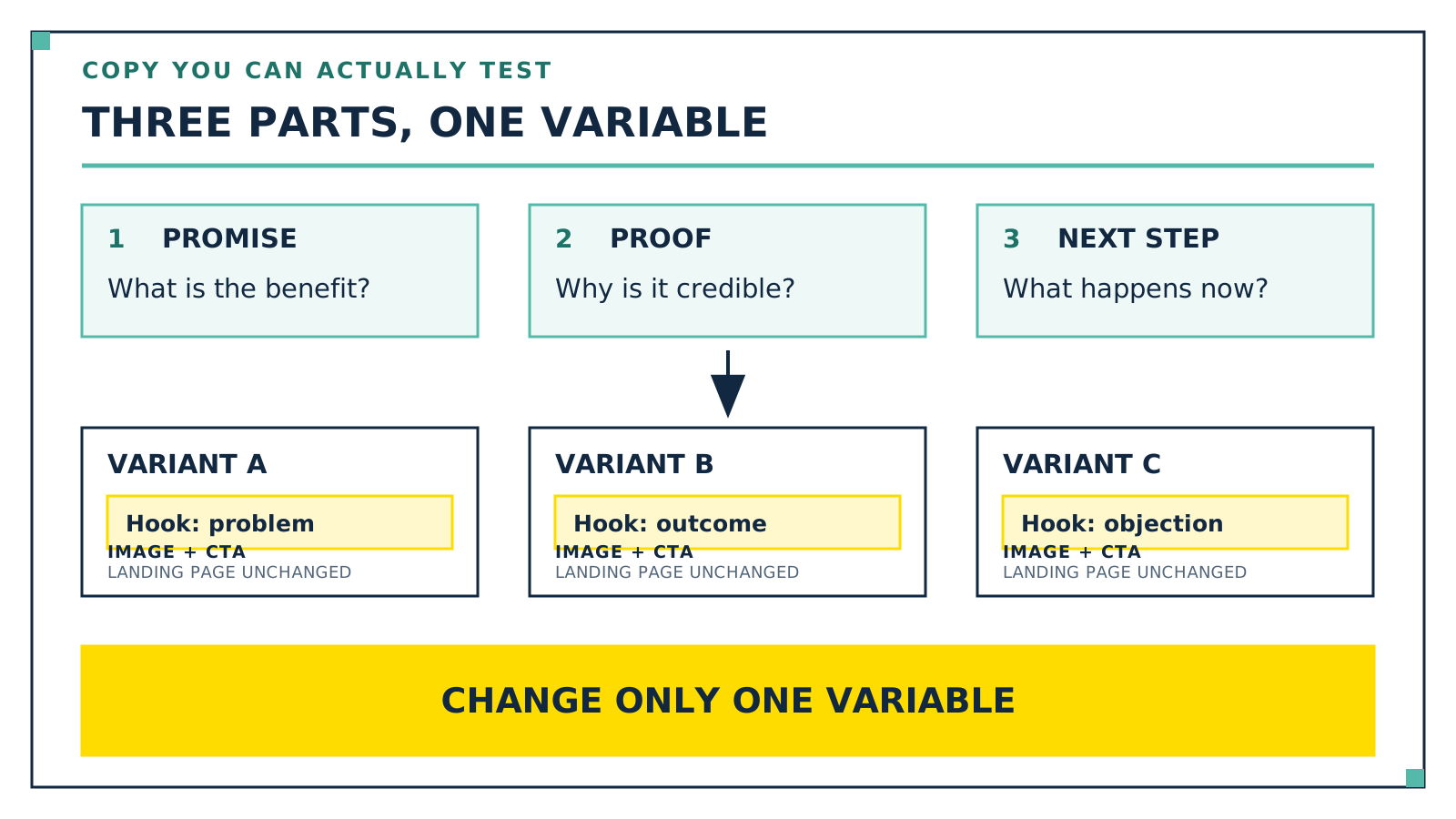
The structure: promise, proof, next step
Most AI-generated ad copy fails on order, not on grammar. It opens with the brand, explains the offer in the middle, and puts the call to action at the end, where nobody reads it any more. But a feed is not a letter, it is a list people scroll through.
Line one is the promise. Not your service, but the outcome the reader is left with. "Bookkeeping for trades businesses" is a service. "The folder is empty at month end" is a promise. It has to be concrete enough that somebody could disagree with it, because only then can somebody agree with it.
Part two is the proof. It answers the silent question "why would that be true". Meta's help page on ad text shows pairs of weak and strong wording, and the difference is always the same: "All-inclusive offer at a low price" becomes "All-inclusive offer for just $19.99", "Call us and save money" becomes "80% of our new customers save money. One call is all it takes." The proof is the part you do not let an AI decide, because the number has to come from you.
Part three is the next step. One action, not a bundle. Meta's best practices for overlays say an ad should generally have only one call to action. "Join now and start in the classroom" is one step. "Follow us, download the guide and book a call" is three, and three steps are none.
Part
The question it answers
How you know it's missing
Promise
What do I get?
The text describes what you do, not what the reader ends up with
Proof
Why would that be true?
There is not one word in it anybody could check
Next step
What do I do now?
There are two or more calls to action
Three building blocks make ad copy testable, with only one variable changing in the test. Grafik: HumanITy
How short it actually has to be
Length in ad copy is not a matter of style, it is a matter of display. Meta writes that text may be truncated if it exceeds the character limitation, and gives the recommended length for most placements as 125 characters for primary text, 40 for the headline and 25 for the description. It adds that text may be truncated further depending on placement and device, and recommends keeping it as short as possible.
That is the hardest instruction you can hand an AI, and the most useful one. A model that hears "write me an ad text" produces four paragraphs. A model that hears "the promise in 125 characters maximum, the headline in 40" has to choose, and that choice is the actual work. If the text has nothing left after that cut, the problem was never the text. It was the offer.
A second point from the same help page is easy to miss: leave the text field in the ad creative empty and Meta may pull text from the destination URL, which you cannot edit. Build the ad from an existing Page post and the text cannot be edited at all.
Meta's own text generation: two sentences that decide everything
Ads Manager contains a text generation feature that produces up to five variations of primary text and headline from your original input, optionally matched to personas. It sounds like you could skip the writing. Two sentences from Meta's own help centre say otherwise.
The first is language. Meta writes: "Text variations with and without personas are currently available when primary text inputs are in English, Portuguese and Spanish. We are gradually expanding text generation features, so they are not available in all regions or languages." If you advertise in German, or in any language outside those three, this is not a dependable foundation. As of September 2026.
The second is measurement. Meta writes: "Since reporting is based on a single ad, you won't see performance details for specific text variations." The same passage adds that variations are shown when Meta predicts they will improve performance, and that more options typically mean more opportunities. All of that can be true and it still leaves the same consequence: you may get a better result, but you get no insight. Which promise pulled is in no report.
The same applies to the "add text options" feature, where you enter several versions of primary text, headline and description for a single ad. It is convenient, and it is blind. An insight is worth more than a percentage point, because you can carry it with you: onto the landing page, into the email, into the sales call, into the next offer.
Variants that teach you something
A variant is not a rephrased sentence. A variant is a different claim about what your offer solves for the reader. If two ads promise the same thing and differ only in syntax, you cannot decide anything afterwards, no matter how clean the numbers look.
Meta describes exactly this principle for A/B tests: two versions of an ad strategy are compared by changing variables such as ad images, ad text, audience or placement. Meta's advice is threefold: choose a hypothesis before you pick the variable, use the same budget for both versions, and do not test informally by turning ad sets or campaigns on and off manually, which leads to inefficient delivery and unreliable results. Translated to copy:
Write down a hypothesis before you write. Not "version B is better", but "time saved pulls harder than money saved in this audience". A sentence that can turn out to be wrong.
Build three or four promises that contradict each other. Time against money, safety against growth, beginners against advanced users. If one reads like a variation of another, it is not a variant.
Decide what you are testing. A pure copy test needs a genuinely neutral motif that suits every promise. If each promise carries a different image, you are testing the complete creative of image and copy.
Create separate variants and use the A/B test. Separate ads give each variant a reporting row; Meta's experiment adds the controlled comparison.
Make the name carry the information. If the promise is in the ad name, you read the results later without reconstructing anything. I use a fixed scheme built from objective, month, name and a numbered hook identifier.
When such a test may be read, and why the learning phase matters most for that, is covered in How to Run Ads on Meta: A Guide. The short version: do not touch it until the test window is full, and set the kill rule before the start.
Image and text have to say the same thing
An ad creative is not text plus image, it is one statement in two channels. If either one breaks away, the ad loses while being skimmed. First, the image carries the promise, not merely the mood.Second, the image text carries the body copy rather than repeating it, while remaining legible and inside Meta's safe zone. Third, name what you are testing correctly. With a neutral motif, copy alone can change. If image and copy jointly carry a new promise, you are testing a complete creative, not the sentence in isolation.
For the image layer itself there are two workable routes. Meta's Advantage+ creative can generate image variations, overlays and animations, but it comes with the same limitation as text generation: you do not see which variation worked. A motif you build yourself, where text and layout come from a template and only the image layer is generated, stays in your hands, reproducible at any size and editable afterwards.
What you are not allowed to claim
Two rules limit what can go into ad copy, and both apply whether a human or an AI wrote it.
The first comes from competition law. Under § 5 of the German Act Against Unfair Competition (UWG), anyone who engages in a misleading commercial practice that is likely to cause someone to take a decision they would not otherwise have taken is acting unfairly. A statement is misleading if it is untrue or otherwise capable of deception, and the statute names the results to be expected from use, the price and how it is calculated, and the trader's qualifications, status, authorisation or awards. Pictorial representations count as statements just as text does. In everyday terms: the proof in part two of your ad text has to be a real number from your own business. An AI that invents a plausible-sounding percentage is writing you a cease-and-desist letter.
The second comes from Meta. Under the Advertising Standards, each ad is reviewed against Meta's policies when an advertiser places an order. And ads must not contain content that asserts or implies personal attributes, directly or indirectly. The trap is that good audience work leads straight there: the better you know the reader's situation, the greater the temptation to attribute it to them. You may name the problem. You may not imply that this particular reader has it. Which attributes Meta lists and where the line runs is covered in Audience Analysis for Ads: A Guide.
None of this is legal advice, it is a reading of the statute and of Meta's own policies as of September 2026. If you advertise in a regulated field, have the wording checked by somebody who carries the liability. And if you hand the AI real customer emails or reviews as raw material so it writes in the right words, decide beforehand what goes into an AI tool. How I draw that line is in AI and Privacy: What the AI Gets to See.
At my place Susi writes the variants, I hit go
This part is handled by Susi, my AI employee for Meta ads. She writes copy in a fixed four-step order: the text mirrors the visual hook first, then comes the clear outcome, then the proof in numbers, then one unambiguous instruction. That is the same arc as above, with the image as step one, because in a feed the image is seen first. She builds the images as HTML statics with an AI image layer inside them, so that layout and text stay reproducible and only the motif is generated.
The decisive difference is in one word: every campaign the Meta ads connector creates starts out paused, enforced technically. Not as an agreement, as a state. Susi does not spend a euro on her own. I hit go, and only after I have read the ad. The advertising rules follow the same principle as the numbers: no personal attributes in targeting, no unrealistic promises, AI-generated images get labelled, and when data is missing she says so instead of guessing.
The evaluation follows rules defined in advance. Three full days or 3,000 to 4,000 impressions are my minimum window for delivery diagnostics, not a substitute for the result count of the optimisation event. For robust variant learning, Susi uses Meta's A/B test and the predefined hypothesis; individual reporting rows outside an experiment remain directional signals. Susi has worked this way since 17 July 2026 and has written dozens of evaluations.
Frequently asked questions
Can I just have an AI write my ad copy?
The draft yes; claims from nowhere, no. From a good brief an AI builds variants in the requested length and structure. You can give it verified figures, approved quotes and prices as sources; it must not invent the proof.
Why set variants up as separate ads instead of text options?
Because Meta reports at the ad level. Separate ads make observation data visible per promise; text options within one ad do not. For a causal claim about which promise works better, also use Meta's A/B test because ordinary delivery can distribute reach and audiences unevenly.
Does Meta's text generation work in German?
According to Meta's help centre, text variations with and without personas are currently available when primary text inputs are in English, Portuguese and Spanish, and Meta is expanding the feature gradually, so it is not available in all regions or languages. For German-language advertising that is not a dependable foundation, as of September 2026.
How long can an ad text be?
Meta recommends 125 characters for primary text, 40 for the headline and 25 for the description across most placements, and notes that text may be truncated and may need to be shorter still depending on placement and device. Treat those numbers as the brief you hand the AI, not as an upper bound you try to fill.
How many variants do I need for a test?
Three or four promises are enough if they genuinely contradict each other. More variants mostly means the same budget spread across more ads, each of which then takes longer before it says anything at all. What matters is not the count but that exactly one thing differs between any two variants.
Can an AI-generated image go into an ad?
At my place there is a house rule for that: AI-generated images get labelled. Independently of labelling, competition law draws the line that pictorial representations count as statements and must not mislead. A generated image showing a result that does not exist is a problem no matter how it was made.
Where to go from here
Take your last ad and cut it down to three parts: promise, proof, next step. If the proof is missing, today's work is a verified figure or approved quote. Then write two clear hypotheses and decide: a neutral image frame for a copy test, or a coherent image-and-copy creative for each promise. Use Meta's A/B test for the robust comparison. If you want to turn that into a standing role rather than a one-off, the process is in Creating an AI Employee: How to Start. Susi herself exists as a ready-made template in my community Claude Practitioners, together with the rest of the workforce.
Kevin Welter
Developer, IT architect, author of technical books (Kubernetes, cloud infrastructures) and speaker. Runs his business with an AI workforce of fourteen AI employees and shows solo business owners in his community how to hire their first AI employee.