My copy-research map for ads answers four questions: problem, trigger, objection and alternative. Find the answers in real sources, but use customer emails, conversations and community content first only for minimised internal pattern analysis. A statement belongs verbatim in advertising only with documented permission or a clear basis for use; otherwise abstract the pattern and rewrite it. Depending on the offer, full audience and campaign planning also covers reachability, region, purchase eligibility, channel use, value, exclusions and unit economics.
I run my business with a workforce of AI employees, each with their own role and their own personnel file. One of them, Susi, does nothing but Meta ads, and with her this research comes before any ad copy, never after. If you want to see the whole team: My AI Workforce. Everything on the topic lives on the AI employees page.
What an audience analysis for ads actually is
In this post, audience analysis means a copy-research map: the situation, problem, language and buying hurdles of the people you want to reach. Demographics and interests alone do not tell you which sentence belongs in line one. They can still matter for reach, delivery area, purchase eligibility or special ad categories.
The useful part is the language layer. You collect how people name their problem themselves, before they know your solution exists. Someone looking for a bookkeeper rarely writes "compliance process", they write "I haven't touched the receipts since March". That difference decides whether an ad stops the scroll or gets recognised as advertising and swiped away.
Why the interest menu is no longer an audience definition
This is the part most guides still explain the way they did five years ago. Meta's help centre is very clear here: every detailed targeting option you add is an audience suggestion by default, which means your ads are shown to people who match your suggestions and also to other audiences when that is likely to improve performance.
You can turn suggestions into constraints by choosing to narrow the audience further and unticking the Advantage+ detailed targeting box. That does not always apply, though: if you optimise for link clicks, landing page views, conversations, conversions, app events, app installs or value, Meta's help centre states that Advantage+ detailed targeting is applied automatically and you cannot deactivate the option. Those are exactly the objectives most self-employed people use the moment enquiries or sales are the goal.
What remains as a hard limit is a short list. Through audience controls, Meta says you select locations, a minimum age, languages and custom audiences to exclude. Everything else, including age, gender and custom audience inclusions, can be set as a suggestion, and Meta adds the sentence that settles the argument: audience suggestions do not necessarily restrict your audience. Meta's own example: if you select women as the gender, your ads can still be shown to men when Meta AI expects them to respond.
Meta's AI assembles the audience from signals instead, such as past conversions, Meta Pixel data and interactions with previous ads. That is data about behaviour, not about intent, and none of it knows your offer.
Which leads to the actual point: the work has moved. You used to set an audience and then write copy for it. Today you write a promise, and the promise sorts who responds and who the system goes looking for next. That is why audience analysis is no longer groundwork for the settings, it is groundwork for the ad. More on the AI features running alongside you inside Ads Manager: Creating Meta Ads With AI: A Guide.
The four things you actually need to know
What you need
How you know you have it
The problem in their words
You can quote the sentence without smoothing it out, and it contains no jargon from your industry
The trigger
You can say what happened in the last four weeks that set off the search
The objection
You know the reason someone does not buy despite being interested, the real one, not "too expensive"
The alternatives
You know what else they are considering, including doing it themselves and doing nothing
The problem in their words. Not "inefficient bookkeeping processes", but the sentence someone says in the first conversation. Those sentences are the raw material for your hook and your primary text. They are also the only reliable test of whether you know your audience: if you can only phrase the problem in your own sales vocabulary, you do not.
The trigger. People rarely search because a problem exists. They search because something happened: a deadline, a breakdown, a letter, a lost contract, a colleague who does it better. The trigger sets the urgency, and with it whether your ad leads to an immediate offer or to a slow entry point.
The objection. The objection you ignore while writing comes back later as a rejection. Naming it openly in the ad filters in advance. That costs clicks and saves meetings.
The alternatives. Your real competition is almost never the other provider. It is the spreadsheet someone built themselves, the brother-in-law who knows a bit about it, and the state of muddling through. Your ad has to beat those alternatives, not a competitor's offer the person has never seen.
Where to find all of this
Source
What you take from it
Your own sales calls, emails, chat threads
Problem and objection in their original wording, plus the trigger, which is almost always in the first sentence
Reviews, yours and your competitors'
What gets praised is your promise, what gets criticised is the objection of the whole industry
Forums, groups, comments under trade articles
The language people use before they speak to any provider, unvarnished
Search queries reaching your site
Phrasings people actually type. Search Console groups its data by the query dimension
The Meta Ad Library
What your competitors are claiming right now, in full text and viewable without an ad account
The Ad Library is the most underrated of these. According to Meta it contains every active ad delivered across the Meta technologies, anyone can open it, and you can search for any term, name or page. What you read there is not what works, Meta does not reveal that. What you read is which promise someone considers good enough to spend money on. Twenty such ads side by side show you which phrasings are worn out in your market, and that is just as valuable as the ones that are missing.
An audience template, by contrast, is only as good as the material you write into it, and the material comes exclusively from the five rows above.
Five steps to an audience map
Collect material, unfiltered. Twenty to thirty original sources: call notes, emails, reviews, forum posts, ad copy from the Ad Library. No summarising at this stage, or the exact phrasing you need later disappears.
Sort into the four fields. Problem, trigger, objection, alternative. Every find goes into exactly one column. Anything that fits none of them is usually your own opinion.
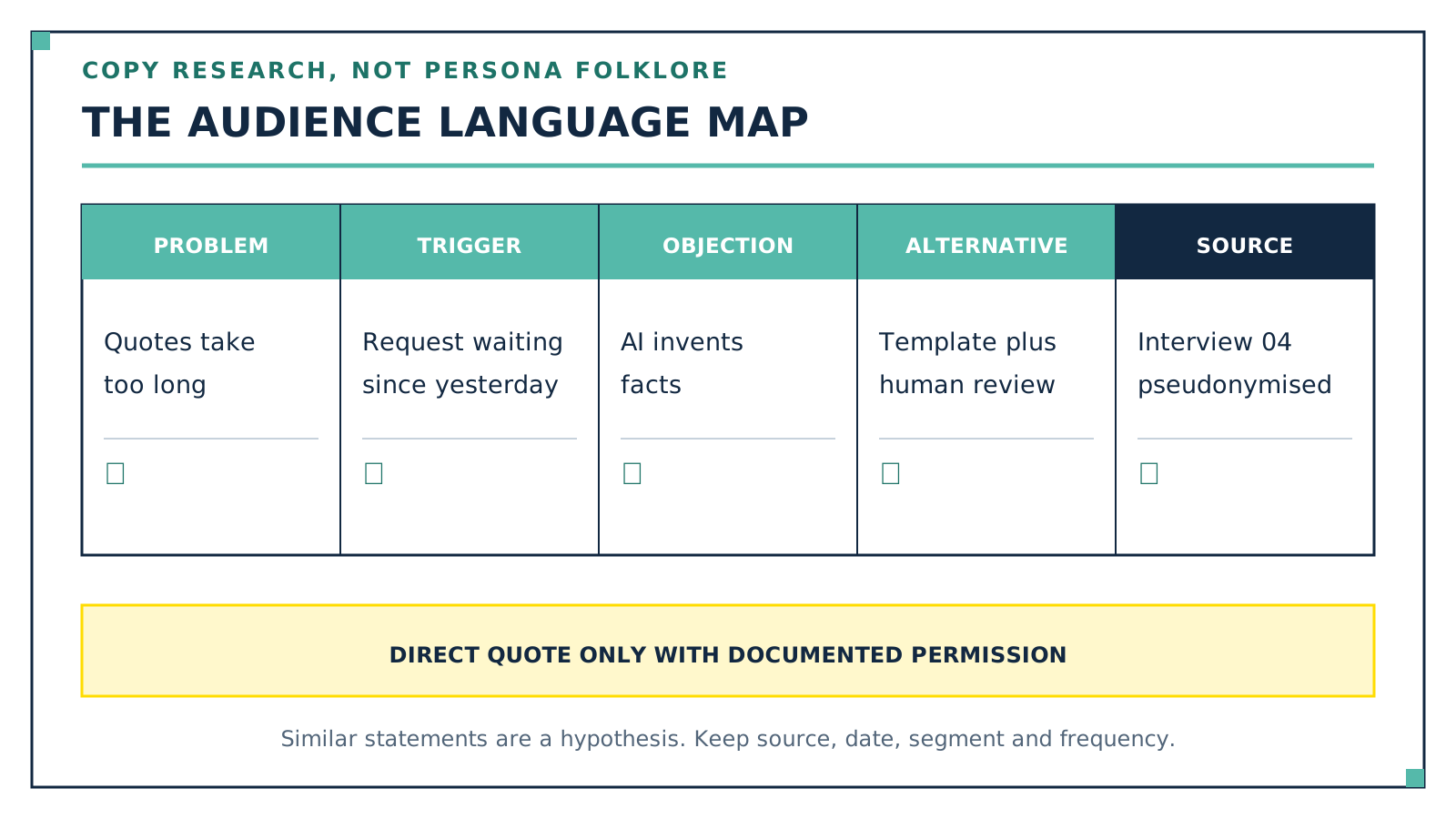
Mark repetitions as hypotheses. Three similar sources are a signal, not yet a robust pattern. Keep the source, date, segment and frequency, then test the wording against more sources and campaign data.
Split the segments. If two groups show up with different triggers, those are two audiences and therefore two ads, not one compromise text for both.
Write one promise per segment. A single sentence that picks up the problem in their words and says what is different afterwards. That sentence is the actual audience definition, because it is what sorts who responds, and it is the first building block of the ad text made of promise, proof and next step.
If you use AI for steps two and three, minimise and pseudonymise personal data, limit access and retention, and respect confidentiality, group rules and copyright. Publish a direct quote only with documented permission or a clear basis for use; otherwise rewrite the abstracted pattern. How I separate that processing is in AI and Privacy: What the AI Gets to See.
The audience map connects wording, trigger, objection, alternative and source. Grafik: HumanITy
What you still must not say with those real words
There is a trap that good research leads you straight into. The more precisely you hit your audience's language, the stronger the temptation to address the person directly about their situation. Meta's advertising standards prohibit that within a clearly defined area: ads must not contain content that asserts or implies personal attributes, whether directly or indirectly. According to Meta that includes race or ethnicity, religion, beliefs, age, sexual orientation, gender, disability, physical or mental health, financial status, voting status, trade union membership, criminal record and name.
The difference comes down to a single word, and Meta shows it with its own examples: "Meet senior singles" is allowed, "Meet other senior singles" is not. What is allowed describes the product and speaks about a group in general. What is prohibited implies that you know this particular person's attribute. In practice: you may name the problem, but you may not tell readers they have it. "Here is how you get out of receipt chaos" rather than "You haven't touched your receipts since March, have you?"
The same caution applies when you use Meta's "describe your audience" feature, where Meta's AI generates demographics, interests and behaviours from your description. Meta explicitly tells you there to avoid sensitive topics such as information about ethnicity or health status.
And there are sectors where the targeting choice is restricted from the outset. For campaigns in special ad categories, meaning housing, employment and financial products and services, Meta says certain options are limited or unavailable, among them age, gender, postcode, targeting exclusions, lookalike audiences and some interests. This affects advertisers located in the US as well as campaigns addressing audiences in the US, Canada or certain European countries. Advantage+ audience is not available for these categories according to Meta. Anyone advertising in those fields depends even more on the ad itself doing the sorting. This is not legal advice, it is a summary of Meta's own policies as of September 2026.
In my business Susi does this before any ad exists
All of that groundwork is handled by Susi, my AI employee for Meta ads. I give her an objective, community, webinar or retargeting. The first step is never ad copy, it is Ad Library research on the competition. From that she builds a map made of real audience words, and only then comes the copy in a fixed four-step structure and the image layer.
At the end there is a campaign set up in my Meta account, technically forced to paused. Susi does not spend a single euro herself. I flip the switch, and only after reading what is in there. For delivery diagnostics, I usually allow at least three full days or roughly 3,000 to 4,000 impressions. That alone is not proof of conversion performance: the actual decision depends on the optimisation event, result count, predefined stop rules and, where appropriate, a controlled Meta A/B test. Susi then recommends one of three actions: kill, scale by 20 per cent, or let it run. The kill threshold is set before the start. Susi has worked this way since 17 July 2026 and has written dozens of evaluations so far.
For the research part, one thing matters above all: it is a role, not a one-off exercise. The map goes stale because markets change their language. Pull it fresh from real material once a quarter and you will still be writing ads that sound like the market a year from now, instead of like your own sales page. How to set up a role like that is in Creating an AI Employee: How to Start.
Frequently asked questions
What belongs in an audience analysis for ads?
For the copy-research map, four things matter most: the problem in the audience's own words, the trigger for the search, the objection that stops the purchase, and the alternatives they weigh. Full campaign planning may also need reachability, region, eligibility, channel behaviour, customer value, exclusions and unit economics. Demographics and interests belong in only where they help you make a real targeting or message decision.
How do I run an audience analysis without customers?
Through other people's material. Competitor reviews, forums and groups around your topic, and the Meta Ad Library, which Meta says contains every active ad and can be searched by anyone. That gives you problem, objection and alternatives. The trigger comes fastest from ten real conversations, unpaid ones included.
Isn't it enough to pick interests in Facebook Ads?
Less and less. Meta's help centre states that detailed targeting options are audience suggestions by default, and that when you optimise for link clicks, conversions, leads or value, Advantage+ detailed targeting is applied automatically with no way to switch it off. Hard limits come from locations, minimum age, languages and exclusions. The substance is increasingly decided by your ad.
How many audiences do I need for one campaign?
As many as there are distinct triggers. Two groups with the same problem but different triggers need two ads with different promises, because the urgency is different. A compromise text for both ends up speaking to neither. Fewer segments with a clear statement beat many with a blurry one.
Can I put my audience's words into the ad verbatim?
Not automatically. Even when Meta permits the wording, confidentiality, privacy, group rules and copyright may still restrict publication. Use direct quotes only with documented permission or another clear basis for use. Otherwise keep the wording as internal research and publish a rewritten, abstracted version. Meta's advertising standards add a separate rule: ads must not assert or imply sensitive personal attributes such as health status, financial situation, age, religion or ethnicity.
Do I need a template for audience analysis?
A table with four columns will do: problem, trigger, objection, alternative. Add a fifth for the source, so you can trace later where a sentence came from. The value does not come from the form, it comes from the number of real original quotes you write into it.
How to continue
Take the last ten enquiries you received, minimise and pseudonymise the material, and record the recurring problems in your own words. Keep direct quotes internal until you have documented permission or another clear basis for publication. Then spend half an hour in the Ad Library and collect twenty ad texts from your industry as hypothesis material, not as proof of what works. If you want to turn that into a permanent role instead of a one-off exercise, Susi is available as a ready-made template in my community Claude Practitioners, together with the rest of the workforce.
Kevin Welter
Developer, IT architect, author of technical books (Kubernetes, cloud infrastructures) and speaker. Runs his business with an AI workforce of fourteen AI employees and shows solo business owners in his community how to hire their first AI employee.