A website costs money in two separate pots, and only one of them can be priced in advance. The running pot is printed on the providers' own pricing pages: IONOS lists a .de domain at 1.30 euros a month as its regular comparison price, hosting at Strato starts at 5 euros a month after the first contract year, a site-builder subscription runs from 12 to 50 euros a month at Jimdo and from 16.66 to 177.31 euros at Wix, and a shop starts at Shopify with 27 euros a month on annual billing, all figures including VAT, as of September 2026. The one-off pot, the build itself, hangs on six questions: how many pages, who writes the text, who supplies the photos, which real features come along, how many languages, and who maintains it afterwards. Billing happens in four ways: fixed price, hourly rate, site-builder subscription or your own labour, and each one moves the risk somewhere else. A serious figure for the build only exists once the scope does, and anyone who names one without asking you anything is guessing. That is why every number in this post is one you can look up on a provider's page, and for everything else you get the question that moves the price instead.
I ran this calculation for my own business and landed somewhere unusual: my websites are built by an AI employee from my AI workforce, including the page you are reading. I worked through the same cost question for AI employees in general in What an AI Employee Really Costs. If you are one step earlier and still want to know who builds and what you have to supply, that is answered in Getting a Website Built: Steps, Options. This post is purely about the money.
Two pots that never belong together
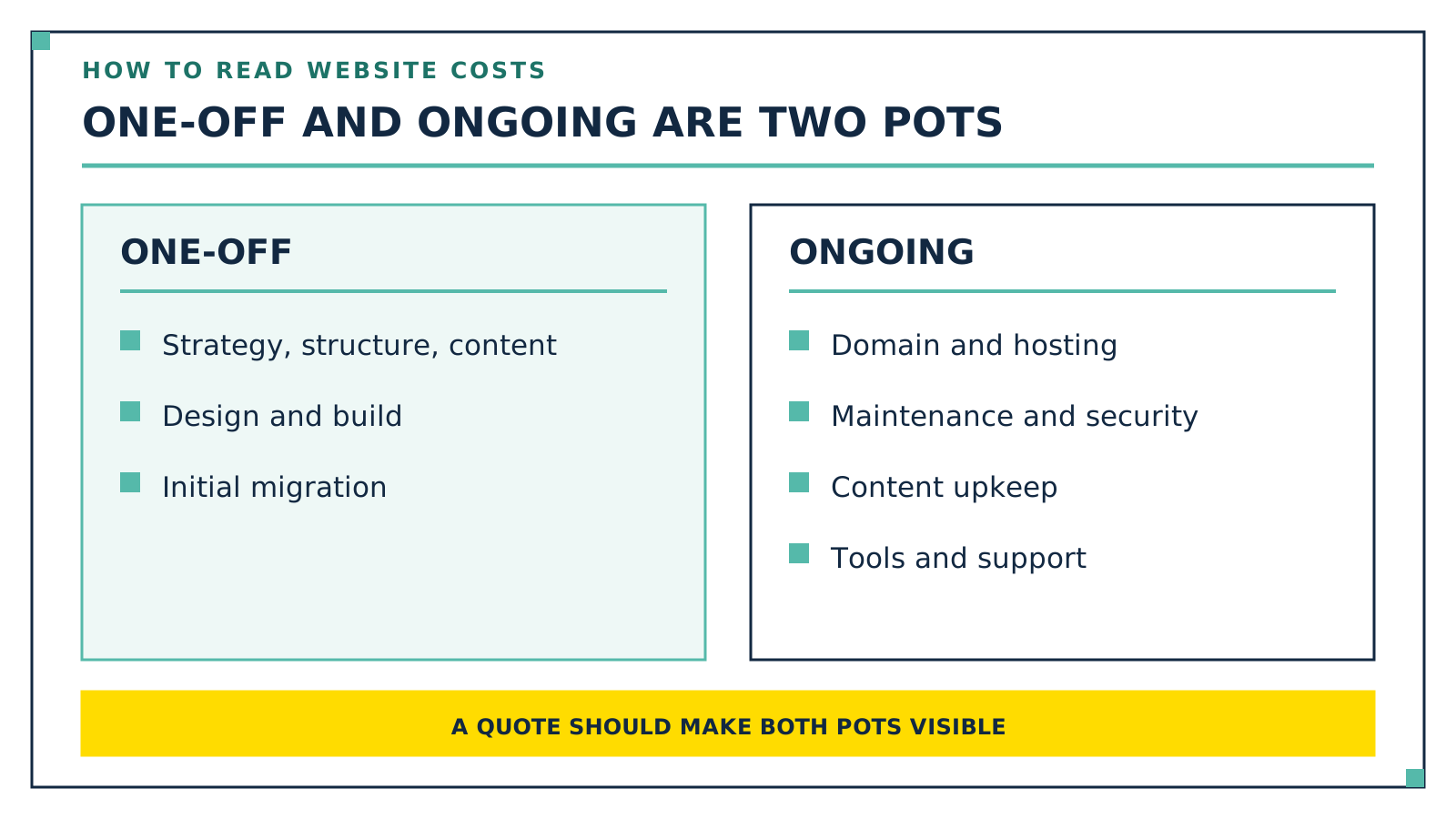
The most common mistake when comparing is throwing both pots into one total. A quote for a fixed amount and a subscription for a monthly amount are not comparable until you know what each one contains.
One-off
Running
What it covers
inventory of the old site, structure, design, build, filling in content, legal pages, testing, launch, redirects for old addresses
domain, hosting or platform subscription, mailboxes, add-on services with their own invoices, maintenance and changes
Who prices it
the provider, based on your scope
the provider, publicly, on its pricing page
When it hurts
once, when you place the order
every month, for years
What to check
whether everything you need is really included
what applies after the first contract year
Which running items come up at all is listed in Getting a Website Built: Steps, Options. This post goes one level deeper: to the amounts behind those items, and to the question of how a scope turns into a price.
One-off project costs and ongoing running costs belong in separate pots. Grafik: HumanITy
The six questions that move the price
When two quotes for the same website are far apart, it is almost always one of these six points, and almost never the hourly rate.
Driver
Why it moves the price
What you can decide beforehand
Number of pages
Every subpage needs structure, content, build and its own test on a phone. One good single page is cheaper than twelve mediocre ones.
List every page of the old website and cross out anything nobody has looked at in a year.
Who writes the text
The single biggest lever. If the quote says "subject to your input", you write it. If it says "copywriting", you pay for it, often per page.
Decide per page: carry the existing text over, shorten it, or have it written fresh.
Who supplies the photos
Your own photos cost at least time and, depending on the subject, production, editing and releases; a photo shoot is its own line item, stock images are a subscription or a one-off purchase with licence terms.
Count how many usable photos of your own you actually have before booking a shoot.
Real features
A contact form is standard. Appointment booking, shop, customer accounts, newsletter, members' area are each their own building block with their own setup, their own invoice and their own maintenance.
Only take the feature you already have a concrete process for today.
Multiple languages
Multiplies content, maintenance and testing, not just translation. Every change afterwards happens twice.
Settle whether the second language brings revenue or just looks good.
Maintenance afterwards
Left out of quotes more often than anything else, and still decides whether the site is still correct in two years.
Have changes itemised as a flat rate or an hourly price before you sign.
Relaunching an existing website has a seventh driver a new build does not: carrying over the existing content and redirecting every old address. That is work nobody sees and still has to be paid for. How it runs and why it cannot be cut is in Modernizing a Website With AI: How To.
What running it costs, with figures from the providers' pages
These amounts are public and can be looked up. All figures include VAT, as of September 2026, and they change.
Item
Provider and figure
Domain
IONOS advertises the .de domain at 0.08 euros a month for twelve months and shows 1.30 euros a month alongside as the regular comparison price, and 2 euros a month for .com.
Hosting
Strato: Starter 5 euros a month after one free month on a twelve-month term, Basic 9 euros after twelve promotional months at 1 euro each, Plus 12 euros, Pro 22 euros. On monthly terms the same plans cost 6, 10, 14 and 24 euros, plus a 10 euro setup fee.
Site-builder subscription
Jimdo: Free 0 euros with a Jimdo subdomain; Start 12 euros, Grow 20 euros, Grow Legal 29 euros, Unlimited 50 euros a month with a custom domain in the premium plans. Wix: Light 16.66 euros, Core 29.75 euros, Business 40.46 euros, Business Elite 177.31 euros a month, each with a free domain for one year.
Shop
Shopify: Basic 27 euros a month billed annually, 36 euros billed monthly, Grow 79 or 105 euros, Advanced 289 or 384 euros. Card fees on top, from 2.1 percent plus 0.30 euros per payment on Basic.
Running it yourself
Vercel: Hobby at 0 US dollars for personal, non-commercial projects; Pro from 20 US dollars a month is intended for professional developers, freelancers and businesses, plus taxes and possible usage charges. The domain is extra, paid to your provider.
Two things stand out. Running a small website is the cheapest part of the whole calculation. And as soon as real features arrive, the ratio flips: a shop costs more in subscription than many years of hosting, and the card fees run alongside with every sale.
Why the advertised price is rarely the price
The figures above show a pattern that sits in almost every offer: the big price applies to the first year, the small one next to it applies afterwards. At Strato the same Basic plan costs 1 euro a month for twelve months and 9 euros from the thirteenth. It says so plainly, but it distorts every comparison that only takes the first number. So calculate over three years, not over the first one, and watch three points while you do:
The follow-on price. Find the word "then" on every pricing page and calculate with that figure, not with the entry price.
The contract term. A plan you can cancel monthly costs more at Strato throughout than the same plan with a twelve-month commitment. Flexibility has a stated price here.
The setup fee. Usually in the small print, quantified at Strato as 10 euros, and it appears in no monthly price.
Four models for how it gets billed
Scope decides what a website costs. The model decides who carries the risk when the scope changes, and that is exactly what price arguments are about.
Model
You pay
Risk sits with
Fits when
Fixed price
an agreed amount for a scope described in advance
the provider, as long as the scope holds; with you the moment you change it
the scope is described in writing and in full, including page count, features and revision rounds
Hourly rate
the time actually spent, usually with an estimated range
you
the scope is not settled yet or you want to shape it as you go, and you agree a budget cap
Site-builder subscription
a monthly amount to the platform, and you do the building
you, in the form of your time
you have little content, want to build it yourself, and are not planning a move to another platform
Doing it yourself
domain and hosting, otherwise only your time
entirely you
you know the technology or want to learn it, and do not count your own time as a cost
With a fixed price, one sentence in the quote decides the final amount: how many revision rounds are included. If that is open, the fixed price is not fixed. With an hourly rate it is the agreed cap at which you get asked. Both questions cost you a minute in the conversation and possibly a four-figure amount later.
"Free", by the way, is not a fifth model, it is usually one of the four with a different label. Free site-builder plans like Jimdo's Free package you pay for in restrictions, and free website offers from service providers usually through a tied hosting subscription or a minimum term. Look for where the amount is stated, because it is stated somewhere.
Landing page or website: what changes the price
A landing page is cheaper than a website, but not as much cheaper as it looks. The reason: the biggest cost block is not the number of pages, it is the content work, and that lands on a landing page almost in full. Structure, text, photos, form, legal pages and the test on a phone are the same work as for a small website, just concentrated on one page.
What genuinely drops away is the navigation and the maintenance of several subpages. What gets added as soon as the landing page is built for an ad campaign: clean measurement, so you can see what the ads bring in, and often several versions of the same page to compare. At that point the budget for the page and the budget for the ads belong in one calculation, not two.
How to check a quote before you compare prices
Write your scope on one sheet and hand it to every provider: the goal of the site, a list of all pages, a list of all features, who writes the text, who supplies the photos, who provides the legal pages, who makes changes after launch. With that sheet you get quotes describing the same work, and only then does comparing prices mean anything.
Then the test: a provider who still has questions after reading that sheet has read it. One who names a figure immediately, without a single question, is guessing. A ballpark number is sometimes exactly what you want to hear, it just is not a calculation and it will not hold up in the project.
What an AI employee changes about this calculation
In my business this work is done by Ralf, an AI employee who has been running since 16 July 2026 and has built more than 20 client websites by now. He gets the address of an existing website and turns it into a modern site that works on a phone. For the cost question, one detail matters more than the speed: he invents no services, no prices and no reviews. What is not on the old site is not on the new one either, it goes into the report as a placeholder. That is precisely the point where a price otherwise derails, when the build reveals that half the offering was never captured.
The costs move somewhere else in the process. The building gets cheap, the checking stays work: build, screenshots and click test run before every launch, a second AI employee reads it against the source, and nothing goes live without my approval. How he works and which tools sit behind him is on Build a Website With AI: How Ralf Works. That page also names the price of this route: Ralf comes as a ready-made template in the premium tier of my community at 45 US dollars a month, and in the standard tier at 9 US dollars a month you build him yourself.
None of this replaces an agency when a shop has to connect to an inventory system or several departments have a say. For a website that has grown over the years, whose content already exists, it is the option where you see the scope before you talk about a price.
Frequently asked questions
What does a website cost on average?
An average will not help you here, because it throws single pages and shops into one number. What you can price instead are the running costs: domain, hosting or subscription, and everything with its own invoice. The build itself follows the six drivers above, and you know those for your own case better than any statistic does.
Why are two quotes for the same website so far apart?
Because they are not describing the same work. Usually they differ on the text, on the revision rounds, and on the maintenance after launch. Put both quotes side by side and mark those three points, and the difference almost always explains itself.
What does a website relaunch cost compared to a new build?
A relaunch can save content creation when the text and photos are still right. Still budget content migration and editing separately: outdated or poorly structured material needs work. Add a complete inventory of the old site and a decision for every old address: redirect it to a genuinely matching destination or retire it deliberately.
Can a website really be free?
Running one, yes, within limits; the three routes there and where they end are written up separately. Free site-builder plans usually run on a provider subdomain; Vercel's Hobby plan is for personal, non-commercial projects only. For a professional business presence I recommend a domain you control yourself. Check the renewal price after any introductory inclusive period.
What does maintenance cost after launch?
That is negotiable and belongs before the signature. Have it itemised: what a text change costs, how quickly it gets done, and whether there is a flat rate. Leave it open and in two years you have an outdated website again, and then you pay for a relaunch instead of maintenance.
Where to go from here
Take a sheet of paper and write two columns: on the left every page your website should have, on the right who supplies the text for it. Below that, the features you genuinely need, and a line for who makes changes after launch. That sheet is the basis of every honest figure you will be given, whoever gives it. If you then want to see the provider types compared, that is in Getting a Website Built: Steps, Options. Ralf and the other ready-made AI employees are available to load in my community Claude Practitioners.
Kevin Welter
Developer, IT architect, author of technical books (Kubernetes, cloud infrastructures) and speaker. Runs his business with an AI workforce of fourteen AI employees and shows solo business owners in his community how to hire their first AI employee.