Call analysis with AI does not mean summarising one conversation, it means comparing many of them. The result is a pattern register: a list of the questions your clients ask again and again, each paired with the clearest answer you have given so far. Before the first recording comes the data protection question, meaning legal basis, consent, purpose and retention period. After that come four analysis steps: pseudonymise, turning names into roles and companies into industries; pull the questions out verbatim together with their trigger; cluster what shares the same worry; and mark, for each cluster, the answer after which no follow-up question came. The entry gets a source, a frequency and a date, and it is maintained on a fixed rhythm. Out of that come a playbook, an FAQ, objection handling and raw material for content, built from your own sentences.
For me the register is the product and the transcript only an intermediate step. A transcript answers what was said in one conversation, a register answers what my business gets asked over and over. That is what sales conversations, website copy and articles are made of. How I take a workflow apart is in Process optimisation with AI, and which role handles which task in my business is collected under AI employees.
Minutes and a register are two different tools
Minutes are not an early version of a register. Minutes work on one conversation, a register works on your whole body of conversations.
Minutes
Pattern register
Unit
one conversation
many conversations
Guiding question
what applies now?
what gets asked again and again?
Contents
decisions, tasks, deadlines
questions, variants, clearest answer of your own
Shelf life
weeks
months to years
Personal data
yes, that is the point of it
yes at first, and only once a re-identification check is passed no longer
How automatic minutes work is covered in Automatic Meeting Minutes with AI. This article starts where fifty sets of minutes answer no question that would move you forward.
Stage 0: data protection comes before the recording
The method below starts with pseudonymisation, the legal questions start earlier: anyone pseudonymising has long since collected the recording and the raw transcript, which means they have already processed them. Legal basis, consent, purpose, transparency, access control and retention period therefore have to be settled before the microphone goes on; data minimisation does not legitimise processing on its own, it only limits its extent. What applies here is in Transcribing Calls: What German Law Says, including § 201 of the German Criminal Code: record only once everyone involved has agreed beforehand. I am a developer, not a lawyer, and this is not legal advice.
Step 1: pseudonymise before you analyse
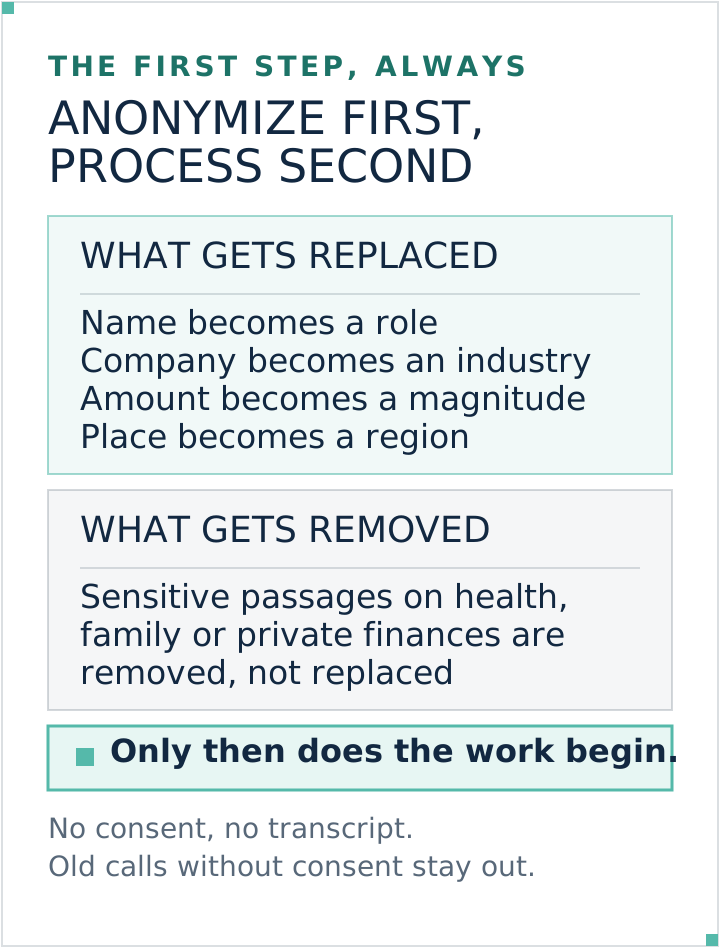
The pseudonymisation pass is the first analysis step, for two reasons. Legally, Art. 5(1)(c) GDPR requires data minimisation, and patterns do not need a single surname. Methodologically, names are noise: as long as a full name and a company name sit in the text, your head reads the individual case. Put "managing director, car retail, ten employees" there instead and you see the pattern. You write the substitutions down so they come out the same on every pass:
What the transcript says
What the extract says
First and last name
role: managing director, buyer, practice owner
Company name
industry plus size: trade business, twelve people
Town, street, postcode
region: northern Germany, metropolitan area
Amount, contract number, date
order of magnitude, period: mid four figures, spring
Names of third parties, competitors
category: a competitor, a previous supplier
Health, family, private finances
removed, not replaced
The last row is the important one: passages like that get deleted rather than generalised, because special categories of personal data need a legal basis of their own (Art. 9 GDPR).
Replacing names is not yet anonymisation. Art. 4(5) GDPR calls pseudonymisation a form of processing in which the data can no longer be attributed to a person without additional information kept separately: which is exactly your ledger. Recital 26 GDPR draws the line, pseudonymised data remains personal data, and the yardstick is the means reasonably likely to be used for identification.
As long as the ledger holds the link, the material needs a purpose, a legal basis, access control and a deletion deadline, even with no names in it. Role, industry, size, point in time, conversation ID and a verbatim quote can together make a person identifiable again: check every entry individually and generalise rare characteristics and conspicuous quotes. You only call it anonymous once the link has been deleted and the entry has passed that check.
Pseudonymise and remove sensitive passages before analysis begins. Grafik: HumanITy
Step 2: pull out the questions
Where the text comes from matters less than where it is processed: Transcription Software Compared puts the local and the cloud tools side by side, and Transcribing Teams Calls shows what the platform already brings along. From the transcript you extract five kinds of question, and only the first one has a question mark:
The question asked. "How long does that take?"
The objection in question form. "And what if it doesn't work for us?"
The worry without a question mark. "We had someone do this once before, it didn't end well."
The follow-up. If the same topic comes up a second time, your first answer was not the clearest one.
The question never asked. You recognise it because you raise it yourself. If you explain something five times unprompted, your website has a gap.
For every hit you record three fields: the verbatim quote in the client's own words, the trigger, meaning what was said immediately before, and the source with a conversation ID and a timestamp. The quote stays verbatim: you need your clients' phrasing later as a heading and as an FAQ line. This is where a language model helps, and where you check it: one pass per transcript, verbatim quotes plus the line before, no paraphrase, uncertain hits flagged. Then you read a sample against the transcript, models like to smooth out language.
Step 3: cluster without losing the difference
After five conversations you might have forty quotes, and some of them sound identical. Throwing everything containing the word "price" into one entry is the point at which a register breaks. Before merging anything you ask three questions, only the second one decides:
Is the same worry behind it? Not the same word, the same worry.
Does the same answer help both? If yes, one entry. If no, two, even if they are worded identically.
Does it come up at the same point in the conversation? The same trigger is evidence, not proof.
Two rules keep the register clean: you move from fine to coarse, never the other way round, because an entry merged too early cannot be pulled apart again. And diverging wording moves into the "variants" field.
Step 4: recognise your own clearest answer
Each entry gets one answer, verbatim out of your own mouth. Four signals can be read off the flow of the conversation:
No follow-up came on the same point afterwards. The easiest one to check.
The other person restates it in their own words. "Ah, so basically I only pay once ..."
The conversation moves on instead of circling. Often the client proposes the next step.
The answer is short. Long answers are the ones where you are still searching.
These signals are observations, not proof. A missing follow-up can mean understanding, but also lack of time, politeness or disinterest, and a later order depends on much more than one sentence. That is why the field is called "clearest answer of my own so far" and not "best answer": it is a candidate for the next pass. Record follow-up, restatement in the client's own words, next step and later outcome separately, then you can see which signal holds.
If there is no good answer of your own, the entry gets the status "open". That is the best yield: the question comes up regularly and you have no answer yet that holds. So you write one properly, once, instead of improvising it a sixth time.
Five conversations become one register entry
The example below is built so the method can be shown without real conversation data. A landscape gardener analyses five initial conversations:
No.
Quote
Trigger
1
"Can you tell me in advance roughly what range we're looking at?"
after the site visit was booked
2
"I don't want to buy a pig in a poke, what does something like this cost?"
after three firms were mentioned
3
"We have a budget in the mid four figures, is that enough?"
after describing what she wants
4
"It shouldn't end up three times that."
after the site visit was announced
5
"And what does the upkeep cost me every year?"
at the end of the conversation
All five are about money, and even so they become three entries. Quotes 1, 2 and 4 belong together, because test two is unambiguous: the same explanation helps all three, namely how binding a figure can be before the site visit. Quote 3 names a budget and asks whether it is enough, and only an assessment helps with that. Quote 5 concerns the time after handover. The first entry looks like this:
Field
Contents
ID
G-01
Question in the client's words
"What does something like this cost, roughly?"
Variants
"What range are we looking at?" · "Buy a pig in a poke" · "Not three times that"
Trigger
as soon as a site visit is booked or announced
What is behind it
the fear of an open-ended bill, not interest in the price
Clearest answer of my own so far
"Before the site visit I give you a range, not a figure. After the visit it becomes a fixed price inside that range. If I can't hold it, I tell you on the day of the visit and not in the quote."
Why this one
no follow-up on price afterwards, the client proposes a date himself
Sources, frequency
conversation 4 (min. 6), 2 (min. 2), 1 (min. 9); 3 of 5 initial conversations, as of 19 September 2026
Status
candidate, re-check in the next quarterly pass
The entry from quote 5 would get the status "open": the question about annual upkeep comes up regularly and the business has answered it differently every time.
What comes out of the register
Four things come out of a maintained register: the playbook, if you sort by trigger rather than by frequency; the FAQ, which takes the question in the client's words as the heading and your answer as the answer; objection handling, open entries first; and content on questions somebody demonstrably asks. One rule sits above all of it: the register is the source, not the model.
The rhythm you update on
Occasion
What happens
Effort
Build-up
batches of ten to twenty conversations, a sample check against the transcript after each batch
the big block, one-off
After each conversation
collect quotes and triggers only, no clustering
a few minutes
Quarterly pass
cluster, count, reread answers, close open entries
half a day
Special pass
new offer, price change, new target group
as needed
Every answer carries an expiry date. The numbers are working heuristics, not measured saturation, and with very varied bodies of conversations they may be too small. The stopping rule is a rule of thumb too, mine is: three batches without a new entry and the material is analysed. You set the rhythm up once, and that is where most people get stuck. You do not have to do it alone: in the community there are people who already keep a register, and you can go through a first quarterly pass together on a call.
What comes after the register
The register remains the reviewed source, but it can feed several outputs. When relationships between calls, patterns, audiences and uses matter, it can become a knowledge graph from calls. If a team should ask questions and receive answers with sources, the next step is an AI knowledge base. For direct use, recurring barriers become sales objection cards and real customer questions become FAQs. The operating framework is AI knowledge management: ownership, validity, review and return to daily work.
Who keeps the register in my business
The method works by hand, it is merely monotonous, and monotony is what you hand over. That role is filled by Gustav, my AI employee for analysing call transcripts, in the same order as above. In my setup, Whisper runs locally for speech recognition.
His most important rule is not a technical one: he distils what you have said yourself and invents no advice on top of it. How a role like that comes into being is in Hiring an AI employee: the process, and which roles carry weight in day-to-day coaching and consulting is in AI for coaches.
Frequently asked questions
What is call analysis with AI?
Comparing many conversations rather than summarising a single one. Recurring questions are pulled out of pseudonymised transcripts, clustered, and linked to the clearest answer of your own. The result feeds a playbook, an FAQ, objection handling and content. The AI searches and sorts, the answers stay yours. For the most frequent entries, ten to twenty conversations are usually enough.
May the finished register be kept indefinitely?
Only if it is genuinely anonymous. As long as a ledger holds the link, or an entry points to a person through role, industry, point in time and a conspicuous quote, it remains personal data, with a purpose, a deadline and access control. Check every entry individually before you call it anonymous.
Can I let the AI pick the best answer?
Let it suggest, not decide. A model finds passages where an answer sits and no follow-up came afterwards, but extraction and attribution still need sample checks. Which answer becomes yours is your call, otherwise the register holds a model answer.
Does this run locally, without the cloud?
Yes. In my setup, Whisper runs locally on the machine for speech recognition. Whether further processing steps run locally or in the cloud depends on the setup in question.
How to carry on
Do not start with three hundred conversations, start with five. Take the most recent initial conversations you have clean consent for, strike out names, companies, places and amounts, and then extract nothing but the questions. If you end up with three quotes that hit the same worry, you have your first register entry.
If you would rather not do this yourself every quarter, Gustav is available as a ready-made package in my community, with the pseudonymisation pass, consent templates and a demo transcript to practise on. The templates are samples without warranty. Everything about it is under Community.
Kevin Welter
Developer, IT architect, author of technical books (Kubernetes, cloud infrastructures) and speaker. Runs his business with an AI workforce of fourteen AI employees and shows solo business owners in his community how to hire their first AI employee.