If you want someone else to edit your video, you supply five things: the complete raw footage in original quality, the audio, a binding spec for length and format, the rights to the music and the images, and a statement of what the video is supposed to achieve. After that, almost every job runs the same way: brief, review of the footage, rough cut, fine cut, round of corrections, final version, sign-off. The price does not come from the length of the finished video, it comes from everything in front of it: the amount and condition of the raw footage, how densely it is cut, subtitles, graphics and the number of correction rounds. That is why nobody serious quotes a price without seeing the material: 15 minutes of clean footage and four hours from three cameras, two audio tracks and no clapperboard can produce the same end result and cost a multiple of the effort.
I no longer edit my own videos and I don't hire a cutter either: in my business, raw footage goes to a fixed role from my AI workforce and comes back finished. How I decide what gets handed over at all is in Which Tasks You Can Hand Off to AI. This post is about the part before that, the part no quote explains: what you have to supply before anyone can cut anything.
What you have to supply before anyone can start
The complete raw footage, untouched. All files, not your own selection, and in camera quality: not sent through a messenger, not converted by you, not pre-assembled on your phone. Every intermediate step costs image quality that no edit brings back.
The audio, separately, if it exists separately. Lavalier mic, recorder, interview track. Audio is the hardest thing to repair: noise and reverb reduction win some of it back, but where the signal clipped the information is gone. The same holds for the picture within limits: brightening and stabilising have their limits, and blown-out highlights do not come back.
Length and format, binding. A landscape video for YouTube and a vertical reel are two edits, not one with different margins. For upload, YouTube recommends MP4 with H.264 in the "High" profile and AAC-LC at 48 kHz, and at standard frame rate 1080p at around 8 Mbps and 4K at 35 to 45 Mbps.
The rights to music and images. Missing most often, surfacing latest, so it gets its own section below.
A goal and, if one exists, a script. "Make something nice" is not a brief, it is an invitation to three rounds of corrections. One sentence is enough: who watches this, what should they do afterwards, which single statement has to stick.
One contact person and a deadline. One person who bundles feedback and signs off. Three opinions from three departments are the most expensive part of any job.
If clients, patients or staff appear in the material, uploading it to a service provider is a deliberate decision and not a formality. How I handle that is in AI and Privacy: What the AI Gets to See.
Music and image rights belong before the edit
What follows is not legal advice, it is the list that belongs before the edit rather than on the day before publication.
Music. German collecting society GEMA holds blanket agreements with the Meta services, YouTube and TikTok through its subsidiary ICE. The catch is stated by GEMA itself: privately and non-commercially you use the platform's music library free of charge, but according to GEMA, Instagram grants the right only for personal content and only on Instagram; commercial and non-private purposes are expressly not permitted. Your business profile therefore sees a different selection than your private account. The neighbouring rights held by labels and the rights held by publishers are not licensed by GEMA at all. Once the video leaves the platform, for example onto your website, the blanket agreement ends and GEMA's VR-OD 10 tariff applies. In the YouTube Audio Library the standard licence requires no attribution, and for Creative Commons tracks you credit the artist in the video description; the help page covers use on YouTube and expressly gives no legal advice for problems off the platform. What is allowed elsewhere is decided by the licence of the individual track.
People on camera. Section 22 of the German Art Copyright Act is short: portraits may only be distributed or publicly displayed with the consent of the person depicted, and in case of doubt consent is deemed given if that person received payment. Section 23 names exceptions, for instance people appearing only incidentally alongside a location, but withdraws them as soon as a legitimate interest of the person depicted is infringed. Image rights are only one layer here, data protection and the purpose of the recording count alongside them, all the more so with employees. Robust practice is therefore a written release naming purpose and channels: on the shoot day that is a sheet of paper, three months later it is a phone call.
Who may use the finished video how. Section 31 of the German Copyright Act distinguishes simple and exclusive rights of use and allows them to be limited in territory, time and content; if the types of use are not expressly named, subsection 5 makes the scope follow the purpose of the contract. Paid ads, a course, cuts, duration and the question of whether you get the raw footage and project file therefore belong in the order.
How the review loop actually runs
Step
What happens
What you have to do
1. Brief
goal, length, format, tone, deadline in writing
supply and confirm
2. Review of footage
usable parts marked, gaps reported
be reachable for questions
3. Rough cut
structure is set: order, length, which statements are in
corrections built in, export in the agreed formats
check
7. Sign-off
done, invoice, archiving
accept it or name the defects
The most important step is number three, and it is the one most often skipped. "That passage can go" costs five minutes at the rough cut; at the finished version the same sentence throws away subtitles, graphics and the music edit with it.
Why the number of correction rounds belongs in the order
Because two completely different things look alike. Under Section 633 (2) of the German Civil Code a defect is a deviation from the agreed quality; where nothing was agreed, what counts is what is customary for works of that kind. Typical cases: the video was meant to be 60 seconds and is 80, the subtitle misspells your company name, there is a black frame in the export. Whether something really is a defect in the individual case is decided by the contract, not by this list. Where there is one, Section 635 lets the contractor choose between remedying the defect and producing a new work, and he bears the necessary expenses, expressly including transport, travel, labour and material costs; he may refuse only where the cost would be disproportionate. A change request is something else: you no longer like the music, the opening would be better another way, a second format would be nice. That is not remedial work, it is a new order.
The dividing line is the agreement from step one: the more precise the brief, the smaller the grey zone. That is why every clean quote carries a number. My recommendation as a buyer: two rounds included, each further round charged by effort. Without that number the provider either prices in the worst case and is too expensive, or the best case and turns reluctant from round three. And here is a point almost nobody knows: under Section 640 (2) of the German Civil Code a work counts as accepted if the contractor sets a reasonable deadline for acceptance and the customer lets it pass without naming at least one defect. Towards consumers that only applies after a notice in text form.
What an edit includes, and what costs extra
The split below is not market data, it is the allocation that has proven itself when buying. Written into the quote this way, it saves the argument afterwards.
Belongs in the agreed price
Order and pay for separately
watching and selecting from the footage you supplied
footage you supply later
rough cut: pauses, false starts and fluffs removed
subtitles, especially styled and animated ones
bringing audio to an even level
audio repair: noise, reverb, interference
simple transitions, titles and end card
motion graphics, animated overlays, logo
basic colour correction so the cameras match
a colour look or grade to reference
one export in one agreed format
every further format, especially the vertical crop
the agreed correction rounds
every round beyond them
delivery of the finished file
project file, archive, additional rights of use
The single largest item on the right is subtitles, not because generating them is hard but because correcting them is; hook, script and caption are not in the table at all, because they belong to a reel commission, not to the edit: every automatic tool mishears proper nouns. How that step works is in Auto-Generate Subtitles: A Guide.
The four billing models and what drives them
Model
How it is calculated
Who carries the risk
Fits when
per finished minute
fixed price per finished minute
the provider
the material always looks similar
per hour
hours worked times hourly rate
you
the scope is open or footage arrives late
package price
one price for a described result
the provider
the result can be described precisely up front
allowance or subscription
a fixed volume per month at a fixed price
you, if you don't use it up
production is continuous and predictability counts
The way you bill does not decide the type of contract. What decides it is what is owed: under Section 631 of the German Civil Code a contract for work obliges the contractor to produce the promised work, meaning a result; under Section 611 a service contract obliges him to render the promised services, meaning the activity. A contract for work can still be billed by the hour, and a service contract as a lump sum. So describe both separately in the order: the result and the payment. Wanting certainty about the result does not get you there through the billing form. Two rules from the same code are worth knowing: if the amount of the remuneration is not determined, Section 632 (2) treats the customary remuneration as agreed, and what is customary gets decided by someone other than you. And under subsection 3 a cost estimate is, in case of doubt, not to be paid for: absent an agreement to the contrary you pay nothing for the calculation. A separately agreed concept or design service is a different matter and may be charged.
Whatever the model, five things drive the effort: the amount of raw footage, because every minute has to be watched, including the minutes that never make it in; the condition of the raw footage, meaning one camera or three and audio on the camera or on a recorder that has to be synced; the cutting density, because a calm interview and a reel with a cut every second have the same finished length, not the same effort; subtitles and graphics; and the correction rounds, the only item that still grows after the order is placed.
Where these jobs fall apart
Almost never on the technology. The list repeats itself:
The footage never arrives. Order placed, deadline set, files still on the memory card in a drawer.
Feedback in drips. Three voice messages, two emails and a call across four days, each with new wishes, each restarting the round.
Rights were settled last. The music has to go, and the cut sat on its beat. That is not a swap, it is a new fine cut.
Nobody signs off. The video is done, everyone is happy, and no one says so.
Handing it over instead of commissioning it: how it runs here
In my business raw footage does not go to a service provider, it goes to a role inside the company. Eddi is my AI employee for video editing: raw footage and a script in, a finished, technically checked video out. Pauses out, subtitles on, overlays placed, 9:16 format, black frame check passed.
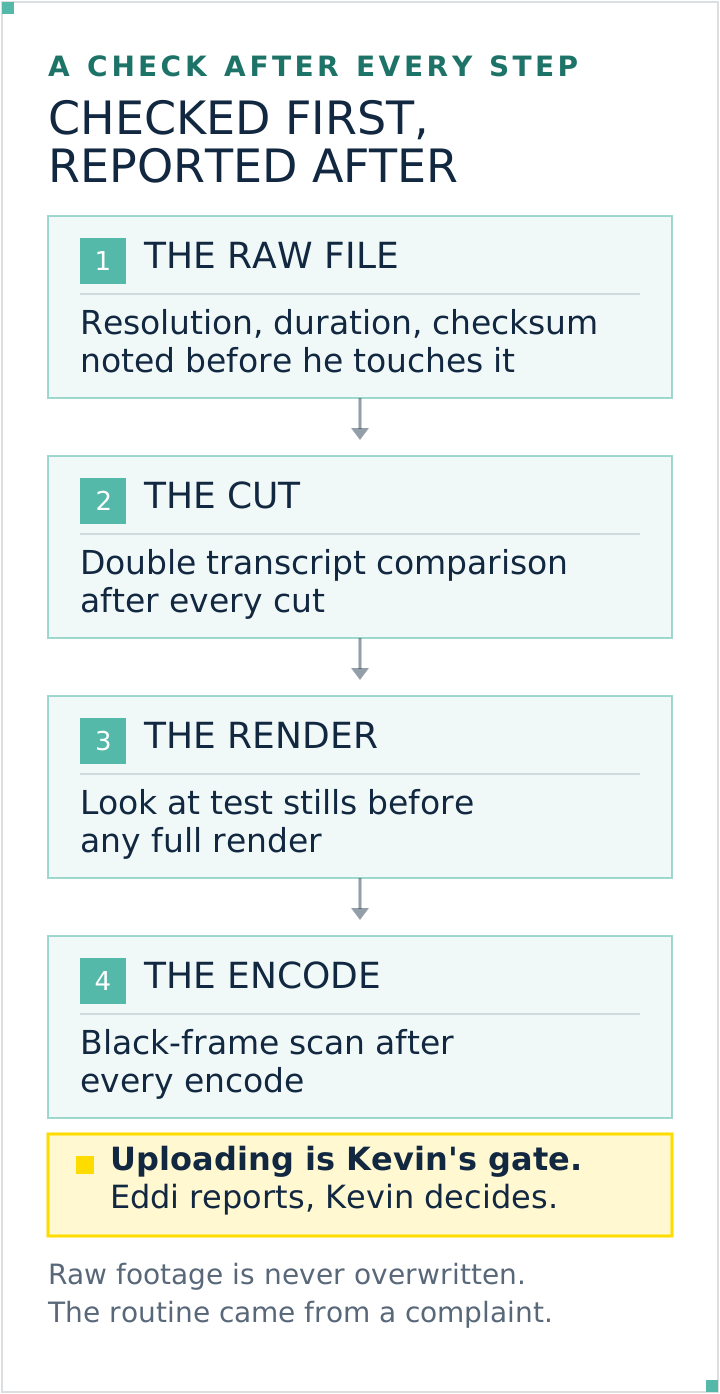
What carries this is not the speed, it is what he checks every single time. Before any processing starts he records resolution, duration and a checksum for every source file. After every encode an automatic black frame scan runs, after every cut he compares two transcripts against each other so the subtitles do not say things nobody said, and before every full render he looks at test stills. The routine came out of a complaint from me: an earlier delivery had black frames in it, and the scan has been built in ever since. He never overwrites my raw footage. For scale: in one job he cut 20 interview videos, a good 66 minutes of raw footage down to just under 49 minutes of finished edit, each with its own subtitled version on top.
He does not shoot: without raw footage there is no video. He works on the command line with ffmpeg, a local Whisper model and Remotion, not with a mouse in an editing suite. And nothing gets uploaded without me: posting is my gate. Which program to pick if you cut it yourself is in AI Video Editing Software Compared.
Four checks safeguard the raw file, edit, render and encode. Grafik: HumanITy
Frequently asked questions
What does it cost to have a video edited?
A solid number only exists once someone has seen the material. The price hangs on the amount and condition of the raw footage, the cutting density, subtitles and graphics, and the number of correction rounds. Billing runs per finished minute, per hour, as a package or as a monthly allowance. To compare, send every provider the same footage list and the same target formats.
How much does AI video editing cost?
If you build the workflow with Claude Code and the right open-source tools, the ongoing software cost in my setup is limited to a small Claude subscription. Tools such as ffmpeg and a locally run Whisper model add no further licence fees. Your own computing power and the time for setup, quality checks and approval still count. This is therefore the cost of running your own workflow, not the market price of a finished video-editing job.
Can you have a video edited by an AI?
Yes, as long as raw footage exists. An AI finds pauses and false starts, generates subtitles, crops to vertical and exports, in six steps you can run yourself. What it cannot do is shoot. And it needs the same input a human does: complete footage, clean audio, binding specs for length and format.
How many correction rounds are normal?
Every provider handles this differently, which is why the number belongs in the quote. What has proven itself: two rounds included, each further round charged by effort. More important than the number is the distinction. A defect, meaning a deviation from the agreed quality, gets fixed, and under Section 635 of the German Civil Code the contractor bears the cost. A change request is a new order.
Can I use music from the Instagram library for a company video?
The licence the platforms hold covers private, non-commercial use, according to GEMA. Commercial use is expressly not permitted, which is why business profiles see a different selection. Once the video leaves the platform, for example onto your own website, the blanket agreement does not apply at all.
Where to go from here
Don't start with the provider search, start with half a page: total running time of your footage, number of cameras, audio situation, the finished length you want, target formats, deadline, number of correction rounds. With that you get comparable quotes instead of guesses, and filling it in shows you where your own gaps are. You don't have to write it alone: in my community Claude Practitioners there are people who have drawn up the same list already, we go through it together on the calls, and that is also where Eddi and the other ready-made AI employees are available to load. How such a role gets built inside your own business is in Hiring an AI Employee: The Process.
Kevin Welter
Developer, IT architect, author of technical books (Kubernetes, cloud infrastructures) and speaker. Runs his business with an AI workforce of fourteen AI employees and shows solo business owners in his community how to hire their first AI employee.