Generative Engine Optimization, or GEO, is the work of getting a website to appear in the answers of generative search systems and to be linked there as a source: in ChatGPT search, in Perplexity, in Microsoft Copilot, and in Google's AI Overviews and AI Mode. The term comes from a research paper by Aggarwal and colleagues, published in 2023 and presented at KDD 2024; it groups these systems under the label "generative engines". The abbreviations AEO and LLMO are also in circulation; they overlap with GEO but are not clean synonyms: AEO is usually broader and also covers featured snippets and voice assistants, LLMO puts the emphasis on the language models themselves. Technically GEO is not a second discipline next to SEO but a continuation of it: for its own AI features, Google states that there are no additional requirements. That statement is about Google and does not transfer without further ado to ChatGPT, Perplexity or Copilot, which have their own crawlers, indexes and fetch paths. What genuinely differs is the metric: classic search counts position, impressions and clicks; an AI answer counts whether your content was used as a source and linked. The two do not move in lockstep, so you measure them separately.
I run my business as a solo freelancer with a workforce of AI employees built on Claude. One of them measures my own website, and from day one for both sides: classic search and AI search. The full concept is on the AI employees page, and who does which job is in the org chart. This piece defines the term, separates what is documented from what is merely claimed, and shows how to check for yourself whether you are being cited.
Where the term comes from, and what it means in plain language
The research paper states the problem plainly: generative search systems synthesize several sources, and the author of the source has "little to no control over when and how their content is displayed". The authors report that their methods raised visibility by up to 40 percent, and note in the same breath that the effect varies strongly by domain: a research result under controlled conditions, not a number you can transfer to your own website.
Nobody phrases the question that way in daily life. There it sounds like this: "If someone asks ChatGPT for a physiotherapist in my town, do I show up in the answer, and is my website listed as a source?" How young the field still is linguistically shows in a Google autocomplete query I ran on 19 September 2026: the technical term returned ten suggestions, while user-side phrasings returned none at all in German.
What actually works differently in an AI answer
Six differences with practical consequences.
Criterion
Classic search result
Answer from an AI system
What gets shown
links with title and snippet
a summarized text with source references
Your metric
position, impressions, clicks, click-through rate
whether and how often you are cited as a source
How the query is processed
one query, one result set
Google's "query fan-out": several derived queries
Who fetches your page
Googlebot, Bingbot
additionally OAI-SearchBot, PerplexityBot, Claude-SearchBot, plus user-triggered fetches
What data you get
clicks and queries in Search Console and Bing
citations in Bing Webmaster Tools, impressions in Search Console
Repeatability
a similar result for the same search
the answer varies by session, country and model version
The most important point sits in the third row. Google describes query fan-out as "a set of concurrent, related queries generated by the model". Your page can therefore be pulled in for a sub-question the user never typed. That is why tightly scoped pages can play a role in AI answers even when they do not rank near the top for the main term.
The second-to-last row explains why so many GEO offers stay vague. Google says two things at once, and both are true: sites appearing in AI Overviews and AI Mode are included in Search Console's regular Performance report under the "Web" search type, clicks and all. Alongside that, since 31 August 2026 every site has the separate generative AI performance report, and it shows impressions only. So a click figure for AI Overviews on its own does not exist. If someone sells you exactly that, it is worth asking where it is supposed to come from.
What is documented to matter
These five points come from the providers' own documentation, not from an agency checklist.
The page has to be indexed and snippet-eligible. Google puts it as a hard precondition: "a page must be indexed and eligible to be shown in Google Search with a snippet." Anyone shielding content with noindex or nosnippet is shielding it from the AI features as well.
The content has to be fetchable without detours. Google's instruction reads: "ensure your content is crawlable, as Google Search generative AI models use publicly accessible, crawlable content." Anything behind a login or a paywall is not available to these systems.
The right crawlers must not be blocked, and they are not the ones people assume. Every provider separates search crawlers from model crawlers in its own documentation: OAI-SearchBot is "used to surface websites in search results in ChatGPT's search features", GPTBot collects training material, and OpenAI explicitly recommends allowing OAI-SearchBot. The same pattern applies to Claude-SearchBot versus ClaudeBot. So blocking GPTBot does not block ChatGPT search, as long as OAI-SearchBot stays allowed. Which line belongs where is in Optimizing Your Website for AI Search.
Structure and quality count, but as ordinary craft. Google's recommendation for its AI features consists of the familiar points: unique content instead of commodity material, a clean technical foundation, clear headings, good images and video. None of it is AI-specific, and that is precisely the message.
For Google, add well-kept business details. Google's AI features guide explicitly lists keeping Merchant Center and Business Profile information up to date, and Google's local ranking help says: "Businesses with complete and accurate info are more likely to show up in local search results." That is documented for Google's local search, not for every generative system.
So the documented levers are largely the same ones that make a website visible in classic search. Points 1, 2, 4 and 5 come from Google's documentation and apply to Google's AI features first of all; point 3 is documented per provider.
What gets claimed without evidence
This is where an assessment parts ways with a sales pitch. Four things sold as GEO measures, and what Google itself writes about them.
Claim
What is documented
"You need an llms.txt file so AI systems can find you."
Google writes: "You don't need to create new machine readable files, AI text files, markup, or Markdown to appear in Google Search."
"You need special schema markup for AI search."
Google writes: "Structured data isn't required for generative AI search, and there's no special schema.org markup you need."
"You have to break your text into small machine-readable chunks."
Google writes: "There's no requirement to break your content into tiny pieces for AI to better understand it."
"There is a dedicated writing style for AI search."
Google writes: "You don't need to write in a specific way just for generative AI search."
The llms.txt case deserves its own note, because it is the most heavily marketed fad in the field. Google's John Mueller put the file this way on 15 June 2026: "It's basically you're telling these systems, like, I have the best website ever." An Ahrefs study published the same day, covering 137,210 domains, gives the picture from data: of the roughly 38,400 domains with a valid llms.txt, 97 percent received not a single request for that file in May 2026. So a visibility benefit is not documented, and the file wants maintaining like any other.
Caution also applies to "GEO scores" and visibility indices from monitoring vendors. Those are metrics of the respective tool, calculated from its own prompt set: usable as a trend line inside the same tool, not as an absolute statement about your visibility, because nobody outside the vendors knows the underlying population.
Structured data, finally, remains a sensible measure for classic search and for making your page machine-readable. I still use Organization, LocalBusiness and Article, I just do not sell them as a GEO lever.
How to measure whether you are being cited
Four routes, ordered by data quality, the first three free.
Bing Webmaster Tools, the "AI Performance" report. The most direct evidence available right now, announced by Microsoft as a public preview on 10 February 2026. It shows "Total Citations", "Average Cited Pages", "Grounding Queries" as the phrasings the AI used when retrieving your content, plus citations per URL and the trend over time. According to the announcement it covers Microsoft Copilot, AI-generated summaries in Bing and selected partner integrations, not every system.
Search Console. The separate generative AI performance report shows impressions from AI Overviews and AI Mode, broken down by pages, countries, devices and date, for every site since 31 August 2026. It contains no clicks and no queries, and the same 1,000-row limit as the regular performance report applies. The clicks from those appearances are not lost, they sit in the regular performance report under the "Web" search type, just not identifiable as AI appearances. Enough to answer "am I in there at all", not enough for root-cause analysis.
Your own server logs. They record which AI crawlers actually fetch your pages. The interesting ones are the search bots (OAI-SearchBot, PerplexityBot, Claude-SearchBot) and, separately, the user-triggered fetches (ChatGPT-User, Perplexity-User, Claude-User). The second group is the stronger usage signal, because a person triggered the action, but it is not proof of a citation: OpenAI describes ChatGPT-User as a fetch on a user's behalf, not as a citation log. Whether a question led to your page, and whether the page was named in the answer, is not in there.
Your own prompt set, run regularly. Ten to fifteen fixed questions a prospect would genuinely ask, sent to several systems on a fixed rhythm and logged: are you mentioned, are you linked, who gets named instead. It is the simplest method you control yourself for systems with no webmaster report; monitoring vendors query the same systems, just with their own prompt set. The limitation belongs in every report: answers vary by session, country and model version. That gives you a trend, not the view of an individual user.
The routine that follows is always the same: record a baseline and file it, implement the measures, then re-measure weeks later with the identical setup. Without the first measurement the second one is worthless. The prompt set is the part nobody can take off your hands, because it has to fit your business. If you cannot put your own fifteen questions together alone, bring them to the community, where people have already built the same list for their field.
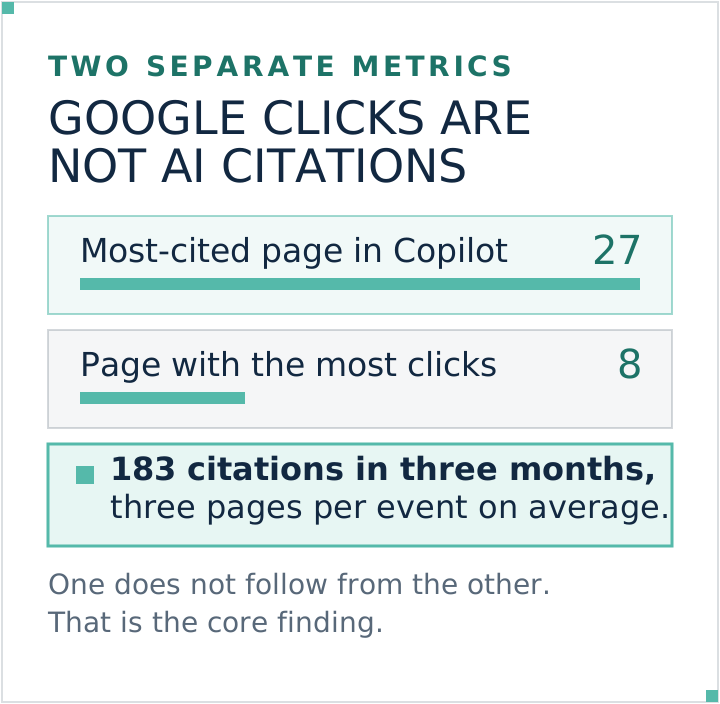
Google clicks and AI citations are separate metrics. Grafik: HumanITy
The employee who keeps both metrics apart
This is where a topic turns into a role. Anyone can record a baseline once. Repeating it eight weeks later with an identical setup is what hardly anyone does.
Sebastian, my AI employee for SEO and GEO, therefore runs both series side by side: the classic one from Search Console and Bing Search Performance, the generative one from Bing's "AI Performance" report, the Search Console report and a prompt set of his own. Every raw output lands in a dated job folder, every finding names its source file. He changes nothing on a live website. He measures, I decide.
Why that separation is not theoretical shows in a finding from my own website: in the three months up to 16 September 2026, Microsoft Copilot cited kevinwelter.com 183 times, averaging three pages per citation event. The single most cited page reached 27 citations, while the page with by far the most Google clicks reached only 8. Google ranking and AI citation frequency are two metrics, and one does not follow from the other.
Literally, optimizing for generative search engines. It covers the work of getting content to appear in the answers of systems such as ChatGPT, Perplexity, Microsoft Copilot, or Google's AI Overviews, and to be linked there as a source. The abbreviations AEO (Answer Engine Optimization) and LLMO are also in circulation. The three overlap but are not clean synonyms: AEO is used more broadly and includes featured snippets and voice assistants, LLMO puts the emphasis on the language models themselves.
Is GEO something different from SEO?
It is an extension, not a replacement. For its own AI features Google states that there are no additional requirements: the page has to be indexed, crawlable and snippet-eligible, and the content helpful and clearly structured. For the other providers there is no comparable statement; there, crawler access and Bing presence count on top. What is new is not the measure, it is the metric. Instead of position and click, the citation counts.
Does llms.txt help with visibility in AI answers?
There is no evidence for it so far. Google explicitly writes that you do not need new machine-readable files or AI text files to appear in Search. An Ahrefs study of 137,210 domains found in June 2026 that 97 percent of valid llms.txt files received not a single request in the previous month. So a benefit is not documented, and maintaining it is extra work.
How do I find out whether ChatGPT or Copilot cites my website?
For Copilot, most directly through Bing Webmaster Tools: since February 2026 the "AI Performance" report shows, free of charge, the number of citations, the cited pages and the grounding phrasings. For ChatGPT there is no comparable report; there a fixed prompt set run regularly and logged helps, plus a look at your server logs for the AI crawlers, bearing in mind that a ChatGPT-User fetch is not yet proof of a citation.
How to continue
Start with an hour, not with a strategy. First: open robots.txt and check whether OAI-SearchBot, PerplexityBot, Claude-SearchBot and Googlebot are allowed. Second: set up Bing Webmaster Tools, verify ownership, and open the "AI Performance" report; that is your first real number. Third: write down ten questions a prospect would ask, send them once to ChatGPT, Perplexity and Copilot, and save the answers with a date. That is your baseline, and in eight weeks you re-measure with the same setup.
What the classic half of the measurement looks like is in How to Run an SEO Audit With AI, and which tool really delivers what is in SEO Audit Tools Compared. The ready-made templates for baseline and re-measurement, and the discussion around them, are in my community.
Kevin Welter
Developer, IT architect, author of technical books (Kubernetes, cloud infrastructures) and speaker. Runs his business with an AI workforce of fourteen AI employees and shows solo business owners in his community how to hire their first AI employee.