Grok vs Claude 2026: Compared for Work
Grok vs Claude (October 2026): subscriptions, API prices, models, agents, privacy and processing location in one table, from a daily Claude user.
Read the articleOctober 31, 2026 · 13 min read
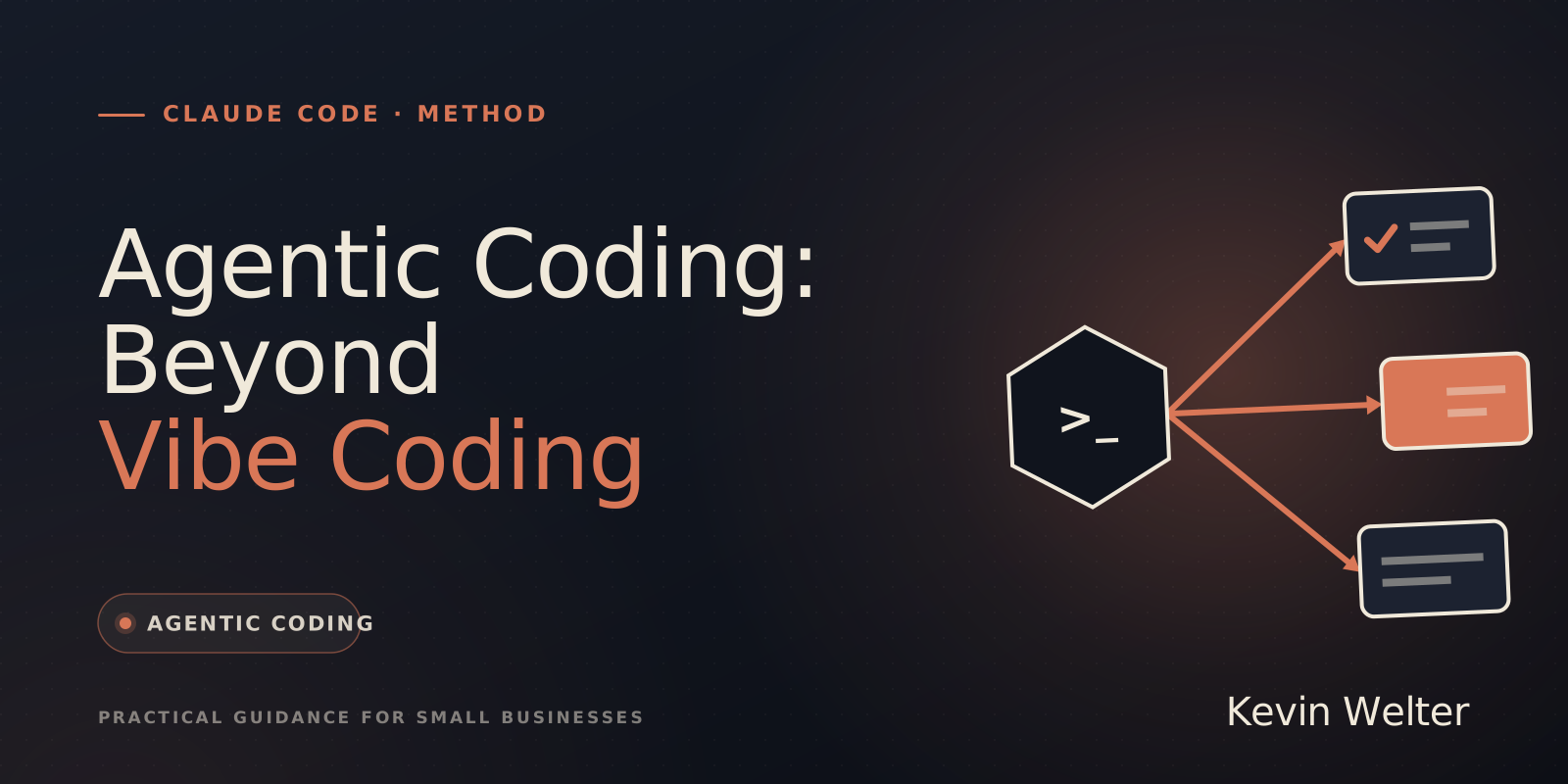
Agentic coding means an AI agent gets a task and works through it in a loop. It reads the existing code, plans the steps, changes files, runs commands and tests, reads the result and fixes what's wrong until the task is done. You set the goal and the limits and review the result. Unlike vibe coding, the code gets read, tested and reviewed. Unlike autocomplete in your editor, the AI doesn't just write the next line, it works through a whole task with tools.
What agentic AI is in general is in Agentic AI Explained: What It Is and Isn't. This post is about programming, and further down about how I work this way.
I collect the other building blocks and guides under Understanding and Using Claude Right.
Anthropic describes how Claude Code works as an "agentic loop" with three phases: gather context, take action, verify results. These phases blend together, the loop runs until the task is complete, and you can step in at any point.
Tools make this possible: according to the docs, without tools Claude can only respond with text; with them it reads code, edits files and runs commands. Given "fix the failing tests", the agent runs the test suite, reads the error output, finds and edits the relevant files and runs the tests again.
The developer Simon Willison calls code execution the defining capability that makes this way of working possible. A coding agent checks whether the code runs, not just whether it looks plausible.
You'll also read "agentic engineering". Who used it first, I can't document, but two sources are clear. Andrej Karpathy, who had already coined "vibe coding" in February 2025, wrote a retrospective on X on February 4, 2026, for the first anniversary of vibe coding. Programming via agents, he wrote, is becoming a default workflow for professionals, with more oversight and no compromise on quality. Many people had tried to find a better name to set this apart from vibe coding; his current favourite was "agentic engineering". So he doesn't present the term as his own invention. His reasoning: "agentic" because you almost never write the code directly any more, you orchestrate agents and oversee them. "Engineering" because it takes expertise you can learn and get better at.
Simon Willison has been collecting patterns for it since February 23, 2026, in his guide "Agentic Engineering Patterns". He defines agentic engineering as developing software with the assistance of coding agents, meaning agents that can both write and execute code. His examples are Claude Code, OpenAI Codex and Gemini CLI.
I use agentic coding and agentic engineering interchangeably here. To me, the word engineering stresses the discipline around it: the brief, tests, review, responsibility.
The difference is how much the AI does on its own and who checks the result.
| Autocomplete | Vibe coding | Agentic coding | |
|---|---|---|---|
| What the AI does | suggests the next lines in the editor | writes code on request | completes a task in several steps |
| Runs commands and tests | no | depends | yes, that's part of the loop |
| Does anyone read the code? | yes, you decide on every suggestion | no | yes, you or a reviewer role |
| What you provide | the cursor in the code | a wish | brief, limits, a check |
| Typical use | typing faster | prototype, private helper | software other people use |
GitHub describes this range for Copilot itself: from suggestions in the editor to an autonomous agent that edits files, runs commands and validates its work.
Vibe coding isn't bad, it has a different purpose. Willison reserves the term for unreviewed, prototype-quality code. When that holds up is covered in What Is Vibe Coding? A Plain Guide. Agentic coding is for anything other people will use.
How Claude Code and Codex differ day to day is in Claude Code, Codex or Copilot: Which One?. All alternatives with dates and sources are in Claude Code Alternatives in 2026.
To me, six building blocks belong in it:
/code-review reviews the changes in a fresh subagent that never saw your conversation. According to Anthropic, that's why it isn't swayed by the reasoning that produced the code. More in Claude Code Review: Cost, Setup, Limits and Claude Code Subagents: Best Practices.My AI employees work with Claude Code, each in their own folder with personnel file, working instructions, skills, knowledge and job folders. Before anything goes live, a separate reviewer checks it, and whoever created something never reviews it themselves. How such a folder is built is in Creating an AI Employee: How to Start; how the employees run on a server is in Claude Code on a Server: tmux, Remote Control. What a review against my brief looks like is shown on the page about Kai.
Software development with an AI agent that reads code, edits files, runs commands and tests and iterates on its own until a task is done, while you set the brief and review the result.
With vibe coding you accept the AI's code without reading it. With agentic coding an agent also works largely on its own, but with tests, rules and a review by you or a second role. Vibe coding suits prototypes, agentic coding suits software other people use.
Agentic engineering is software development with coding agents treated as a serious discipline. Andrej Karpathy named it in February 2026 as his favourite term for the professional way of working after vibe coding, and Simon Willison defines it in his guide "Agentic Engineering Patterns".
Well-known tools are Claude Code from Anthropic, Codex from OpenAI, Gemini CLI and Antigravity CLI from Google, and the agent mode and cloud agent of GitHub Copilot.
Not necessarily to start. But for it to be more than vibe coding, someone has to write a clean brief, set the checks and judge the result.
Start with a small, real task in a folder under Git. Write into the brief how the agent can tell it's done, and have the result reviewed by someone who didn't write it. If you haven't set up Claude Code yet, start with Install Claude Code: Windows, Mac, Linux. When your briefs get bigger, Spec-Driven Development With AI Agents will help. How others build and review with agents is what we discuss in my community AI Employee Framework.
Grok vs Claude (October 2026): subscriptions, API prices, models, agents, privacy and processing location in one table, from a daily Claude user.
Read the articleClaude vs Gemini: prices (as of September 2026), context windows, privacy, and coding tools in one table, plus my view as a daily Claude user.
Read the article
Kevin Welter
Developer, IT architect, author of technical books (Kubernetes, cloud infrastructures) and speaker. Runs his business with an AI workforce of fifteen AI employees and shows solo business owners in his community how to hire their first AI employee.
Your first AI employee up and running within an hour
Join the community$5/month founding price, first 50 members