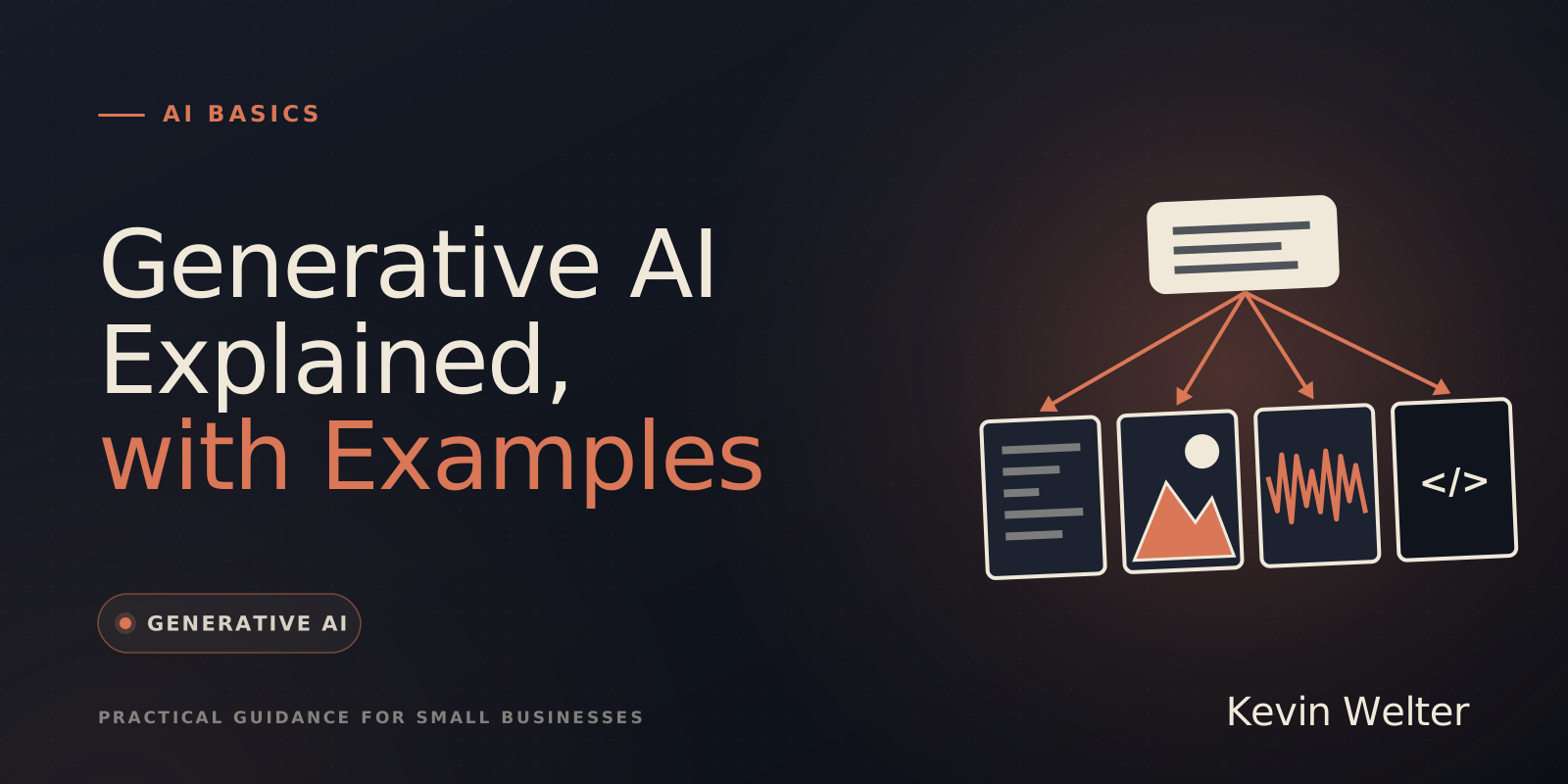
Generative AI is artificial intelligence that creates new content: text, images, music, spoken language, videos or code. It has learned from huge amounts of existing examples what such content typically looks like and, on your instruction, produces something new in that style. The best-known examples are AI chats such as ChatGPT, Claude and Gemini, and image generators.
I use generative AI every day. My fourteen AI employees run on Claude Team, some also on open models or through the API. Much of what they deliver is generated text, such as the posts on this website that Sebastian writes. Here I explain what makes generative AI tick and where it stops. All AI basics are on my AI Basics page.
What generative AI is
"Generative" means producing. In its profile on generative AI, the US standards body NIST uses this definition: the class of AI models that emulate the structure and characteristics of input data in order to generate derived synthetic content. NIST includes images, videos, audio, text and other digital content.
An AI model is the result of this learning: a huge collection of numbers the program uses to compute an output from your input. What exactly a model is, I explain in What Is an AI Model? Simply Explained. Your input is called a prompt, the instruction or question you give the AI, for example "Write a short reply to this customer enquiry".
Google notes in its glossary that there is no formal definition of generative AI. Most experts agree, however, that such models create content that is complex, coherent and original. For you, that means: the result isn't copied from a database but computed afresh each time. That's why you rarely get the same wording twice for the same instruction.
How it differs from other AI
Many AI applications don't create anything new; they sort, rate or predict something. That's why Google contrasts generative AI with predictive machine learning. A spam filter only decides whether an email is advertising. A generative AI writes you the reply to the email.
Generative AI is part of AI, not its opposite. I explain the umbrella term in What Is AI? Artificial Intelligence Explained. Agentic AI goes one step further: it uses a generative model as its engine and lets it complete tasks itself with tools. What that means is in Agentic AI Explained: What It Is and Isn't.
Examples of generative AI
- Text: AI chats such as ChatGPT, Claude and Gemini write emails, quotes, summaries or social media posts. Behind them is a large language model, or LLM for short. Ready-made instructions for such tasks are in Prompt Templates: 12 Copy-and-Paste Briefs for Small Businesses.
- Images: image generators create a photo, a graphic or an illustration from a description. Which tools exist is in AI Image Generation Compared, free routes in Creating AI Images: Free and Free to Use.
- Sound and speech: Google names models that compose music or generate realistic speech. Typical uses are voice-overs or background music for a video.
- Video: video models create new videos, for example from a description.
- Code: an AI writes programs from your description. When that holds up and when it doesn't, I explain in What Is Vibe Coding? A Plain Guide.
An everyday example, made up: a bakery needs a text for the weekly offer and an image for Instagram every Friday. The owner gives the AI the three offers with prices, gets a draft text and has a matching image generated. She checks the prices, swaps a word that doesn't sound like her, and posts. The AI delivered two drafts quickly; responsibility for the content stays with her.
With me it works similarly, just with roles: Eddi, my AI employee for video, edits my footage. For generations at an AI image service he has a rule of his own: they cost money, and larger series only run after I approve them.
Where generative AI hits its limits
- It sometimes makes things up. NIST calls this confabulation: confidently stated but false content, colloquially known as hallucinations. A generative AI always produces something plausible, even when it doesn't know the answer. How to spot it is in AI Hallucinations: Why AI Makes Things Up.
- Its knowledge has a cutoff date. For the current Claude models, Anthropic gives June 2026 as the reliable knowledge cutoff. What happened afterwards the model only knows if it searches the web or you give it the information.
- It often sounds the same. NIST warns of undesired homogeneity in the outputs. If everyone works with the same instructions, the texts sound alike too.
- Rights and labelling. With images, voices and texts, questions of copyright and labelling come up. I cover copyright in a separate post on AI and copyright. What applies to labelling is in the post on labelling AI content.
What to watch out for
- Provide your material. Put prices, facts and names into the instruction instead of leaving them to the AI.
- Check every result before it goes out. Especially numbers, names and dates.
- Bring in your own voice. A few example sentences of yours help the AI match your tone.
- Take care with real people. Don't generate images or voices of real people without their consent.
Frequently asked questions
What is the difference between AI and generative AI?
AI is the umbrella term for programs that solve sophisticated tasks. Generative AI is the part of it that creates new content. A spam filter is AI, but not generative. An AI chat that writes you an email is generative AI.
Is ChatGPT generative AI?
Yes. ChatGPT is an app in which a large language model from OpenAI generates text. According to Anthropic, the current Claude models also accept images as input, not just text. How app and model fit together, I explain in What Is an AI Model? Simply Explained.
What does GenAI mean?
GenAI is short for generative AI. It means the same thing.
Can generative AI work with my own documents?
Yes, if you give them to it, for example as a file in the chat. Whatever is in the conversation, the AI can use. For large collections there are methods that pick out the relevant passages before answering; I explain them in What Is RAG in AI? RAG Systems Explained. Customer data belongs only in plans with a suitable contract.
Where does generative AI get its knowledge?
From training on huge amounts of text, images or audio. The model learns patterns in the process, but doesn't file the examples away like an archive. How this works for language models, I explain in How Do LLMs Work? A Plain-English Guide.
Where to go from here
If you want to take a step back, read What Is AI? Artificial Intelligence Explained. Next on the learning path, I explain the method by which AI learns in the first place: machine learning. What lies behind names like GPT, Claude Opus or Gemini, I explain in What Is an AI Model? Simply Explained. How others use generative AI day to day is what we discuss in my German-speaking community Claude Practitioners.
Your first AI employee up and running within an hour
Try it free for 7 days (in German)