Shadow AI: When Your Team Uses AI in Secret
Shadow AI means your team uses AI tools the business never provided. Why it happens, the risks, and how to spot it and bring it under control.
Read the articleOctober 27, 2026 · 10 min read
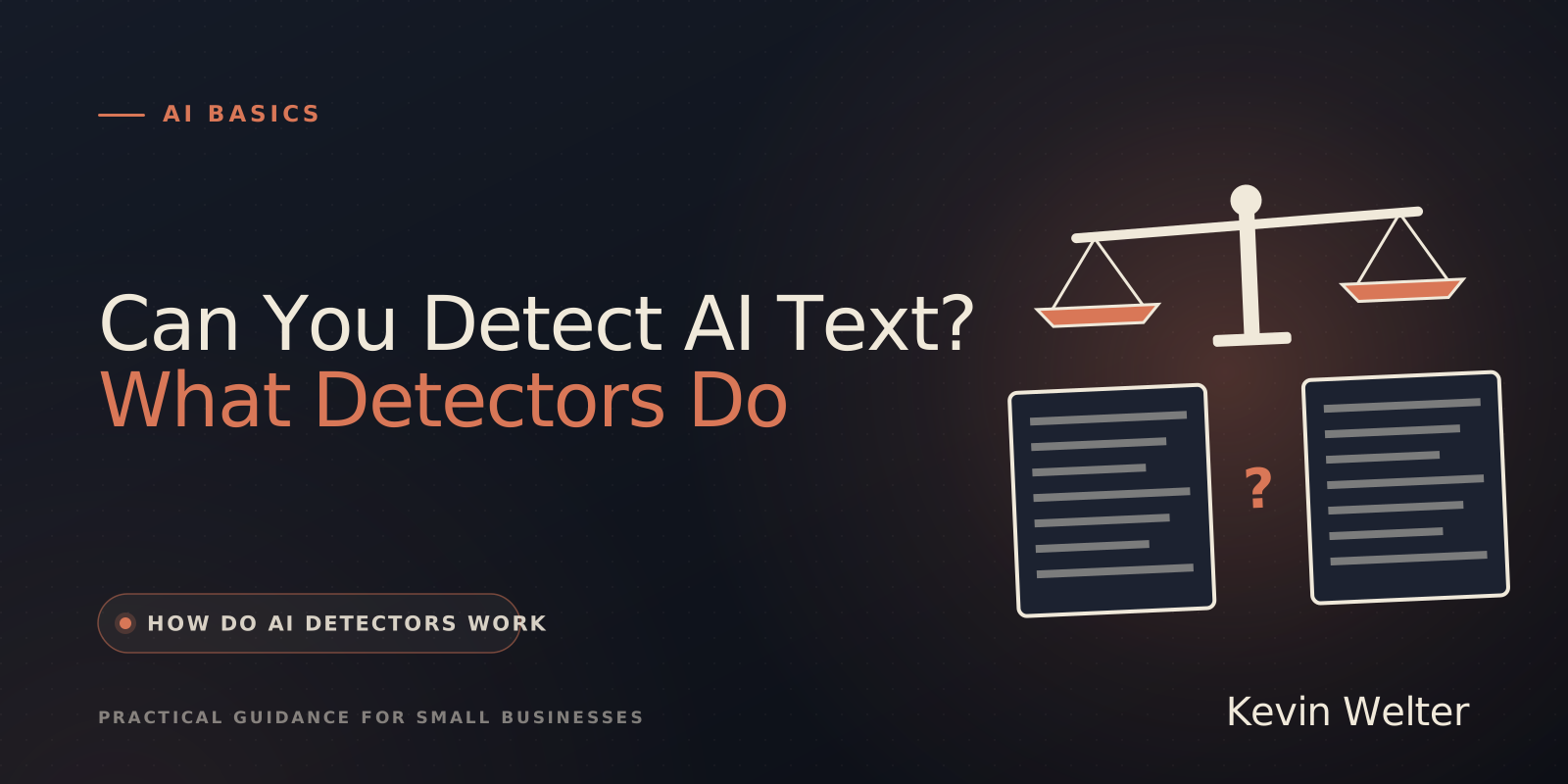
AI-written text cannot be reliably detected today, neither by people nor by tools. AI detectors give a probability, not proof: independent studies show that they wrongly flag human texts as AI and often miss AI texts that have been reworked. OpenAI, the company behind ChatGPT, switched off its own detection tool in 2023 because its accuracy was too low.
I work with Claude every day. My fifteen AI employees run on Claude Team, some also on open models or through the API. I have not run a detector test of my own. The figures in this article come from published studies and from OpenAI itself, all retrieved on 27 October 2026. All the basics about AI are collected on my AI Basics page.
There are two common designs. One is an AI model itself, trained on many pairs of human-written and AI-written texts; for a new text it estimates which group the text fits better. That is how OpenAI describes its own detector. The other measures how predictable a text is for a language model.
This measure is called perplexity: the more expected the word choice, the lower the value, and the more likely the detector is to treat the text as machine-written. The problem: people write predictably too, for example in a foreign language, on forms or in very factual texts.
A third approach is watermarking. Here the maker of the language model marks the text while it is being written, with an invisible pattern in the word choice. Google DeepMind has published such a method for text, called SynthID. A watermark only helps with texts from models that actually apply it, and Google itself writes that confidence can drop sharply when a text is thoroughly rewritten or translated.
The following results come straight from the publications:
| Source | What was tested | Result |
|---|---|---|
| OpenAI, 2023 | its own detector, English test texts | 26% of AI texts correctly identified, 9% of human texts wrongly labelled as AI; switched off on 20 July 2023 |
| Liang et al., 2023 (Stanford) | seven detectors, 91 essays by people for whom English is a foreign language | on average 61.22% wrongly labelled as AI; 89 of the 91 essays flagged as AI by at least one detector |
| Weber-Wulff et al., 2023 | 14 tools, two of them commercial | all below 80% accuracy, only five above 70%; for machine-paraphrased AI texts only 26% accuracy |
| Dugan et al., 2024 (RAID) | twelve detectors, over 6 million texts | easily fooled by targeted changes, different generation settings and unseen models |
The second finding matters most in practice. The same detectors identified essays by US school students as human almost without error. For people writing in a foreign language, on the other hand, they were mostly wrong. The researchers attribute this to simpler, more predictable word choice. When they had ChatGPT polish the language of the same essays, the error rate fell to 11.77%. They therefore explicitly caution against using detectors in evaluative or educational settings.
For context: the studies test tools from 2023 and 2024. Newer versions may do better or worse. According to the authors of the RAID study, many vendors advertise accuracy of 99% or more, but very few detectors are tested on shared, challenging benchmark data. An advertised figure is no substitute for an independent test.
OpenAI lists further limits for its detector that illustrate the principle well: very unreliable on short texts under 1,000 characters, significantly worse in languages other than English, and AI text can be edited so that the detector no longer recognises it.
Even without a tool there are clues. My own list for business emails includes these patterns, which are among the most obvious traces in AI drafts:
The full list is in Can AI Write Emails in My Voice?. Such patterns are clues, not proof. People sometimes write exactly like this, and if you give the AI a few of your own texts as a model, you get drafts without these traces. The Stanford researchers show the same for tools: a simple instruction to ChatGPT was enough to get past the detectors.
A more reliable clue than style is wrong or invented facts: a source that does not exist, a quote that appears nowhere. How to spot such inventions is explained in AI Hallucinations: Why AI Makes Things Up. But even that only proves the text is wrong, not who wrote it.
Not accurate enough to rely on. In the study by Weber-Wulff and colleagues, all 14 tools tested were below 80% accuracy. OpenAI switched off its own detector after it identified only 26% of AI texts and wrongly flagged 9% of human texts.
Yes. It hits people writing in a foreign language especially often: on essays by non-native speakers, seven detectors wrongly labelled an average of 61.22% as AI. OpenAI writes about its detector that it sometimes labels human text as AI incorrectly but confidently.
Most studies test English texts. OpenAI writes that its detector performs significantly worse in other languages. In the Weber-Wulff study, accuracy for human texts machine-translated into English from other languages dropped by 20%, according to the authors. My conclusion: for non-English texts, expect more errors rather than fewer.
It is possible, but you cannot see it: only the matching detection method finds a watermark. Google has published such a method for text with SynthID. After thorough rewriting or translation, detection can become much less certain, according to Google.
Not reliably. A chat such as ChatGPT or Claude is not built as a detector, and even specialised detectors are often wrong, as the studies above show. So do not ask the AI whether a text came from it; check whether the text is correct.
Next time you write a text with AI, give it two of your own texts as a model and then strike the patterns from the list above. Then read the text aloud: does it sound like you? How to turn your content into a presentation with AI is in How to Create a Presentation with AI. How AI is now changing Google Search as well is covered in my article on Google AI Mode. If several people on your team write with AI, a few shared rules pay off; what belongs in them is in AI Usage Policy for Small Teams. How others handle AI texts in their business is what I show in my community AI Employee Framework.
Shadow AI means your team uses AI tools the business never provided. Why it happens, the risks, and how to spot it and bring it under control.
Read the articleFree AI compared: what the free plans of ChatGPT, Claude, Gemini and Copilot can do, where their limits are and what they do with your data.
Read the article
Kevin Welter
Developer, IT architect, author of technical books (Kubernetes, cloud infrastructures) and speaker. Runs his business with an AI workforce of fifteen AI employees and shows solo business owners in his community how to hire their first AI employee.
Your first AI employee up and running within an hour
Join the community$5/month founding price, first 50 members