SkoolStats review in short: SkoolStats* is an independent analytics tool for Skool communities. According to the provider, you can filter more than 121,000 communities by language, category, price and size, see their member growth over a week, a month or three months, and open a history with one value per day for each community. It costs €149 a month or €1,499 a year, there is no trial, and according to its terms there are no refunds (as of October 2026). Its strength is comparison: prices and growth in a niche side by side, plus candidates for partnerships. The revenue column "Est. MRR", on the other hand, simply multiplies members by list price, which makes it an upper bound rather than revenue. It can be worth it while you are actively working on pricing, positioning or partnerships; for a one-off look, Skool's Discovery directory and free statistics pages are enough.
Full disclosure: SkoolStats provides me with the tool free of charge as part of a partnership, and I earn a commission through my link. I looked at it with questions about my own German-language community, Claude Practitioners: Where do I stand, who could I partner with, and what do others charge? Since my community shows up in the tables, this is not a neutral view. For the numbers in this article, Sebastian, my AI employee for SEO, used my account to analyze all 4,239 active German-language communities SkoolStats listed in October 2026.
* Affiliate link: if you subscribe through this link, I earn a commission. Your price stays the same. SkoolStats provides me with the tool free of charge as part of a partnership.
What SkoolStats is and where the data comes from
SkoolStats, which the provider also spells "Skool Stats", is a database of Skool communities with a web interface. In its own words, it watches "121k+ communities, updated daily" with more than 3.2 million data points, and according to its terms it uses only publicly available information from Skool. SkoolStats is not part of Skool; the provider says so itself. The language of each community is detected automatically.
What we saw: by default, the view only includes active communities with at least three members. On one day in October 2026, the tool reported 108,415 of them in the morning and 111,299 at midday. 4,013 of the 4,239 German-language records were from October 13 or 14. A community's history only starts once SkoolStats begins tracking it: my community was created on April 28, 2026, its history starts on May 22.
SkoolStats features at a glance
Once logged in, there are three menu items: Discover, Lists and Settings. The real work happens in Discover.
Feature
What it shows
Good for
Discover table
one row per community, columns selectable and sortable: overall and category rank, members, price, normalized monthly price, Est. MRR, posts, courses, modules, creation date
an overview of a niche
Filters
language, category, members, price, creation date, name, description and more
narrowing down, e.g. "German, Tech, paid"
Growth
change compared to one week, one month or three months ago, also sortable
seeing who is growing right now
Chart
up to ten communities over time, 7 days to 1 year, absolute or in percent
comparing competitors directly
Detail page
key figures, description and, under "Historical", one value per day for members, price and MRR
following a single community
Lists
your own lists to track communities over time
watching competitors or partners
There is also an email column for owner contact addresses; more on that below. The pricing page lists alerts, but we only found a "Rank changes" switch in Settings.
How to compare Skool communities: my test with Claude communities
I started with a simple search: "claude", language filter German, table view. In October 2026, it returned 30 results, 13 free and 17 paid. The 14 communities with a monthly price ranged from $8 to $98, with a median of $32. The two largest results each have more than 10,000 members and are free. My community ranks 17th of 30 with 101 members, and at $9 a month it sits at the low end of the price range.
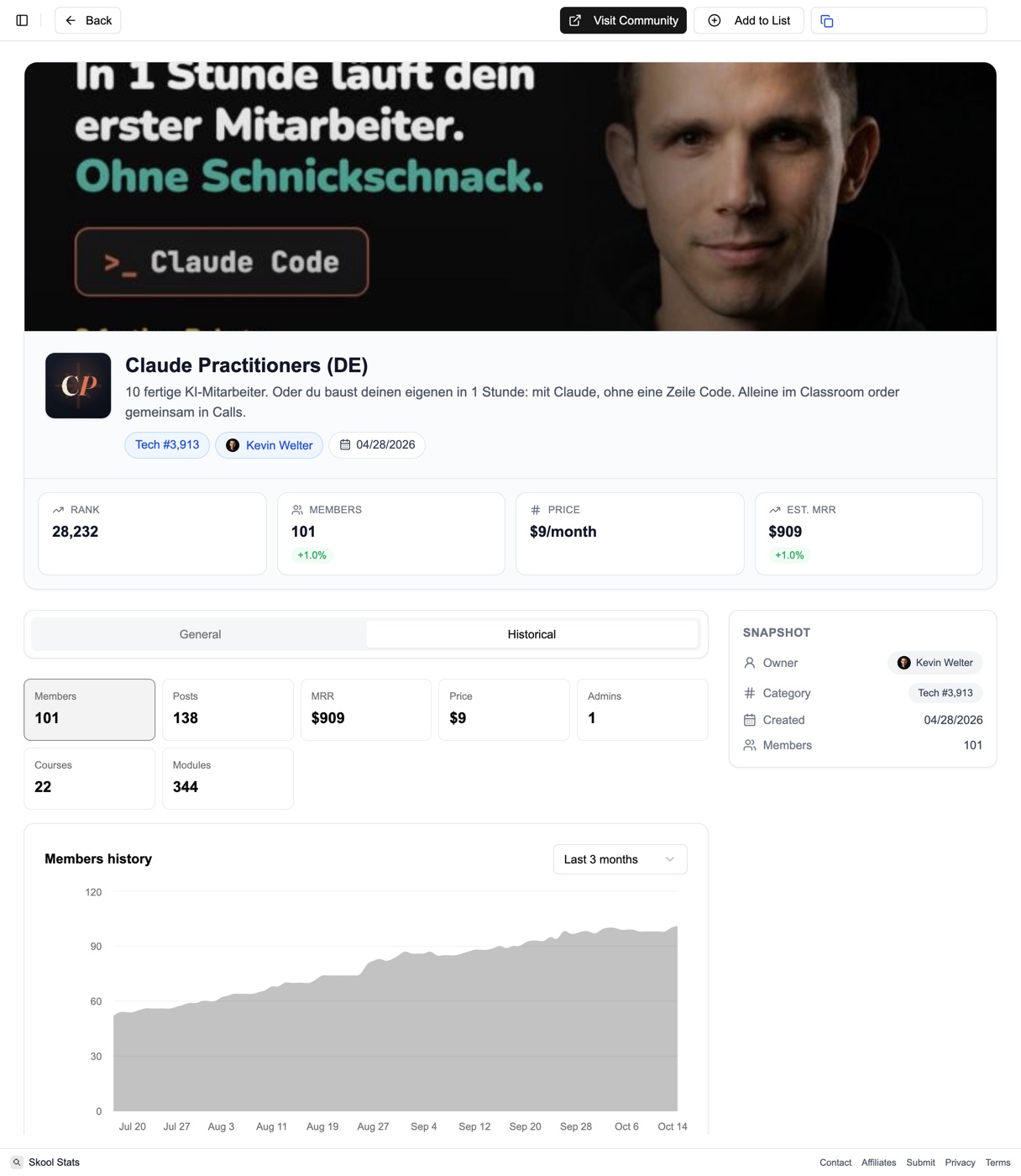
My own community in SkoolStats: key figures and member history over the last three months. Screenshot: SkoolStats, October 2026
According to its history, my community had 9 members on May 22, 2026, 62 on August 3 and 101 in October 2026. That is plus 98 percent in three months and plus 14.8 percent in the last month. Among the 342 German-language communities with an AI term in their name, it ranks 124th by members. Skool's own dashboard can't give me that context because it only knows my community. Which AI communities exist and what they cost is covered in AI Communities on Skool Compared, and the overview across all topics in German Skool Communities: Overview.
SkoolStats pricing and terms
Item
According to the provider, as of October 2026
Premium monthly
€149 a month, cancel anytime
Premium yearly
€1,499 a year, about €125 a month ("-16%")
Email lookups
200 a month included, €29 per additional 100
Agency
on request, with team access
Trial or free tier
none
From Germany, the pricing page showed us euros; the affiliate page calculates with $149. Without a subscription, you can only open one fixed example search: paid AI communities with more than 1,000 members. The terms say "ALL SALES ARE FINAL" with no refunds, and you need to cancel at least 24 hours before renewal. They date from summer 2025 and still mention $48 a month; what counts is the price shown at checkout.
Where SkoolStats reaches its limits
Est. MRR is an upper bound. According to the tooltip, it is "derived from member count and price". We recalculated it: it is exactly members times normalized monthly price for 1,040 of 1,044 paid German-language communities. The formula doesn't know about free legacy members, trials, cancellations or additional pricing tiers. In my case, the $45 premium tier is missing; it calculates 101 times $9. Where else the formula goes wrong, for example with one-time and placeholder prices, and why you shouldn't read estimates like this as revenue, I show with examples in How Much Do Skool Communities Make?.
Some data is old. In October 2026, 215 of the 4,239 German-language records were older than seven days, 189 older than 30 days, and the oldest dated from August 2025. Its terms say SkoolStats does not guarantee the information is current and advise you to verify it yourself.
Free-text search is fuzzy. It apparently searches descriptions too. Searching for "ki" (German for AI) with the German filter returns almost 700 results, including communities that only contain "Kinder" (children) or "Ski".
Owner emails: why I don't use that feature
SkoolStats looks up contact addresses of community owners at the click of a button, with 200 lookups a month included. I don't recommend this feature. In Germany, marketing emails without prior consent are generally not allowed under § 7 UWG (Act Against Unfair Competition), even between businesses; this is not legal advice. For partnership requests I only use channels owners invite you to use: the contact option on their website or, once I'm a member and we've already talked there, a personal message.
Who SkoolStats is worth it for, and who it isn't
More likely worth it
Less likely worth it
You are setting or changing your price
You only want to check how big one community is
You are looking for partners with a related topic and a similar size
You want to know what a specific community earns; no outside tool shows that
You track how competitors grow over several months
Your community is new, and pricing and positioning aren't on the table yet
You run several communities or advise owners
Your tool budget is well below €149 a month
For most small communities, that is a high price; one month with a clear question can bring more than a yearly plan running in the background. How I turn price data into a pricing decision is covered in How to Price Your Skool Community. If you want to try it with your own question: SkoolStats*, cancel anytime.
SkoolStats alternatives
Alternative
What it shows
When it's the right choice
Skool Discovery
Skool's own directory with search, categories and language filter, members and price per community, free
You want to know which communities exist for a topic and don't need history
Skool Game leaderboard
according to Skool, real-time leaderboards showing earnings by category, visible only to members of Skool's group Skoolers
You want to see what revenue Skool itself reports at the top, rather than estimates
Profitable
a freely readable statistics page on Skool communities, 48.1K communities according to the page, plus a revenue calculator
You need market figures at a glance, not the history of individual communities
Browser extension Skool Extensions
according to its add-on description, rank and daily growth right on a community's page, from an external ranking source
You want a quick sense of where a community stands while browsing Skool
Profitable also estimates revenue as price times members and calls it "an upper bound" itself.
Real numbers live in your own dashboard
SkoolStats doesn't replace Skool's own dashboard. There, according to Skool, you see your actual MRR excluding members on a free trial, plus cancellations, retention and sign-ups by source; see Skool Analytics: Reading Posts and Members. In my business, Susi, my AI employee, analyzes those numbers. SkoolStats is my outside view, Susi's analysis the inside view. The wider setup is in Community Management with AI Employees.
Frequently asked questions
How much does SkoolStats cost?
According to the pricing page, €149 a month or €1,499 a year, as of October 2026. That includes 200 email lookups a month; each additional 100 cost €29. There is no free tier or trial, only a fixed example search. According to the terms, there are no refunds, and you need to cancel at least 24 hours before renewal.
Is SkoolStats part of Skool?
No. According to the provider, SkoolStats is an independent tool and not affiliated with Skool. Its data comes, in its own words, from publicly available information on Skool, such as member count, price and description. That's why the tool cannot know what a community actually earns. Owners see that in Skool's own dashboard.
How accurate is Est. MRR in SkoolStats?
It is an upper bound, not a measurement. SkoolStats multiplies the member count by the normalized monthly price. Free legacy members, trials, cancellations and additional tiers are missing, and one-time prices are divided by twelve as if they were paid every month. For individual communities, the figure says little; for a rough market overview, the median is more useful.
Is there a free SkoolStats trial?
No, there is no trial. Without a subscription, you can open one fixed example search showing paid AI communities with more than 1,000 members. If you're unsure, start monthly and cancel in time, at least 24 hours before renewal, if it doesn't help you.
What is a good SkoolStats alternative?
Skool's own Discovery directory is free and shows member count and price per community. Revenue reported by Skool itself appears on the Skool Game leaderboard in the Skoolers group, for its members only. Profitable publishes freely readable market statistics, and the browser extension Skool Extensions shows rank and daily growth on community pages. SkoolStats adds filters and daily histories for many communities.
Where to go from here
Before you subscribe, write down one concrete question, for example: What do communities in my topic and language charge, and who is growing there right now? Check Skool Discovery and the example search first, for free, and then decide whether a month of SkoolStats* is worth it for you. How Susi analyzes my own community numbers and how my AI employees are built is what I show in my German-language community Claude Practitioners.
* Affiliate link: if you subscribe through this link, I earn a commission. Your price stays the same. SkoolStats provides me with the tool free of charge as part of a partnership.
Kevin Welter
Developer, IT architect, author of technical books (Kubernetes, cloud infrastructures) and speaker. Runs his business with an AI workforce of fourteen AI employees and shows solo business owners in his community how to hire their first AI employee.