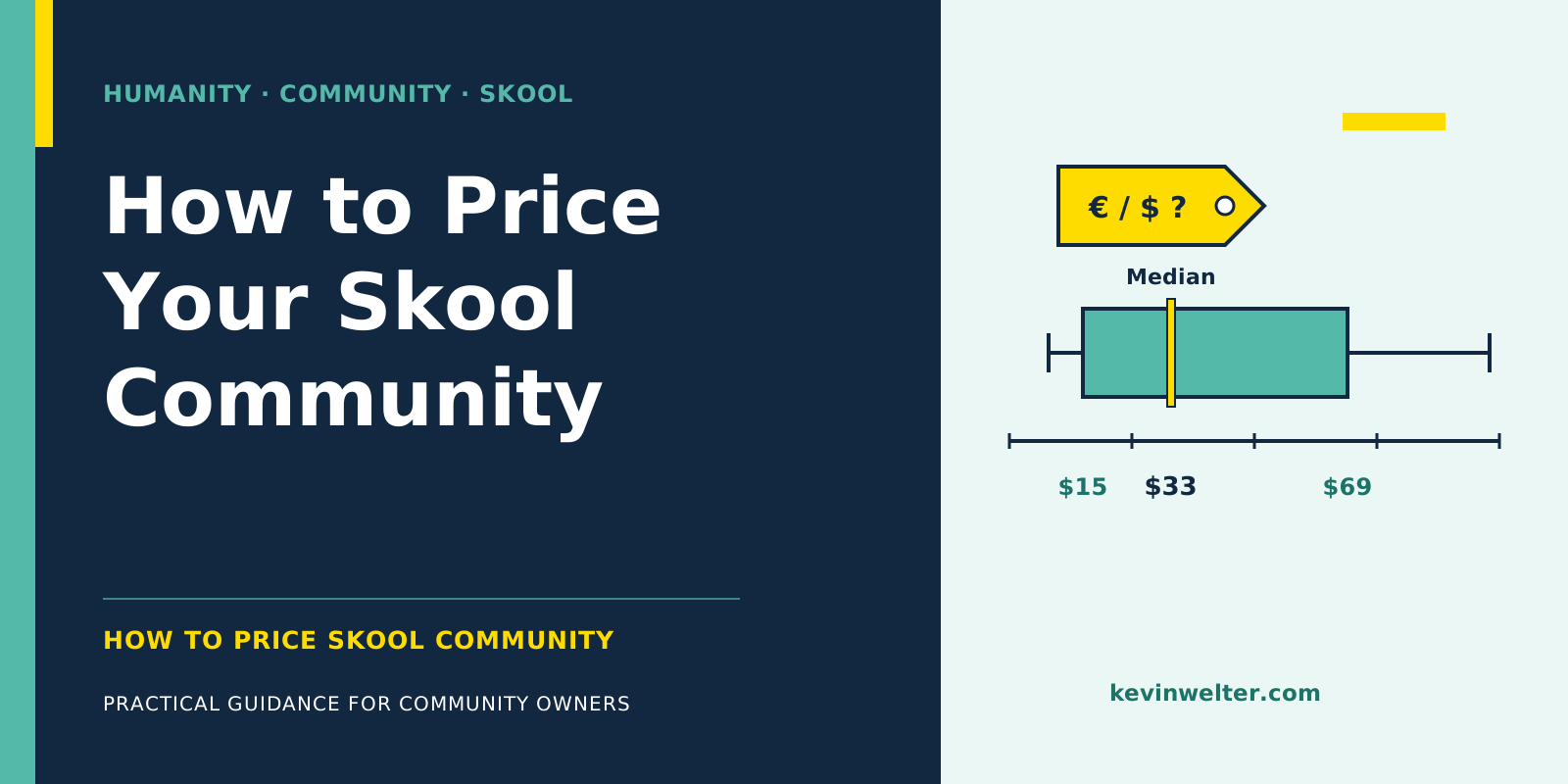
You set the price of your Skool community yourself; Skool doesn't suggest one. To see what others charge, I used SkoolStats* to pull all 4,239 German-language communities listed as active in October 2026. The data covers German-language communities only, the market my own community is in. Three out of four are free. The 890 with a monthly subscription charge a median of $33 a month, and the middle half sits between $15 and $69. Topic makes a difference: business and money communities have a median of $49, hobby communities $18. None of these numbers is a target for you, because they say nothing about what a community delivers for its price. How to price your Skool community comes down to three things: what you deliver every month, what comparable communities in your topic and language charge, and how much commitment you want from members.
My community Claude Practitioners was free from its launch on April 28, 2026 until August 16. Since August 17 it has been paid, today with two tiers at $9 and $45 a month, cancel anytime. I use SkoolStats free of charge as part of a partnership. What Skool charges you as an owner is in Skool Pricing: Hobby vs Pro and the Fees, and whether to charge at all is in Skool Community: Free or Paid?. This post is about the number on your About page.
* Affiliate link: if you subscribe through this link, I earn a commission. Your price stays the same. SkoolStats provides me with the tool free of charge as part of a partnership.
Skool community pricing: what German-language communities charge
This is a full count, not a sample: every community SkoolStats listed as German-language and active (three or more members) in October 2026. SkoolStats detects the language automatically; prices are in US dollars, as on Skool. SkoolStats counted about 111,000 active communities across all languages that day, so German-language ones are roughly 3.8%.
Metric
Value
Active German-language communities
4,239
Free
3,195 (75.4%)
Paid
1,044 (24.6%)
Paid, monthly subscription
890 (85.2% of paid)
Paid, annual subscription
53 (5.1%)
Paid, one-time price
101 (9.7%)
Median monthly price (monthly plans only)
$33
Lower and upper quartile
$15 and $69
The median is the middle value: half of the monthly plans cost up to $33, the other half from $33 up. I'm not giving you an average on purpose: a few communities list placeholder prices of up to $100,000 a month, for example for offers that can no longer be booked. That distorts an average but barely moves the median.
Skool membership price by category
SkoolStats lists each community under the category it has on Skool. The five largest categories among German-language communities, monthly plans only:
Category
Paid (share)
Monthly plans
Lower quartile
Median
Upper quartile
Money
281 (23.4%)
229
$19
$49
$99
Self-improvement
255 (26.7%)
223
$18.50
$33
$68
Health
146 (24.5%)
134
$13.25
$29
$48
Tech
130 (27.4%)
110
$10.25
$29
$85.25
Hobbies
74 (20.8%)
61
$9
$18
$33
All categories
1,044 (24.6%)
890
$15
$33
$69
The share of paid communities is similar across the large categories, between about 21 and 27%. In four of the five categories the gap between the quartiles is wider than the gap between the category medians. In Tech, the lower quartile is about $10 and the upper one above $85. Category alone says little about your price.
A topic narrows it down: for AI communities, those with an AI term in their name, the median of the 91 monthly plans is $39. A SkoolStats search for "Claude" filtered to German returned 30 communities, 13 of them free. The 14 with a monthly price ranged from $8 to $98, with a median of $32. The full picture is in AI Communities on Skool Compared.
Monthly, annual or one-time: the pricing models
According to Skool's help center there are five pricing models: free, subscription (monthly or annual, optionally with a 7-day free trial), freemium with a free and a paid plan, tiers with several paid plans, and one-time payment. Skool names one-time payment as a good fit for lifetime access courses, pop-up groups and seminars.
Among German-language communities the monthly subscription clearly dominates. Annual and one-time prices are rare and sit at a different level:
Pricing model
Communities
Median price
Per month
Monthly
890
$33
$33
Annual
53
$982 a year
$81.83
One-time
101
$640
no monthly price
Be careful when comparing: in its "Normalized Price" column SkoolStats divides annual and one-time prices by twelve. That's correct for annual plans, but a one-time payment doesn't recur every month. Compare monthly plans with monthly plans and read one-time prices separately.
A monthly plan keeps the barrier to join low. An annual plan fits a topic that takes time to pay off, a one-time price fits a program with a fixed end. With small monthly prices, Skool's 30 cents per transaction weigh more; the math is in Skool Pricing: Hobby vs Pro and the Fees.
Price and size: what the data shows and what it doesn't
Free communities have almost twice as many members at the median as paid ones: 42 versus 23. Of the 145 German-language communities with at least 1,000 members, 132 are free. Among paid communities, however, size barely differs by price:
Price per month
Communities
Median members
Under $10
172
23
$10 to $29
280
20
$30 to $49
183
24
$50 to $99
179
22
$100 and up
129
24
One-time price
101
28
Annual prices are divided by twelve here. This is a correlation, not a cause; one possible explanation is that large communities are often a free entry point for an offer outside Skool.
Four limits to keep in mind before you apply these numbers to yourself:
One price per community. SkoolStats doesn't capture tiers, freemium or discounts. For my community it only has the $9 tier; the $45 tier is missing.
List price, not price paid. Members who joined for free earlier are part of the member count, as are inactive members. According to Skool, existing members keep their current price when you change it, even if that price is free.
No deliverables. $33 for a feed is different from $33 with weekly calls. What a community delivers is on its About page, not in the database.
Automatic language detection. Mixed-language communities may be misassigned, and 215 records were more than a week old.
Tiers and free trials
Tiers solve a problem a single price can't: some members want to learn, others want guidance. In my case, Standard at $9 is for learning on your own. Premium at $45 adds all AI employees as ready-made templates, the implementation call, the hot seat and all recordings: different deliverables, not more of the same.
Freemium, a free and a paid plan in the same group, fits when the free group is your entry point.
According to Skool you can offer a 7-day free trial on subscriptions. In Skool's analytics, members on a trial count toward your member number but not toward MRR. Whether trials turn into paying members is shown under "Monthly Free Trials". How to read it is in Skool Analytics: Reading Posts and Members.
My price in comparison: $9 and $45
Claude Practitioners ran free for three and a half months and has been paid since August 17, 2026, announced in the community one week ahead. My reason in one line, translated from German: "Free means non-committal. And non-committal doesn't hire an employee." Why I switched and what it means for members is in Skool Community: Free or Paid?.
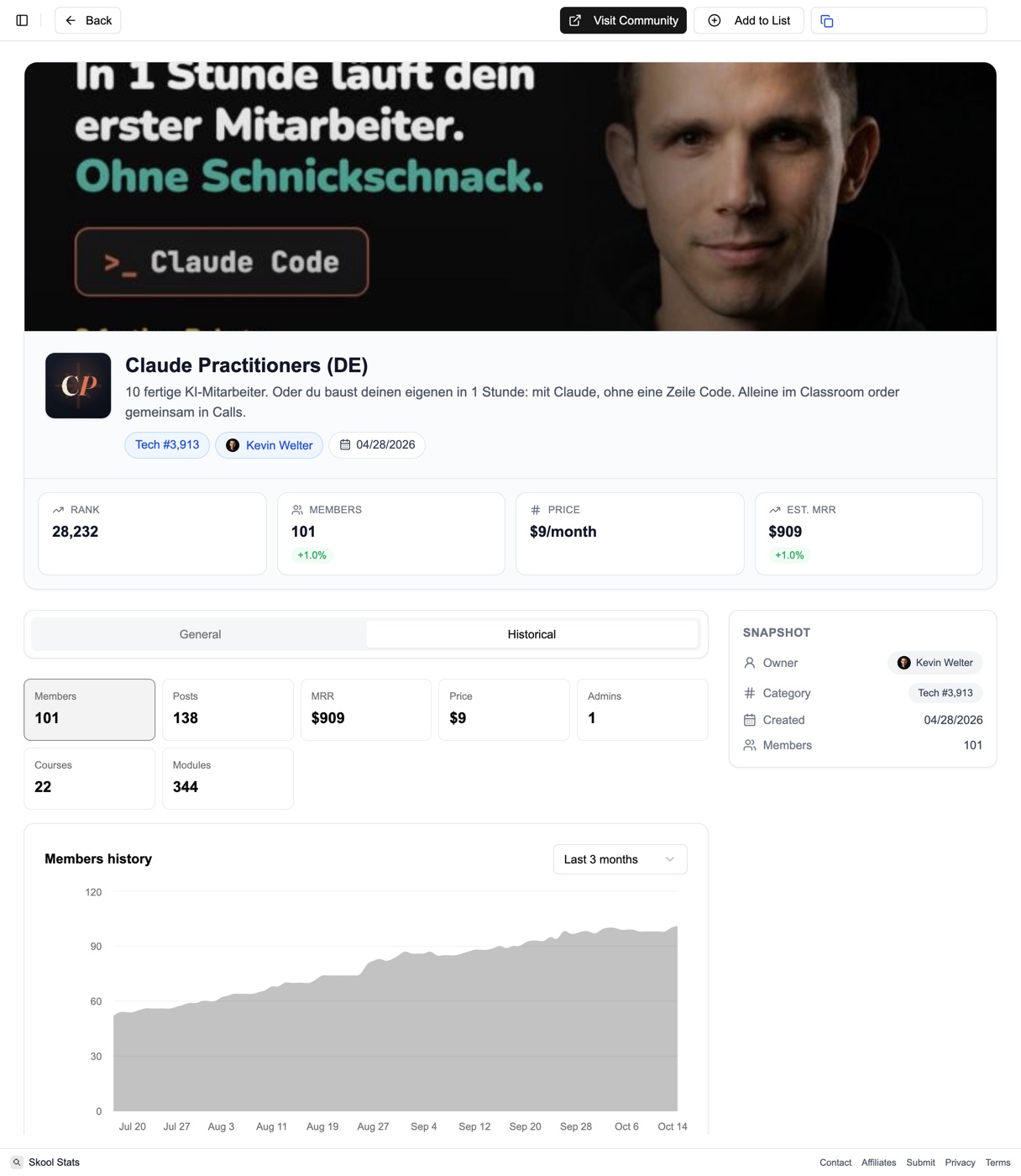
My community in SkoolStats. "Est. MRR" is an estimate of members times $9, not revenue. Screenshot: SkoolStats, October 2026
In SkoolStats, the $9 price appears from August 18, at 72 members back then. In October 2026 there were 101. How many pay, the tool can't tell: anyone who joined for free before is counted at $9. At $9, my Standard tier is in the lowest quarter of German-language AI communities with a monthly plan; at $45, my Premium tier is a little above their $39 median. Why revenue estimates can be off is in How Much Do Skool Communities Make?
How to price your Skool community in five steps
A workable Skool pricing strategy fits into five steps.
1. Write down what you deliver. List what a member gets every month: calls, answers, templates, new lessons. A short list argues for a low price or free; a long one that costs you time needs a price.
2. Build a comparison group. Find 10 to 30 communities on your topic in your language. In SkoolStats* you filter by keyword, language and category and sort by price or members. Note the median and range, split by pricing model. Then open the About pages of the five most similar ones and write down what they deliver for their price.
3. Position yourself. Decide whether you sit below, at or above the median of your comparison group, and write the reason in one sentence: something you deliver that others don't, or an audience that can pay more or less. "Everyone else charges that" isn't a reason.
4. Pick a structure. One price or tiers, monthly, annual or one-time, with or without a trial? Tiers pay off when you have two clearly different offers. Keep VAT in mind: for members in the EU, Skool adds it at checkout, so $9 becomes $10.71 in Germany.
5. Announce, test, measure. According to Skool, existing members keep their current price by default; in my community, everyone from the free phase still pays nothing. Announce any change in good time anyway. I announced my switch one week ahead. Then watch About page conversion, trial starts and cancellations for four to eight weeks before changing anything again.
Comparing with and without SkoolStats
Without a tool, you find prices in Skool's Discovery directory and on About pages, enough for five to ten comparisons. What's missing: a language filter, the median across a whole topic, growth over weeks and months, and price history.
SkoolStats is an independent tool and not part of Skool. According to its pricing page it costs €149 a month or €1,499 a year, with no free tier and no trial (as of October 2026). Without an account there's a fixed example search of paid AI communities with more than 1,000 members. What else the tool does and where it gets things wrong is in SkoolStats Review: Skool Benchmarks. How I split the rest of the community work with my AI employees is in Community Management with AI Employees.
Frequently asked questions
How much should I charge for my Skool community?
Whatever your deliverables can carry. Build a comparison group of 10 to 30 communities on your topic and in your language, note the median and range, and decide with a stated reason where you sit. Then measure conversion, trial starts and cancellations for four to eight weeks.
What is the average Skool community price?
Among the 890 German-language communities with a monthly plan, the median is $33 a month (SkoolStats, October 2026), with the middle half between $15 and $69. Annual plans have a median of $982 a year, one-time prices $640. Three out of four German-language communities are free. I don't have a reliable figure for all languages.
Do cheaper Skool communities grow faster?
Not that the data shows. Paid German-language communities have a median of 20 to 24 members whether they cost under $10 or over $100 a month. Free communities have almost twice as many members at the median. That's a correlation, not a cause.
Monthly, annual or one-time pricing?
Among German-language paid communities, 85% bill monthly, 5% annually and just under 10% one-time. Monthly keeps the barrier to join low, annual fits topics that take time. Skool names one-time payment as a good fit for lifetime access courses, pop-up groups and seminars.
How much of the Skool membership price do I keep?
Skool's own example: at $9 a month you keep $8.40 after fees on the Pro plan and $7.80 on Hobby. For members Skool brings you through its own network, the Growth Boost commission comes off on top. For members in the EU, Skool adds VAT on top of your price rather than deducting it. Details in Skool Pricing.
Where to go from here
Take half an hour for steps 1 and 2: write down what you deliver and find five communities on your topic in your language, with price and deliverables. If your community doesn't exist yet, you set the price when you create it on Skool*. For feedback on your price, post it in my community Claude Practitioners. The community itself runs in German.
* Affiliate links: if you subscribe through the SkoolStats link, I earn a commission; SkoolStats also provides me with the tool free of charge as part of a partnership. If you create your own Skool community through the Skool link, Skool pays me a commission. What you pay SkoolStats or Skool stays the same.
Kevin Welter
Developer, IT architect, author of technical books (Kubernetes, cloud infrastructures) and speaker. Runs his business with an AI workforce of fourteen AI employees and shows solo business owners in his community how to hire their first AI employee.