Credit card reconciliation means matching every line on a card statement to a receipt and a business purpose, checking that the lines add up to the statement balance, and flagging whatever does not fit: a missing receipt, a private purchase, a receipt with errors. An AI employee can do that groundwork and, on a business trip, prepare the expense report around it. Booking, paying out and the tax assessment stay with a human. I had Peter, my AI employee for receipts, work through a test case: an invented trip from Saarbrücken to Munich with seven sample receipts and a card statement with nine lines. After just over eleven minutes (one run, not a benchmark) the expense table, the reconciliation and seven open items were done, including all three hidden errors. The payout came to 11.20 euros.
To be clear: this was a test with sample receipts, not my day-to-day bookkeeping. Day to day, Peter has been matching my credit card statement line by line against the receipts since August 19, 2026. His page lists "pre-sort travel expenses" among other possible uses; he does not perform those additional steps until they have been taught, tested and approved. The test follows German tax law, where my business runs; the rates are explained in Per Diem Germany 2026: Rates and Template. This is an example under the provisions cited and not tax advice for your case.
The test case: one trip, seven receipts, one card statement
Everything is invented, and every receipt is stamped "BEISPIELBELEG" (sample receipt). The employee, Erika Muster, leaves on October 27, 2026 at 6:40 a.m., drives to the station car park, takes the train to Munich and a taxi to the client, has dinner with two people from the client, stays one night and is back home on October 28 at 7:30 p.m. Everything is paid with the company card.
Receipt
Amount
Detail
Online train ticket, return
€179.80
no card ending shown
Taxi, main station to client
€24.60
no card ending shown
Printing at a copy shop
€11.90
Client dinner: bill plus purpose and attendees
€134.50
food 7%, drinks 19% VAT
Hotel, one night with breakfast
€137.00
invoiced to the company
Taxi, hotel to station
€19.80
no date, no VAT rate
Station car park
€24.00
Peter also got the card statement as CSV with nine lines, two without a receipt (€3.90 at a ticket machine, €34.99 at a toy shop), the trip details and the company's travel expense rules. The expected result was fixed before the run; Peter didn't know it.
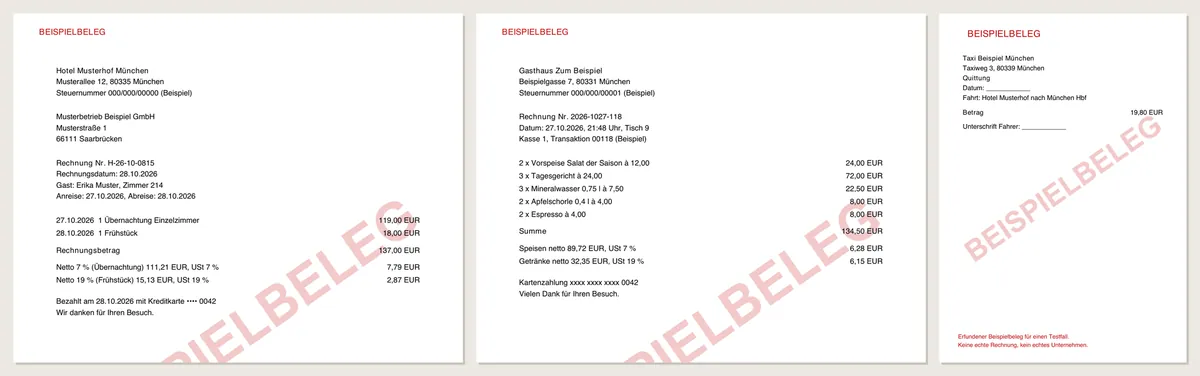
Three of the seven sample receipts (in German). The one on the right is the faulty one: no date, no VAT rate. Test case of 04.11.2026, all details invented
How Peter runs the reconciliation
There is no approved expense process for Peter yet, so the rules from his card reconciliation applied. The run in six steps, as his log records it:
Full text, not eyeballing. Numbers come only from the extracted text. For the undated taxi receipt he also checked the image for a handwritten date. There was none.
Control total first. The nine card lines add up to €570.49, exactly the statement balance.
Renaming. Pattern: date, sender, document type, subject, amount, number. The faulty taxi receipt is named "ohne Datum …" (no date), because the card booking date is not the receipt date.
Expense table. Gross, net, VAT and rate per receipt, plus per diems and the client dinner.
Matching. Two paths: the card ending is printed on the receipt, or amount, date and merchant fit exactly one statement line. If the two paths disagree, the line stays open.
Checking and handing over. Cross-checking net plus VAT, he caught and fixed two of his own subtotal typos; then a script checked his tables against the full texts. Finally, a separate reviewer compared the result with the expected one: 31 of 31 values matched.
The result: costs and per diems
Item
Gross
Net
VAT
Train, 7%
€179.80
€168.04
€11.76
Taxi to client, 7%
€24.60
€22.99
€1.61
Printing, 19%
€11.90
€10.00
€1.90
Client dinner, food, 7%
€96.00
€89.72
€6.28
Client dinner, drinks, 19%
€38.50
€32.35
€6.15
Room, 7%
€119.00
€111.21
€7.79
Breakfast, 19%
€18.00
€15.13
€2.87
Taxi to station
€19.80
open
open
Parking, 19%
€24.00
€20.17
€3.83
Total with receipt
€531.60
The rates match German VAT law (as of November 2026): 7 percent for rail, taxis up to 50 kilometers, the room and, since January 1, 2026, restaurant food; 19 percent for breakfast and drinks (section 12 (2) nos. 10, 11 and 15 of the VAT Act, UStG).
Arrival and departure day of a trip with an overnight stay get 14 euros each (section 9 (4a) Income Tax Act, EStG, as of November 2026). Each meal the employer provides cuts it: 5.60 euros for breakfast, 11.20 for lunch or dinner, also when the employee attends a business meal the employer pays for (Ministry of Finance letter on travel expenses, para. 82).
Day
Per diem
Deduction
Result
Oct 27, arrival
€14.00
dinner at the client meal, company card: €11.20
€2.80
Oct 28, departure
€14.00
breakfast on the hotel invoice to the company: €5.60
€8.40
Total
€28.00
€16.80
€11.20
The 11.20 euros are the payout to Erika Muster, because everything else went through the company card and is not reimbursed twice. For the client dinner, Peter split the net amount of €122.07: 70 percent, €85.45, is deductible as a business expense, €36.62 is not (section 4 (5) sentence 1 no. 2 EStG). The input VAT of €12.43 stays deductible (section 15 (1a) sentence 2 UStG). He checked that purpose and attendees were on the receipt instead of assuming it. What a German business meal receipt must contain is covered in Business Meal Receipts in Germany: Template.
Credit card reconciliation line by line: six of nine clear
Four receipts show the card ending, so the match was certain (€307.40). The train ticket and the first taxi matched on amount, date and merchant (€204.40). Open: the second taxi and the two lines without a receipt, €58.69. The two rides with the same taxi company were told apart by amount.
Before reporting "receipt missing", Peter searched all full texts for amount and merchant.
What the human decides
Peter's list had seven items, the three hidden ones first:
€34.99 at a toy shop, no receipt, no business purpose. Peter doesn't infer "private" from a merchant name; under the company rule that is the bookkeeper's call. Options: ask for a receipt, have it repaid as private (offset against the payout, she pays back €23.79), or accept it as business.
€3.90 at a ticket machine, no receipt. Hand in the ticket, accept a self-made receipt, or treat it as private.
Taxi receipt for €19.80 with no date and no VAT rate. An invoice up to 250 euros needs, among other things, issue date and VAT rate (section 33 UStDV). Peter didn't fill in a rate; that would have been a guess. Options: request a replacement, or accept it without input VAT.
Plus four questions nobody had planted: other meals provided, the drive to the car park (the test rules lacked a mileage rate), whether the dinner was reasonable, and payout approval. None is a calculation: the machine prepares, the human decides at fixed points. More in Human in the Loop: Meaning and Examples.
The prompt to rebuild it
This was the brief to Peter; you can rerun it with your own AI agent:
Here is [name]'s trip to [destination] on [dates]. The folder [path] holds the
receipts, the card statement as CSV, the trip details with departure and
return times, and our travel expense rules. Read every receipt in full text,
rename it as "YYYY-MM-DD sender document-type subject amount number", build
the expense table with gross, net and VAT, calculate the meal allowances with
all deductions and the client dinner at 70 percent, check that the statement
lines add up to the balance, then reconcile the card statement line by line.
Give me a list of everything I need to decide. Don't book anything and don't
guess.
It shows that Peter's reconciliation rules carry over to an expense report: control total first, two matching paths, never force a match. It doesn't show how real receipts go: the samples have a clean text layer, real scans often don't. And one point Peter only noted instead of flagging: the parking receipt has no issue date of its own; read strictly under section 33 UStDV, that is a fourth defect. Before Peter takes over travel expenses, he needs a trained process, tests with real receipts and an approval. What bookkeeping software can do on its own is covered in AI Bookkeeping: What Actually Works Today, storage in Digital Receipt Filing That Holds Up.
Frequently asked questions
Can AI do credit card reconciliation?
The matching part, yes: read receipts, check the control total, match each line. In the test all 31 checked values were right. Whether something is private or a faulty receipt is good enough, a human decides.
Is the German per diem reduced when I take a client to dinner?
Yes, if your employer pays for the meal and you attend: by 11.20 euros for lunch or dinner (Ministry of Finance letter on travel expenses, para. 82, as of November 2026). If a business partner invites you, there is no deduction.
What happens to a receipt without a date?
It stays open. Peter matched the taxi receipt to its statement line but added neither date nor VAT rate.
Does Peter book the expenses afterwards?
No. His process covers matching and reconciling; final approval stays with me and my accountant.
What to do next
Put the receipts, card statement and travel rules of your last trip in one folder, give your agent the prompt above and compare its result with your own calculation.
How Peter was trained, with a written process description, a learning mode and approval, I show in my community AI Employee Framework.
Kevin Welter
Developer, IT architect, author of technical books (Kubernetes, cloud infrastructures) and speaker. Runs his business with an AI workforce of fourteen AI employees and shows solo business owners in his community how to hire their first AI employee.