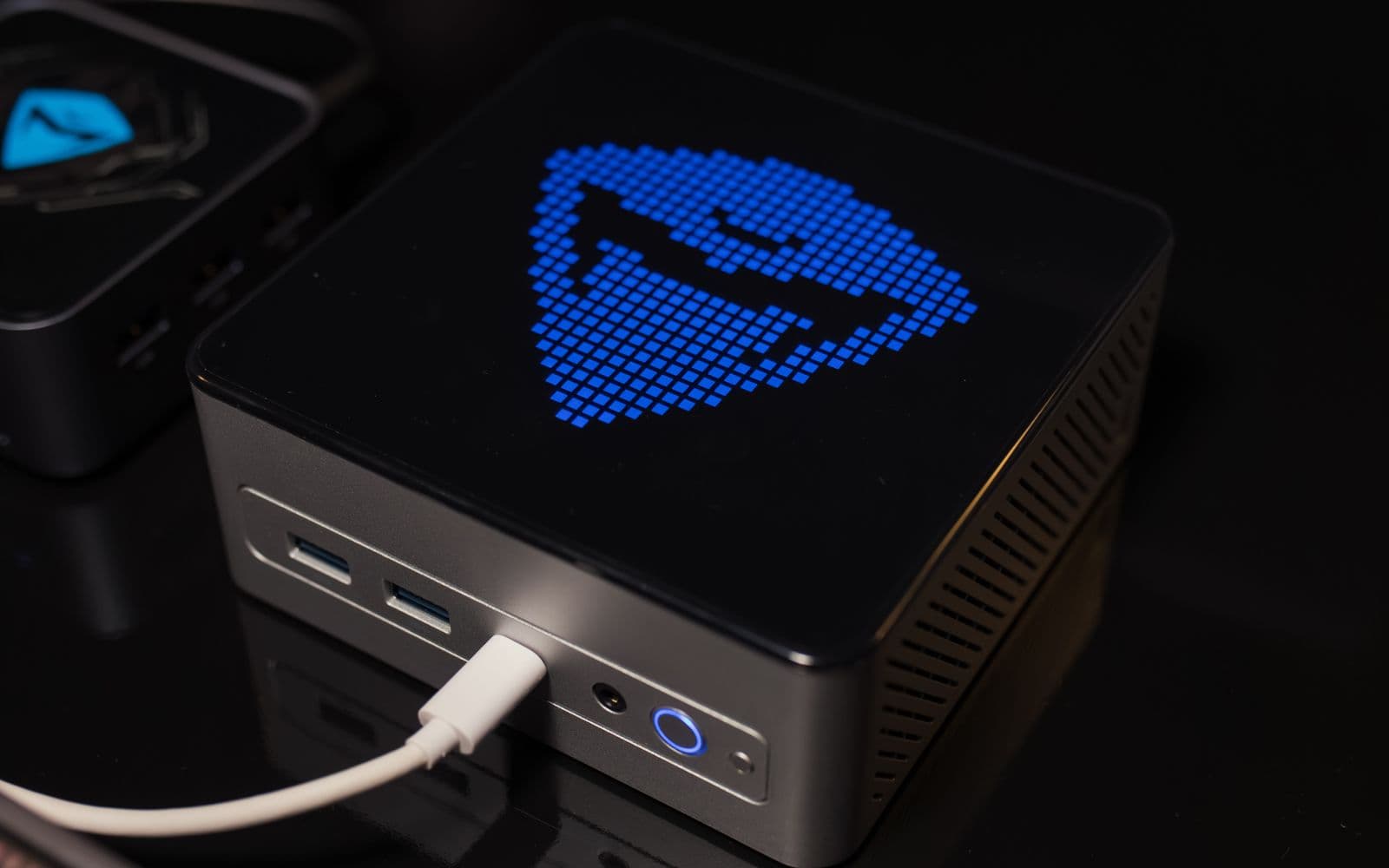
If you want to buy a DGX Spark, Nvidia's Founders Edition has a list price of 4,699 US dollars according to Nvidia, as of September 2026, and a German reseller lists it at 5,180 euros net, in stock (Nelpx, retrieved 16 September 2026). Eight identical partner variants differ only in SSD, case and support, some of them cheaper, such as the ASUS Ascent GX10 from 4,889 euros on Geizhals, as of 16 September 2026. The serious alternatives are a Mac mini, a Mac Studio and a GPU server of your own; which one fits depends not on the price but on the size of the model you want to run permanently.
I ordered the DGX Spark directly from Nvidia in December 2025 and run Qwen 3.8 with 27 billion parameters on it under SGLang, measured at 50.7 tokens per second. Day-to-day experience is in DGX Spark Tested: Worth Buying?. This post is the buying decision: prices with sources, variants, alternatives, successor. Everything on local AI is on my AI page.
What you get when you buy a DGX Spark
The DGX Spark is a 150 by 150 millimeter desktop box weighing 1.2 kilograms, built around the GB10 Grace Blackwell Superchip. Per Nvidia's product page, retrieved 16 September 2026: 20 Arm cores, 128 GB of LPDDR5x unified memory at 273 GB/s, a self-encrypting 4 TB NVMe drive, ConnectX-7 networking at 200 Gbit/s, one 10 gigabit Ethernet port, a 240 watt power supply and a 140 watt TDP for the chip. Nvidia quotes up to 1 PFLOP of FP4 compute.
The number that matters is the memory. CPU and GPU share one pool, and 128 GB holds a single model with 27 to 70 billion parameters plus context without wiring graphics cards together. My system reports around 119 GB as usable. The second figure, 273 GB/s of bandwidth, sets the response speed, where a Mac Studio and dedicated graphics cards beat the Spark.
What you do not get: a training server; the Spark is built for inference and development. The product page names no price and points to Amazon, Micro Center and PNY as retailers and seven OEM partners.
DGX Spark price: list price, euro offers and contradictions
The Founders Edition list price is 4,699 US dollars according to Nvidia, as of September 2026. At launch it was 3,999 US dollars; Nvidia announced the roughly 18 percent increase in February 2026 in its developer forum and attributed it to industry-wide memory supply constraints. A two-unit bundle is listed at 9,449 US dollars per enverge.ai (23 July 2026); Nvidia's Marketplace was unreachable for me on 16 September 2026, so that figure rests on a third party.
In euros, as of 16 September 2026: the German reseller Nelpx lists the Founders Edition with 4 TB at 5,180 euros net, no gross price shown. For the trend: on 4 August 2026 gewusst-ki.de quoted an RRP of 3,949 euros net and 3,683 euros net at Alternate. Those figures sit below today's price; I cannot document why. Expect roughly 3,700 to 5,200 euros net depending on timing and reseller, and check before you order.
For context, what I paid: I ordered the Spark directly from Nvidia in December 2025 for roughly 4,000 to 4,200 euros. That was my price back then, not an offer today; it sits in the lower part of the range above. For your own budget, what counts is Nvidia's list price, as of September 2026, and your reseller's price on the day.
For the partner variants the sources contradict each other, and I would rather say so than pick one. Dell lists the Pro Max with GB10 (128 GB, 4 TB) at 8,224.39 US dollars on 16 September 2026; third parties quote 5,688 to 6,000 US dollars (aicybr.com, 10 August 2026) or 3,699 to 3,999 US dollars (insiderllm.com, August 2026) for the same machine. Configuration and promotions are the likely reason. Take manufacturer prices from the configurator, not from comparison articles.
Founders Edition or partner variant: eight systems
Per macmyths.com (10 August 2026) there are eight official GB10 systems, all with 128 GB of unified memory and the same chip. The differences are SSD, case and support: ASUS Ascent GX10 with 1, 2 or 4 TB, Dell Pro Max and HP ZGX Nano with 2 or 4 TB, Lenovo ThinkStation PGX and MSI EdgeXpert with 1 or 4 TB, plus the Acer Veriton GN100 and the Gigabyte AI TOP ATOM. The Founders Edition ships with 4 TB.
US partner prices per insiderllm.com, August 2026, with no manufacturer site checked but Dell: ASUS 3,099 to 4,150, MSI 2,999 to 3,999, Acer 3,999, Gigabyte 4,662, Lenovo 4,100 to 5,079 and HP 6,030 US dollars. In Germany the ASUS Ascent GX10 with 1 TB is the most widely listed: 27 Geizhals offers from 4,889 to 6,104.19 euros, as of 16 September 2026.
My recommendation: SSD size matters more than the brand. A 27B model as an NVFP4 checkpoint takes 21.9 GB on my machine, a 70B model several times that, plus Docker images and further checkpoints. 1 TB works; with 4 TB you never clean up. I have not compared support terms; for a company with procurement, the familiar supplier can decide it.
Three alternatives: Mac mini, Mac Studio, GPU server
The Spark competes less with other GB10 boxes than with three other routes to a local model. Table prices are entry prices with sources, September 2026.
The Mac figures come from Apple's specifications and its Mac Studio announcement of 25 August 2026; the euro prices are ComputerBase's from the same day. The Mac mini tops out at 64 GB: a 27B model in 8-bit fits, a 70B model with context does not. The Mac Studio M5 Ultra, with 1.2 TB/s and up to 256 GB, offers more speed and room than the Spark, at the price of roughly two Sparks. What the Mac can do in detail is in Local AI on a Mac: Mini as AI Server.
The GPU server is the route with the most performance per euro and the most effort. insiderllm.com: models up to 24 GB run faster on a single graphics card than on any mini PC in this class. Once the model outgrows one card, it gets expensive and loud. A calculation with new parts and electricity is in Your Own AI Server: Hardware and Cost.
Why I bought one and what I measure
My question in December 2025 was not "do I need more compute" but "can I run a 27B model locally and permanently, reachable from all my devices, with no request going through a cloud API". My MacBook Pro M3 Max with 64 GB loads the model, but at 11 tokens per second in LM Studio (8-bit, 27.5 GiB RAM) it was too slow for agent work.
On the Spark, Qwen 3.8 with 27 billion parameters runs as a 21.9 GB NVFP4 checkpoint under SGLang, following the hasso5703/dgx-spark-qwen38 repo, the official SGLang cookbook recipe since 21 August 2026. I measured 50.7 tokens per second for decode (300 tokens, one stream, from the Mac via Tailscale) and around 1,500 tokens per second for prefill. vLLM as an alternative gave 24 to 26 tokens per second. The measurements and the setup are in Qwen 3.8 Locally: DGX Spark Experience.
Two things appear in no spec sheet. First, the unified memory trap: pin more than half of the memory for SGLang (--mem-fraction-static above 0.50) and you risk the host freezing, because CPU and GPU share one pool. Second, the waiting: the first server start takes around 9 minutes because of compilation, then 5 to 7 minutes, and at roughly 2 MB/s at my location a 70 GB download takes hours. Neither argues against buying; both argue for a free first day.
Clustering: what is official and what tinkerers show
If one machine is not enough, you couple several Sparks via the ConnectX-7 ports. Nvidia's product page speaks of up to four systems for models up to 700 billion parameters. The Nvidia clustering documentation describes up to three machines cabled directly or four via a switch, at 200 Gbit/s per QSFP port with approved cables from Amphenol and Luxshare. Notebookcheck reported on 23 February 2026 an eight-machine cluster running Qwen 3.5 with 397 billion parameters at 24 tokens per second, and wrote that officially only a direct link of two machines is intended.
Three sources, three ceilings and a hobbyist proof for eight: two machines on a direct cable are the documented normal case, beyond that you depend on community guides. For me, one machine was the answer.
Successor: DGX Spark 2 or RTX Spark, wait or buy
No DGX Spark 2 is announced, per macmyths.com on 10 August 2026. What Nvidia presented at Computex 2026 is called RTX Spark: a 20-core Grace CPU with a Blackwell RTX GPU and 6,144 CUDA cores, up to 128 GB of unified memory, in laptops from 14 millimeters thick and in desktops from ASUS, Dell, HP, Lenovo, Microsoft Surface and MSI, on Windows, due in autumn, no price. Chip names and prices circulate only as leaks, not from Nvidia. There is no "DGX Spark laptop"; anyone searching for one means RTX Spark.
Whether to wait comes down to one question: if you need Linux with CUDA, Docker and SGLang as the DGX Spark ships it, RTX Spark with Windows is a different product and no substitute. If a notebook with plenty of unified memory under LM Studio or Ollama is enough, waiting for the first reviews makes sense. I would not bet on falling prices: the list price has risen since February 2026, and euro offers sit above August levels.
Frequently asked questions
What does the DGX Spark cost in Germany right now?
On 16 September 2026 the reseller Nelpx listed the Founders Edition with 4 TB at 5,180 euros net. The identical ASUS Ascent GX10 with 1 TB started at 4,889 euros on Geizhals. In August 2026 prices per gewusst-ki.de were still 3,683 to 3,949 euros net; check the current price.
Is the DGX Spark faster than an RTX 5090?
I have not measured that, and the Spark's strength is its 128 GB of memory, not speed. insiderllm.com writes that models up to 24 GB run faster on a single graphics card than on any mini PC in this class; only when the model outgrows the card's VRAM does that flip.
Which version should I buy: Nvidia, ASUS or Dell?
All eight share the GB10 chip and 128 GB of memory. Decide by SSD size, by availability (ASUS is the most widely listed in Germany per Geizhals) and by the supplier your purchasing department knows. The Founders Edition is the 4 TB reference from Nvidia.
Is a DGX Spark 2 coming soon?
None is announced, as of August 2026. Nvidia's next product in this class is RTX Spark with Windows, due in autumn 2026 without a price. For Linux workloads with CUDA and Docker, the DGX Spark remains the machine of choice.
Can I connect two DGX Sparks together?
Yes, via the ConnectX-7 ports at 200 Gbit/s with approved cables; a two-unit bundle exists. Nvidia documents up to three machines directly or four via a switch. Two machines are inside the documented range, more are not.
Is a Mac Studio worth it instead of a DGX Spark?
If you need more than 128 GB of memory or more speed, yes: the Mac Studio M5 Ultra offers 1.2 TB/s and up to 256 GB, but starts at 6,599 euros per ComputerBase, as of September 2026. If your tools need Linux, CUDA and Docker, no. For a single 27B model on a Mac, a Mac mini with 64 GB is enough.
Where to go from here
Before you order, settle three things: which model in which size runs permanently, whether your environment is Linux or macOS, and how many devices access it. A 27B model on a Mac: the Mac mini is the cheaper entry. A 70B model with CUDA: the DGX Spark. Anything bigger: Mac Studio or GPU server.
How the Spark holds up day to day is in DGX Spark Tested: Worth Buying?. The overview of all routes is Local AI: What Actually Works in 2026, and how I use the local model as a coding agent is in Claude Code Alternative Without Cloud. For a small business, AI Server for Small Businesses asks whether you need your own hardware at all.