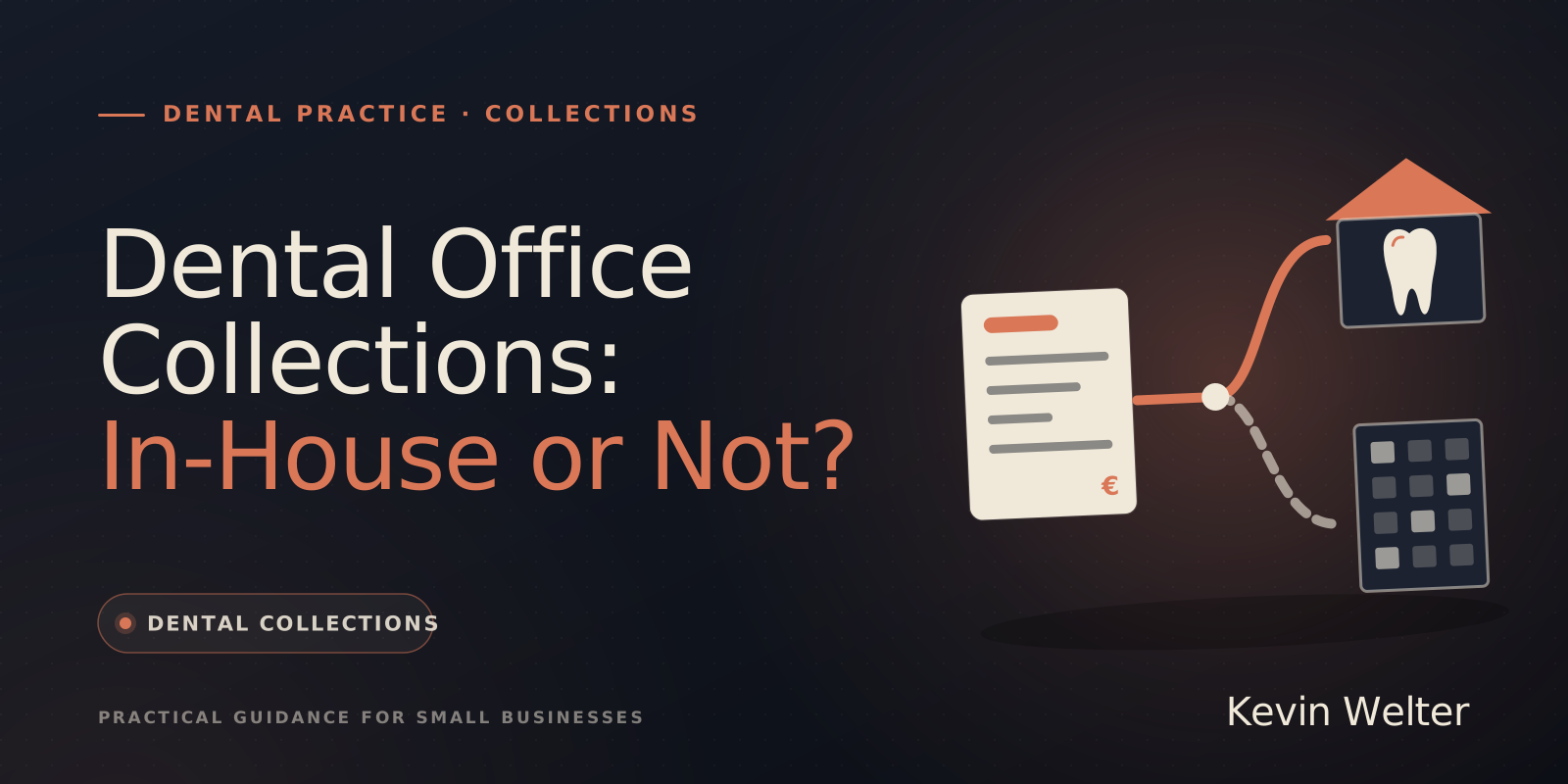
Dental office collections come down to one choice: keep chasing a patient balance in-house, or hand it to someone else. In-house means your front desk sends a reminder, then a firm collection letter, then calls or offers a payment plan, and the patient keeps hearing from the practice they know. Handing it off means a collection agency works the account for you, or you sell the balance outright, which in Germany goes by the name dental factoring. Either way, HIPAA lets you use and disclose patient information for payment, and its definition of payment expressly includes "collection activities", but only the minimum necessary, and an agency working for you needs a business associate agreement. The federal debt collection law mostly applies to the agency, not to your own staff collecting in your name. Which route fits depends on how many balances go past due, how old they are and what the agency or buyer charges. Below are a payment reminder and a first collection letter to copy, with no treatment details in them.
This is a general guide for US practices, as of November 2026, based on the HIPAA rules in 45 CFR and the federal Fair Debt Collection Practices Act. State law adds its own rules, including the time limit for suing on a debt. This isn't legal advice. How reminders work in general, with the German rules, is in Automate Payment Reminders and Dunning. More industries are on AI by Industry.
Dental office collections: three routes
What an agency or buyer charges is in its own offer, which is why there are no fees here. Ask every provider the same questions in writing: what they charge and on what basis, who contacts the patient and how, whether you can exclude certain patients, what data they need, how they protect it, and how you end the contract.
What HIPAA allows for collections
A covered entity "may use or disclose protected health information for its own treatment, payment, or health care operations" (45 CFR 164.506(c)(1)). Payment is defined broadly: it covers activities "to obtain or provide reimbursement for the provision of health care", including "billing, claims management, collection activities" (45 CFR 164.501). So reminding a patient about a balance, or handing the account to an agency, doesn't need a separate patient authorization under HIPAA.
Two limits apply anyway:
- Minimum necessary. You "must make reasonable efforts to limit protected health information to the minimum necessary to accomplish the intended purpose" (45 CFR 164.502(b)). An agency needs name, contact details, amount, dates and account number. It doesn't need the chart.
- Business associate agreement. An outside company that handles PHI on your behalf, for functions such as "billing", is a business associate (45 CFR 160.103). You may share PHI with it only if you obtain "satisfactory assurance that the business associate will appropriately safeguard the information" (45 CFR 164.502(e)), in writing.
Selling PHI is generally prohibited, but the rule excludes disclosures "for treatment and payment purposes" (45 CFR 164.502(a)(5)(ii)(B)(2)(iii)). Before you sell balances, have someone check how a particular deal fits that line.
Where the debt collection law starts
The Fair Debt Collection Practices Act defines a debt collector as someone whose business is collecting debts or who regularly collects debts "owed or due another". It excludes "any officer or employee of a creditor while, in the name of the creditor, collecting debts for such creditor" (15 U.S.C. § 1692a(6)). Your front desk sending reminders in the practice's name is usually outside that definition; the agency you hire is inside it.
One trap: the definition includes "any creditor who, in the process of collecting his own debts, uses any name other than his own which would indicate that a third person is collecting". A letter from an invented "billing department" with another name can pull your practice into the act. Send reminders under your practice's real name. State laws can add their own collection rules, so check yours.
Dental collection letter templates
Both texts name no treatment, no tooth and no procedure. The statement does that. Replace everything in brackets, and send only to the address or email the patient gave you for billing.
Subject: Your statement [number] from [date]

Dear [Mr./Ms. Last name],

On [statement date] we sent you statement [number] for
[amount]. We haven't received a payment yet. It may have slipped
through, so a copy is attached.

Please pay by [new date], online at [link], by phone at [phone]
or by check to [address]. Please include the statement number.

If you have already paid, please disregard this letter. If you
have a question about the statement or your insurance, or would
like to set up a payment plan, call us at [phone], [hours].

Kind regards,
[Name], [Practice name]
If that gets no answer, the collection letter follows. Keep it short and firm, and announce only what you will actually do.
Subject: Past due balance, statement [number]

Dear [Mr./Ms. Last name],

Your balance of [amount] for statement [number] from [date] is
now [number] days past due. We wrote to you about it on [date]
and have not received a payment or a reply.

Please pay [amount] by [date, e.g. 14 days from today], or call
us at [phone] to agree on a payment plan.

[Only if this is your policy and you will follow through:] If we
don't hear from you by that date, we will refer the account to
[collection agency / an outside collection service].

If you think this balance is wrong, for example because your
insurance should have paid part of it, please call us before
that date so we can check.

Kind regards,
[Name], [Practice name]
The same structure for other business emails is in Business Email Templates That Work, and how to follow up without pressure is in Follow-Up Email Templates, No Pressure.
What Peter, Sonja and Frieda prepare
Here is how you use the three roles in your practice. You describe the workflow to each of them once, test it on real cases and approve it.
Peter matches receipts against credit card statements for me, and in the same way he matches balances against payments. He doesn't force a match: a partial payment goes to "unclear". He learns the workflow in read-only mode, then on real cases, then you approve it. The limit in a practice: a payment with a patient's name and an account number is PHI. That matching stays in your practice management software unless the AI service is covered by a business associate agreement with its provider; otherwise the AI employee only drafts letters without patient data.
Sonja writes business emails for me. For your practice she learns the tone from letters you've stripped of names and treatment, and turns it into templates like the ones above. Your team fills them in and sends them.
Frieda doesn't touch sensitive folders for me, including health and legal disputes. For your practice she keeps a list of deadlines and demands from the admin inbox, without legal judgment. Patient emails stay with your team.
None of the three sends anything. Whether you chase a balance, which agency you use and when you stop, you decide. How you put this into practice in your office, we can look at together. How an AI learns your voice is in Can AI Write Emails in My Voice?, and how I decide what an AI may see in AI and Privacy: What the AI Gets to See.
For practices in Germany and the EU there is also my data lock: it sits between your team and Claude and replaces names and other details that point to a person with placeholders before a request goes to Claude. For a US practice it doesn't replace the BAA that HIPAA requires, and pseudonymized is not de-identified.
Frequently asked questions
Do I need patient authorization to send an account to collections?
Not under HIPAA. Payment includes "collection activities", and a covered entity may disclose PHI for its own payment. You still share only the minimum necessary and need a business associate agreement with the agency. State law or your own policies may add steps.
What should a dental collection letter include?
The statement number and date, the amount, how many days it's past due, earlier contact, a new deadline, how to pay or set up a plan, and a phone number for questions. No treatment details. Mention the next step only if you will really take it.
Is my practice a debt collector under the FDCPA?
Usually not when your own staff collect in the practice's name. The act's definition excludes a creditor's employees collecting in the creditor's name, but it includes a creditor who uses another name that suggests a third party is collecting.
When should a dental office send a balance to collections?
There is no federal rule on the timing. Set your own policy: how many reminders, how many days, which amounts, and who decides. Write it into your financial policy so patients know it before treatment.
What to do next
Count how many balances go past 30, 60 and 90 days each month. Write down your sequence: when the reminder goes out, when the collection letter follows, who decides on a payment plan and when an account goes to an agency. Put the two templates into your practice management software. Only then compare agencies, with the questions above. If you want to go through it with me, book a call.
What AI employees can take over elsewhere in a dental office is in AI for Dentists: Office Work, Not Diagnosis. How the expense side gets ready for your accountant is in Dental Bookkeeping: What AI Can Prepare. How to check lab invoices is in Dental Lab Fees: How to Check a Lab Invoice. What to do about missed appointments is in Dental Cancellation Fees: Policy and Template.