Data lock: PII redaction before anything reaches Claude
The data lock sits between your team and Claude. Before a request goes to Claude, it replaces names and other details that point to a person with placeholders. Claude gets the placeholders instead of the names. When the answer comes back, the data lock puts the real names back in, and you read plain text. In other words, it pseudonymises: PII redaction with the names restored in the answer.
The data lock is ready for use and already in operation, in use at a tax advisory firm. I set it up for each client individually and tailor it to their work.
Book a callThe principle in three steps
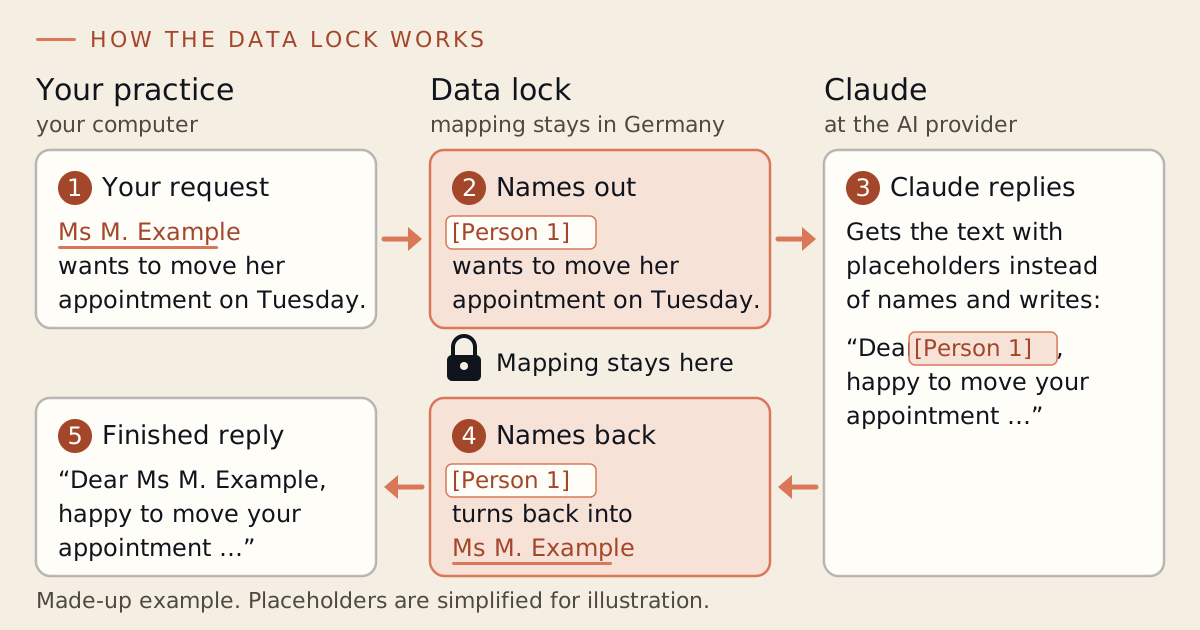
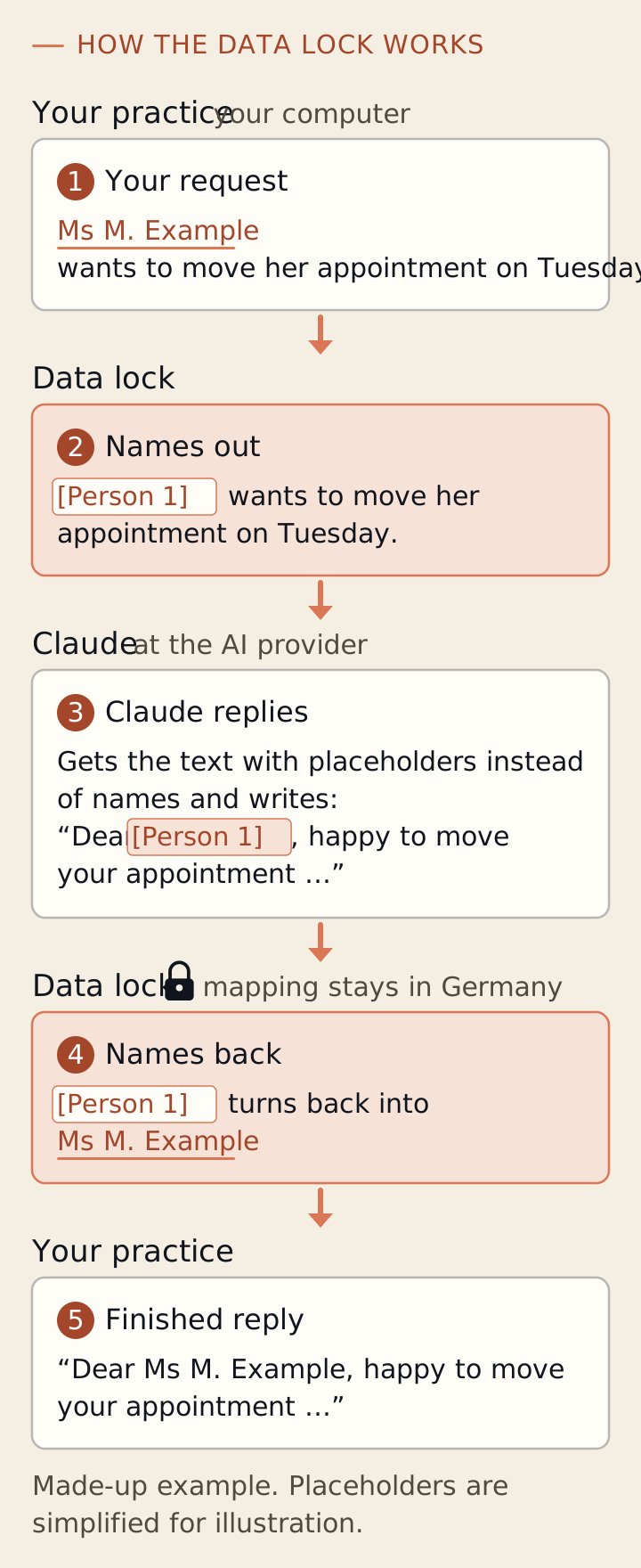
A made-up example; the placeholders are simplified.
- 1
Your text
You work with Claude Code or your AI employee as usual. The request says, for example: “Ms Schneider called on Tuesday.”
- 2
Placeholders instead of names
Before the request goes to Claude, the data lock replaces the name. Claude gets: “[Person 1] called on Tuesday.” The list of which placeholder stands for whom stays with the data lock, by default on our server in Germany.
- 3
Real names in the answer
Claude answers with placeholders, such as “Dear [Person 1], …”. The data lock puts the real name back in, and you read: “Dear Ms Schneider, …”
If the data lock cannot check a text, nothing goes to Claude; you get an error message instead.
For law firms, tax firms and practices
Law and tax firms
Client emails, drafts, summaries: your team works with Claude, and Claude gets placeholders instead of your clients’ names.
Therapy and medical practices
Appointment requests, follow-up questions, letters from the practice office: your team works with Claude, and Claude gets placeholders instead of your patients’ names.
So far the data lock is in use at a tax advisory firm. I set it up specifically for each firm and each practice.
Where the data lock runs
By default the data lock runs on our server in Germany, and every step of it runs there. On request it can also run on your own premises.
Claude itself runs at the AI provider, depending on the contract in the US or through a cloud provider in the EU. What goes there are placeholders instead of the names.
The data lock works with Claude Code, Codex and the AI employees built on them. Browser chats such as claude.ai or chatgpt.com do not run through the data lock.
What I set up for you
I set up the data lock for each client individually and tailor it to their work.
- What gets replaced
- Which details the data lock replaces and which stay readable is set up per client.
- Which work it covers
- Claude Code or Codex in your team, or AI employees built on them: together we decide which work goes through the data lock.
- PDFs and scans
- Content from PDFs and scans is checked and pseudonymised too.
- Where it runs
- On our server in Germany or, on request, on your own premises.
What you should know about pseudonymisation
Pseudonymisation is the first measure Art. 32(1)(a) GDPR names. But pseudonymised does not mean anonymous: under Art. 4(5) GDPR and Recital 26 the data stays personal data and the GDPR still applies, for health data Art. 9 as well. No automatic detection finds every detail. That is why, when we set it up, we also work out which content should not go to Claude at all. This is not legal advice. For your specific setup, we can look at it together.
The data lock in my articles
- Claude Code Mods for Tax Firms: Uses, Risks
Why protecting client data belongs in front of the AI provider, not in a mod.
- Claude Code for Therapists: HIPAA and Privacy
What Claude Code takes off the practice office and why therapy notes need extra care.
- AI Tools for Doctors: The Practice Office
Which office work in a medical practice needs no patient data and where the data lock helps.
Frequently asked questions
How do I anonymize data for ChatGPT?
For single texts you can do it by hand: swap names, places and identifiers for placeholders with find and replace, and translate the answer back yourself. That is pseudonymisation, not anonymisation, and by hand it is easy to miss a spot. The data lock replaces and restores automatically, but it works with Claude Code and Codex, not with the ChatGPT chat.
What is the difference between pseudonymisation and anonymisation?
Anonymous data can no longer be linked to a person. Pseudonymised data can be linked back to a person with a separately kept mapping; under Art. 4(5) GDPR and Recital 26 it stays personal data, and the GDPR still applies. The data lock pseudonymises.
Can professionals bound by secrecy use AI?
In Germany that is a legal question under Section 203 of the Criminal Code and the GDPR that depends on the individual case, and it stays one with the data lock. The data lock is a technical measure that lowers the risk. It replaces neither the data processing agreement with the AI provider nor the service provider’s confidentiality commitment.
Does the data lock work with ChatGPT or Copilot?
Not with the ChatGPT chat or with Copilot. It works with Claude Code, Codex and the AI employees built on them. Browser chats such as claude.ai or chatgpt.com do not run through the data lock.
Does the data lock work with Codex too?
Yes, it recently started working with OpenAI’s Codex as well. The principle is the same as with Claude: before a request goes to OpenAI, the data lock replaces names and other details that point to a person with placeholders. OpenAI gets the placeholders instead of the names, and the data lock puts the real names back into the answer.
Where does the data lock run?
By default on our server in Germany, on request also on your own premises. Claude itself runs at the AI provider and gets placeholders instead of the names.
What happens if the data lock cannot check a text?
Then nothing goes to Claude; you get an error message instead.
What does the data lock cost?
I set it up for each client individually. What your case needs and what that costs, we work out together in a call.
Does the data lock fit your work?
In the call we look at which work it should cover, what that takes, and whether another route fits your case better, such as a local AI on your own hardware.
Book a call