This isn't legal advice, just the operator's perspective I use when I build AI employees for businesses. Claude Code for therapists pays off today wherever no protected health information (PHI) is involved: sorting admin email and drafting replies, maintaining the practice website, writing handouts and templates, preparing receipts for the bookkeeper. Once PHI comes in, HIPAA changes the question. If you're a covered entity, any vendor that handles PHI on your behalf needs a business associate agreement (BAA). Anthropic offers one for HIPAA-ready Enterprise plans and its API, not for Team, Pro, Max or Ultra, and Claude Code itself is only covered with an extra configuration that, as of November 2026, Anthropic offers only to organizations with an Anthropic account team. For everyone else, the practical rule is simple: keep PHI out. For practices and firms that work with confidential personal details, there's my data lock, which pseudonymizes data before it reaches Claude. It's ready, it was built for German law firms, and I set it up for each practice individually.
I'm based in Germany, work with Claude Code every day and build AI employees for clients, including a tax advisory firm. There's no therapy practice case here: the examples are hypothetical, the US rules come from 45 CFR, the Claude details from Anthropic's help center, as of November 2026. For the full overview of AI in a practice, see AI Tools for Therapists.
What Claude Code for therapists can do without PHI
According to Anthropic, Claude Code is an agentic tool that reads files, edits them, runs commands and works with other programs. It's built for software development, but my AI employees run on it, with fixed rules, their own access and my approval before anything goes out. To get started, see Claude Code: A Guide for Beginners.
In a small practice, that could look like this:
Task
What the AI employee prepares
Where PHI hides
Admin inbox
Sorts email, drafts replies
Any message where someone asks for an appointment or help
HIPAA's privacy rules apply to covered entities. Under 45 CFR 160.103, that includes "a health care provider who transmits any health information in electronic form in connection with a transaction" covered by the rules. If you're private pay only, check rather than assume.
A business associate is a person or company that creates, receives, maintains or transmits PHI on a covered entity's behalf. Under 45 CFR 164.502(e), you may only share PHI with one if you obtain "satisfactory assurance" that it will safeguard the information, and that assurance "must be documented through a written contract". That contract is the BAA. An AI provider that receives your session notes on your behalf fits that description.
Is there HIPAA-compliant AI for therapists? What Anthropic covers
No tool is "HIPAA compliant" on its own; what matters is the BAA and which features it covers. Here is what Anthropic's help center says, as of November 2026:
Plans. The HIPAA-ready offering is for Enterprise plans. "Team plans and individual plans (Free, Pro, Max, and Ultra) can't enable HIPAA." The Primary Owner enables it and accepts the BAA in the organization settings, and the step can't be reversed there.
Claude Code needs more. "Enabling HIPAA alone doesn't bring Claude Code or Cowork under your BAA." That takes an additional HIPAA configuration, "currently only available to organizations with an Anthropic account team."
Where it's covered. With that configuration, Claude Code in the terminal is covered when members sign in with their Enterprise account and connect directly to Anthropic, plus the Code tab in Claude Desktop. Not covered: the VS Code and JetBrains extensions, and sessions through Amazon Bedrock, Google Cloud, Microsoft Foundry or an LLM gateway. Cloud sessions, Remote Control and Code Review aren't available at all.
Connectors and skills. Neither is covered by the BAA.
API. The BAA can cover the first-party API once Anthropic turns it on after signing, though not every API feature.
The authoritative list is Anthropic's Implementation Guide for HIPAA Entities. For a solo practice, the takeaway is blunt: on Pro, Max or Team, or on Enterprise without the configuration, PHI doesn't belong in Claude Code. What Team and Enterprise mean beyond HIPAA is covered in Claude Enterprise or Team: Cost and GDPR, and the data handling per plan in Claude Privacy and GDPR: What Applies.
The data lock: pseudonymize before anything reaches Claude
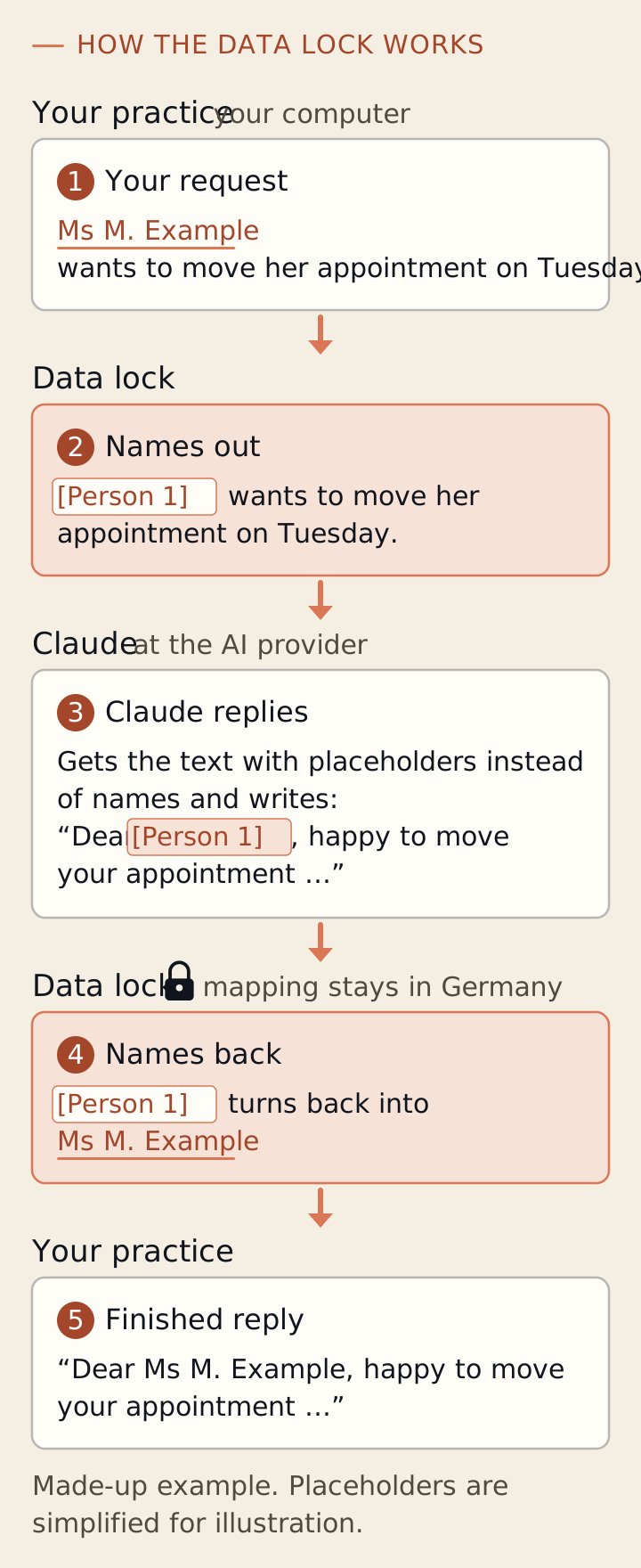
The data lock sits between your practice and Claude. Before a request goes to Claude, it replaces names and other details that point to a person with placeholders such as [Person 1]. Claude gets the placeholders instead of the names. The list of which placeholder stands for whom stays on our server in Germany, and that's where the data lock puts the real names back into the answer.
The principle of the data lock, shown with a made-up example and simplified placeholders. Graphic: Kevin Welter
The data lock is ready. I set it up for each practice individually and tailor it to the way your practice works. We'll look together at what your practice needs and whether the data lock is the right route at all. No automatic detection finds every detail, and therapy notes often identify a person through context alone, so some content shouldn't go to Claude at all. The principle is also described in Claude Code Mods for Tax Firms: Uses, Risks.
News about the data lock goes out in my newsletter; you can sign up on the free resources page.
What a solo therapist can do today
Write a one-page AI policy. Which tool is allowed for which data? What belongs in it is covered in AI Usage Policy for Small Teams.
Separate admin from clinical. Own inbox, own folders. The AI employee only gets the admin side.
Use case examples only de-identified, better abstract. Ask about the structure of a treatment summary, not about your client.
Find and replace before every text. Swap names, places and IDs for CLIENT_1 or PLACE_1. The list stays with you, and you translate the answer back yourself. That's manual pseudonymization, with the limits above.
Check training settings. Commercial products aren't used for training by default, but thumbs-up or thumbs-down feedback stores the whole conversation for up to five years; Team and Enterprise owners can turn that button off.
Need PHI in AI? Get a BAA first, for the exact features you use.
No product is compliant on its own. Anthropic offers a BAA for HIPAA-ready Enterprise organizations and its API; Team, Pro, Max and Ultra can't enable HIPAA (as of November 2026).
Can I use ChatGPT or Claude with client information?
Only under a BAA with the vendor, in features that BAA covers. Without one, use the tools for admin, website and templates.
Can I use Claude Code for AI therapy notes?
Only on a HIPAA-ready Enterprise plan with the additional Claude Code configuration, in the terminal or the desktop Code tab, connected directly to Anthropic. On other plans, session notes don't belong in Claude Code.
Is pseudonymized data de-identified under HIPAA?
Not automatically. Safe harbor means removing 18 identifier types and having no actual knowledge that the rest identifies someone. Replacing names alone rarely gets there.
Can I use the data lock in my practice?
For practices in Germany and elsewhere in the EU: yes, after a call. It's ready, and I set it up and tailor it for each practice individually. In the call we work out which tasks it should cover, what that takes, and whether another route fits your case better, such as a local AI on your own hardware. The data lock wasn't designed with HIPAA in mind, so for a US practice it isn't an answer to HIPAA. Book a call
Where to go from here
For one week, note the work in your practice that needs no client information, and start there. If you want to see how others onboard their first AI employees, join the AI Employee Framework. Which software should hold your clinical records is covered in Therapy Notes Software for Psychotherapists. How to reach clients without overpromising is in Marketing for Therapists: Rules and Tactics. And if you want to know which office work in your practice an AI employee could take over, book a strategy session.
Kevin Welter
Developer, IT architect, author of technical books (Kubernetes, cloud infrastructures) and speaker. Runs his business with an AI workforce of fifteen AI employees and shows solo business owners in his community how to hire their first AI employee.