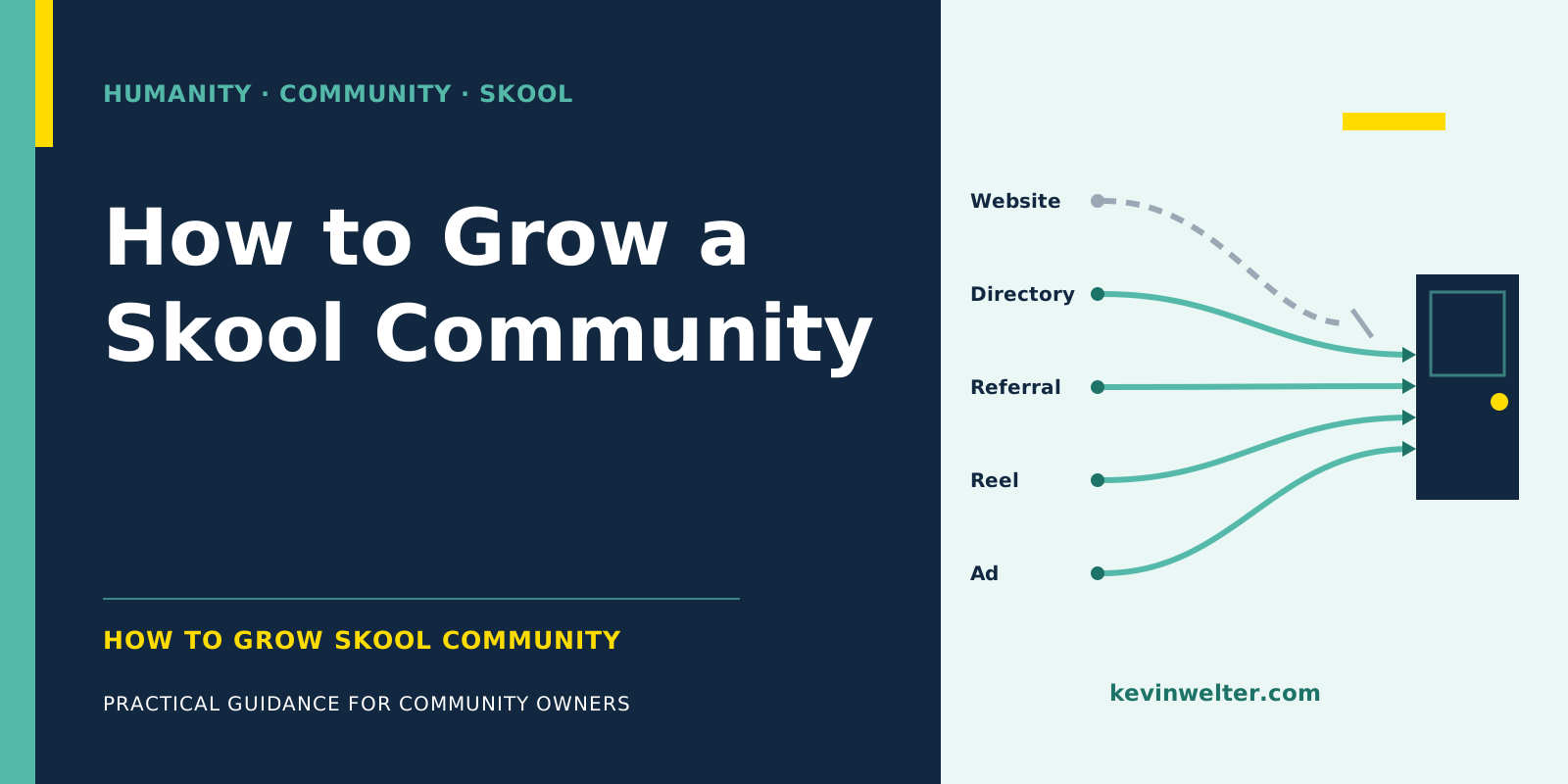
If you want to know how to grow a Skool community, there are five main routes: your own website with a blog, Skool's directory Discovery, referrals from members, social media such as Instagram Reels, and paid ads. The first four cost mainly time or commission; ads cost ad budget and amplify what your About page already does. Discovery only lists your group once it meets a minimum threshold, and according to Skool it ranks groups by member growth, activity and retention. You don't know in advance which route works for you; you find out by measuring. Skool shows your sources for the last 30 days, your own links need parameters per placement, and one wrong link attribute can make an entire source invisible. A membership question about where people heard of you is the cross-check. None of these routes guarantees growth; a reliable measurement is what you can count on.
My community Claude Practitioners has over 90 members, as of September 19, 2026. In September 2026 came the first purchase I can trace all the way from a Google search to joining, and this post explains how I measured it. How growth fits into the rest of my community work with AI employees is in Community Management with AI Employees.
How to grow a Skool community: five routes at a glance
Which route pays off also depends on your pricing model: a free community grows differently from a paid one, and the question of where people buy plays out differently in each. More on that in Skool Community: Free or Paid?. The basics of Skool itself are in Skool: What It Is and How It Works.
Route 1: your own website as a source
My website kevinwelter.com has a blog in German and English, and almost every post ends at the community. Every link to the community carries its own parameters per placement: source website, medium organic, campaign community and a content field that says on which page and in which spot someone clicked. That way I don't just see that someone came from the website, but from which post.
The most important lesson was an inconspicuous one. Until September 19, 2026, every Skool link on my website carried the attribute rel="noopener noreferrer". The noreferrer part stops the browser from passing on the referring page. So Skool counted my website as "direct", lumped together with typed-in addresses, email links, redirects and URL shorteners. The question "Does the website bring members?" couldn't be answered. Since September 19, 2026, noreferrer is gone and kevinwelter.com shows up as a source of its own. For security when opening a new tab, noopener alone is enough.
One day later came the first documented purchase through this route: someone searched on Google, landed on my homepage, opened the post Creating an AI Employee: How to Start, clicked the community button and booked the $9 tier. In the membership question "How did you hear about the community?" they wrote "Google search". A single purchase isn't a trend, but it shows the chain from search to joining can be measured.
If your website first needs to become visible, start with Setting Up Google Search Console and SEO Basics for Small Businesses.
Route 2: Skool Discovery
Skool Discovery is Skool's public directory with a search field, categories and a language filter that includes German. According to Skool, a new group only gets in once it meets a minimum threshold: cover image, group description, completed About page, a first post and invited members. After that, Skool's team reviews it, and according to Skool it usually gets listed within one to two hours.
According to Skool, groups are ranked per category on three things: member growth, member activity in posts, comments and likes, and retention. Bonus points go to good artwork and About page, an interesting niche, authentic engagement and active owners. Penalties go to bots, spam, payments off-platform, bad support and inactive owners. Skool writes that a human also reviews the rankings, and that new groups start lower and rise as the group ages.
Two things belong in your math. First, Growth Boost: it improves your placement and lets Skool run its own ads for your group, and in return, according to Skool, 30% by default of recurring payments from members who come through the Skool network go to Skool, on top of the transaction fee. It's on by default. Since late August 2026 you can raise the rate in stages up to 70%; according to Skool, a higher rate brings more traffic, and existing members keep their old rate. What the stages mean is in Skool Growth Boost: Bidding Up to 70%. Second, reviews: paying members are asked for a review after 30 days, and Discovery shows the average and the count. My community is at 5.0 out of 5 stars from 5 reviews, as of September 19, 2026. In Skool's source stats, Discovery counts toward the Skool network line, together with recommended groups and Skool's own ads.
Route 3: referrals, affiliates and invitations
On the Pro plan, you can give members a share of revenue when they refer new members. According to Skool, that works only for members, not for owners and admins, and only for new members. In my community, members have earned 20% since August 21, 2026. Skool attributes affiliate visitors for 14 days, and according to the help center, support doesn't change attribution after the fact.
Then there are the direct invitation routes. For paid communities, Skool points you to the About page link. Invites by email, CSV list or Zapier grant instant access without purchasing, according to Skool, so they suit free groups or people you deliberately let in for free.
What you should skip: recruiting members of other communities by direct message. Skool's platform policy prohibits unsolicited messages and explicitly lists mass DMs promoting other communities as spam, and the terms prohibit contacting other users for commercial purposes. Tools that send such messages automatically also run into the ban on bots that post and message.
Route 4: Instagram Reels
On Instagram I work with Reels. Conny develops several hooks, the script and the caption in my voice from a topic, a link or a recording, and Eddi edits. Posting happens after my approval: she drafts, I approve. How that works in detail is in Can AI Create Instagram Reels?.
For measurement, one detail from Skool's help center matters: visitors coming through link-in-bio tools, redirects and URL shorteners show up as "direct". Instagram and Facebook are lines of their own in Skool's source stats, but only if the origin isn't lost along the way. The membership question about where people heard of you catches what the stats miss.
Route 5: ads as an accelerator
Ads bring visitors to your About page; convincing them is the page's job. At a low price, that's tough math: in my $9 test, one paying new member cost €100.86, above the €60 kill threshold, so I paused. On format the difference was clear: a Reel sold, a static image only got clicks. How to set up ads for a Skool community, which metric counts and why Meta's count alone doesn't hold up on Skool is in Running Meta Ads to a Skool Community.
Skool community growth: measure instead of guessing
Skool assigns every join to its last source, for 90 days, or 14 days for the Skool network and affiliates, and according to Skool that attribution can't be changed afterwards. The Growth tab in the admin settings shows the last 30 days in near real time. That gives a simple order:
- Clean up your own links: parameters per placement, no
noreferrer, no URL shorteners.
- Ask a membership question about origin: "How did you hear about the community?" Skool allows up to three questions and itself suggests using the third to ask where people found you.
- Read Skool's sources: visits, joins and conversion per source, not just visits.
- Compare both: if the stats and the membership answers diverge, the origin gets lost somewhere.
How to read the numbers in the dashboard and which other metrics count is in Skool Analytics: Reading Posts and Members.
Sebastian measures the website, Susi reads Skool's numbers
Sebastian is my AI employee for SEO and blogging. With him I grew kevinwelter.com from 10 to 224 posts per language, as of September 2026. He found the noreferrer problem and traced the first website purchase from search to joining. He measures with real tools and writes proposals; nothing goes live without my approval.
Susi analyzes the metrics Skool's admin dashboard shows, including the sources. When kevinwelter.com appeared as a new source after the link change, she added the website to her analysis as a source of its own, and the older figures stay comparable. Susi also builds the ads, paused, and I switch them live. Which route gets more time is my decision.
Frequently asked questions
How do I get more members for my Skool community?
Through five routes: your own website with a blog, Skool Discovery, referrals from members, social media such as Reels, and paid ads. Which of them works for you only measurement will show: parameters on your own links, Skool's source stats and a membership question about where people heard of you. None of these routes guarantees growth.
How do I get listed in Skool Discovery?
According to Skool, a new group has to meet a minimum threshold: cover image, group description, completed About page, a post and invited members. After a review by Skool's team it usually gets listed within one to two hours. Ranking per category depends, according to Skool, on member growth, activity and retention, and a human reviews it as well.
What does Skool Discovery cost?
Listing costs nothing extra. With Growth Boost on (the default), Skool takes 30% of recurring payments by members from the Skool network, on top of the transaction fee. In return, Skool says, it improves your visibility and placement and runs its own ads. You can raise the rate up to 70%; per Skool, a higher rate raises the efficiency score and can bring more traffic. Switch it off under Discovery.
Can I message members of other communities to promote mine?
No. Skool's platform policy prohibits unsolicited messages and explicitly lists mass DMs promoting other communities as spam. The terms prohibit contacting other users for commercial purposes, and bots that send messages are banned too. Stick to your own channels, referrals and Discovery for promoting your Skool community.
Why doesn't Skool show my website as a source?
Check first whether your links carry the noreferrer attribute or run through URL shorteners and redirects. Then the origin never reaches Skool and the visit counts as "direct". That was the case for me until September 19, 2026. Remove noreferrer, keep noopener and link directly.
Where to go from here
Check three things today: whether your own links to the community carry noreferrer, whether your About page meets the minimum threshold for Discovery, and whether one of your membership questions asks where people came from. Then read Skool's sources in 30 days and compare them with the answers. How Sebastian and Susi work on this, I show in my community Claude Practitioners, which runs in German. You don't have to guess alone when setting up the measurement there: one question in the feed is enough, and usually someone has already found the same link mistake.