How to write website content that works: page by page, from your own material. Give every page exactly one job (home, one page per service, about, contact), collect what you already have (quotes, sent emails, notes from client calls, a five-minute voice memo), and let AI sort and phrase drafts from it. Every claim gets proof, or it goes. AI is the helper here, not the source: whatever is not in your material, it can only guess. You approve.
Every website project of mine starts with the text, not with colours. Why copy rather than design is the bottleneck, and which three lines belong at the very top, is in Web Design for the Self-Employed: Worth It?. Here we go further: what belongs on each page and how to write it. Blog posts for Google are a separate topic (SEO Content Writing with AI); the basics are in Writing with AI: A Beginner's Guide.
One page, one job
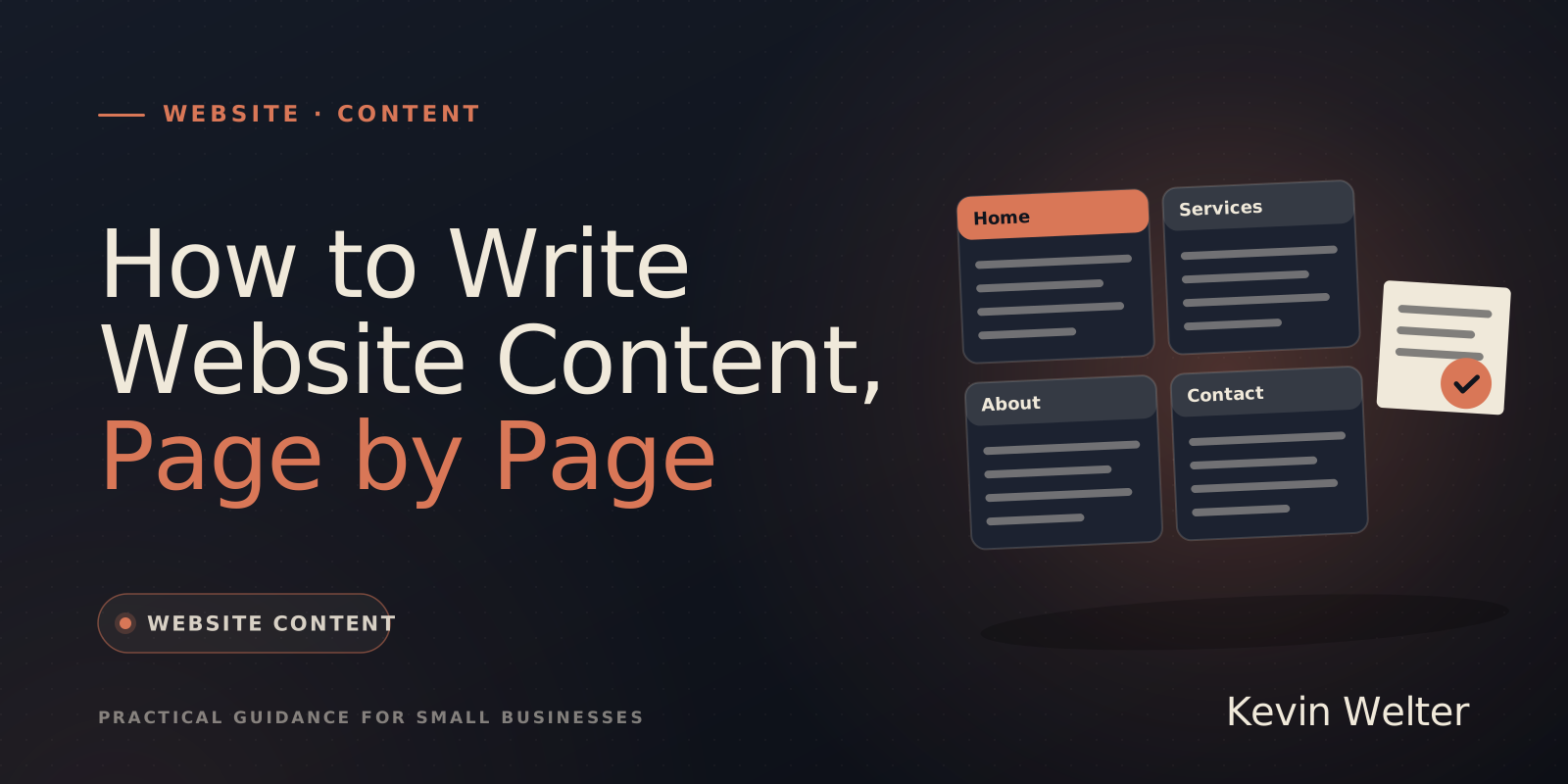
Before you write a sentence, decide what each page has to do. Most small business sites need these four page types, plus the legal pages that apply where you operate.
"One page, one topic" helps the reader, and Google can match a page about exactly one service to a search more easily than a catch-all page with ten services at one sentence each (a heuristic, not a promise).
For every service page, check the search intent: type the service into Google the way a customer would and look at what comes up. Google's SEO Starter Guide puts it this way: "Users who know a lot about the topic might use different keywords in their search queries than someone who is new to the topic." So write in your customers' words, not your trade's jargon.
The material you already have
Generic copy happens when the AI knows only what it knows about your industry. Good content comes from what only you have, mostly already in your inbox.
The voice memo is the underrated part: talk through how a typical job runs, from the first call to the invoice. Spoken, most people are more concrete. How to speak instead of type is in Dictating Prompts to Claude and ChatGPT; free tools for transcribing a recording are in Convert Audio to Text for Free. How recurring client questions become checked answers is in Build FAQs From Customer Conversations.
For tone, real examples beat any description. Sonja, my AI employee for business emails, learned my tone from 50 of my own real sent emails, not from a questionnaire. For a website, three or four good explanatory emails are enough. How to make your tone describable is in Can AI Write Emails in My Voice?.
Replace client names, addresses and amounts with placeholders before emails or notes go into an AI chat.
How to write website content for each page
Home page
The three lines go at the top: what you do, for whom, and the next step. Right below comes the first proof, not the company history: a review, a true number, a photo of real work. Then one sentence per service, linked to its page. The home page sends visitors to the right place; it does not explain everything.
Service pages
This is where people decide. A service page answers what you otherwise explain on every call:
- What exactly you do, in your customers' words.
- Who it is for, and who it is not for.
- How it works, in three to five steps.
- What it costs, or what the price depends on. If you don't want to show prices, say when the customer gets one.
- The most common questions from your call notes.
- The next step, with phone number or form.
A made-up example: an electrician calls the page "EV charging infrastructure", while customers search for "home EV charger installation". So the page is called that, and the jargon comes further down.
About page
"Passionate since 1998" is on thousands of sites. Only yours can say who works there, what you trained in and how you work. That comes from the voice memo, along with a real photo instead of stock. Use titles and licences only the way you are allowed to. What contractors need to show, licence numbers included, is in Contractor Website: What It Needs.
Contact page
The contact page says what happens after someone gets in touch: who replies and by when, but only a time you keep. Phone, email and a short form are enough. Legal requirements depend on where you do business; this is not legal advice. In Germany, for example, § 5 of the German Digitale-Dienste-Gesetz (DDG) requires business sites to show name, address and a quick electronic contact. More is in the legal section of Build a Website for Free: The Real Ways.
Proof instead of claims
Every sentence that sells you needs something to carry it, or visitors skim past it. Mark every flattering adjective in your draft and replace it with something checkable. The examples are made up; use the right column only if it is true for you.
Reviews come with rules. In the US, the FTC rule makes it a violation for a business to write or create a review that misrepresents that the reviewer exists or had experience with the business (16 CFR 465.2). The simplest route is a link to your Google profile. How to reply there is in Respond to Google Reviews With AI.
The same rule applies to the AI. Ralf, my AI employee for websites, uses only claims that can be supported by your sources. Missing information is flagged, not silently filled in. An early cross-check showed why: Ralf found errors in four out of ten briefs. Without that rule, AI fills gaps with something plausible; why, is in AI Hallucinations: Why AI Makes Things Up.
A website copy brief to paste into AI
Use this brief once per page, each in a new chat with Claude, ChatGPT or another AI. The rules matter most: the AI asks first and flags gaps instead of inventing.
You are writing the copy for one page of my website. You invent nothing.

Page: <home | service "…" | about | contact>
Job of the page: <what the visitor should do next>
Reader: <who lands here, with what question, how much they know>
Search term (service pages only): <the way customers type it into Google>
Tone: like my emails below

My material:
1. Quotes / service description: <paste>
2. Three emails in which I explain something to a client: <paste, names replaced>
3. Common client questions from calls: <paste>
4. Voice memo (transcript): <paste>
5. Proof: <reviews with permission, numbers, credentials>

Rules:
- Before you write, ask me up to five questions about what is missing
  from the material. Wait for my answers.
- Only statements that are in the material. If something is missing,
  write [MISSING: …].
- No praise without proof: no "highest quality", "reliable", "tailored"
  unless a proof from point 5 sits next to it.
- Use my clients' words from point 3, not my jargon.
- No introduction about the industry. The first sentence says what I do.

Output:
- Headline, two opening sentences, sections with subheadings,
  the next step at the end (phone, form or booking).
- Then a list: every statement in the copy with the place in the
  material it comes from.
The source list is your checking tool: whatever has no place in the material, you cut or fill in yourself. More ready-made briefs are in Prompt Templates: 12 Copy-and-Paste Briefs for Small Businesses.
What AI does and what stays with you
AI sorts your material, finds recurring questions, shortens, suggests headings and writes variants. What stays with you is what Ralf's team page leaves with the human: positioning, new services, legal claims, sensitive customer data and the actual launch. Nothing gets sent or posted that I have not read myself.
Blog posts for Google are written in my business by Sebastian, my AI employee for SEO, following a guide and a fact sheet and checked in a separate role. For the fixed pages of your site, the process above is usually enough.
Write it yourself or hire a copywriter?
A copywriter brings experience and an outside view, but the material still comes from you. Ask how they will get it, whether they use AI, and who checks facts. How a full website project with a provider runs is in Getting a Website Built: Steps, Options.
My view: the time of expensive websites is over, and I like the idea of being in charge yourself. With your material and AI as a helper, you write your own copy and change it whenever you want.
Frequently asked questions
How long should website content be?
As long as the visitor's question requires. The home page stays short, a service page can be longer. Google says it has no preferred word count.
Can I write my website content with AI?
Yes. Google says it looks at the quality of content, not how it was produced. Details are in SEO Content Writing with AI.
Does every service need its own page?
Every service customers ask or search for separately. Small add-ons go on the matching main page.
How formal should my website copy be?
As formal as your clients are with you. Your sent emails show it. What matters is that it stays the same across all pages.
How to take this further
Start with your most important service page. Collect two quotes, three emails and your five most frequent client questions, and paste them with the brief into a new chat. What comes after the copy, from domain to upkeep, is in Build Your Own Website: A Guide With AI. How to turn copy and material into a website with Claude Code is in Build a Website With Claude Code: A Guide. Whether one page is enough for you is covered in One Page Website: When One Page Is Enough. Ralf and the other ready-made roles are available to load in my community, the AI Employee Framework. For your individual case, let's look at it together.