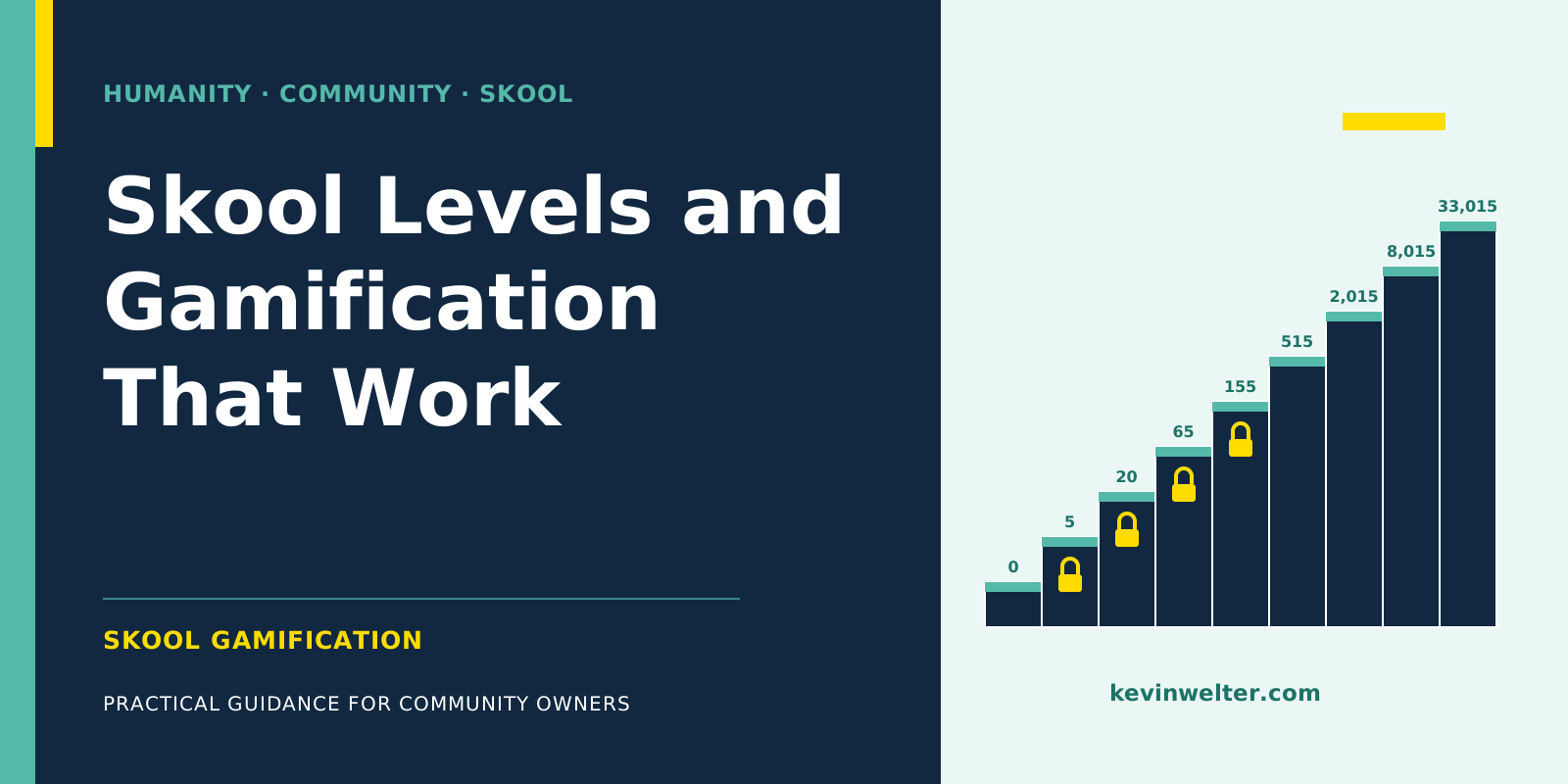
Skool gamification is the system of points, levels and a leaderboard built into every Skool community. The level shows in front of each member's name and on their profile. There are nine levels, and according to Skool's help center you move up through likes: other members like your posts, comments and replies, and each like is one point. Level 2 takes 5 points, level 9 takes 33,015. Levels apply per group, and owners can rename them and tie courses, events, chat and posting to a level. The leaderboard shows who has the most points; owners and admins are not on it. Used well, this gamification is less about competition and more about guidance: you decide which content opens up when someone takes part in the community.
I run my community, Claude Practitioners, on Skool; as of September 2026 it has 20 courses and 282 lessons, all in German. With that much content, the question isn't whether members find enough, but whether they find the starting point. In my community a fixed path does that job: the quick start first, then the 30-day path. Levels are a tool that can complement such a path, and that's how I look at them here. How levels fit into the whole division of labour in a community is in Community Management with AI Employees; the Skool basics are in Skool: What It Is and How It Works.
How Skool level points work
According to the help center, points come from likes: "1 like = 1 point for the post or comment author." Write a post that gets ten likes and you have ten points. Reading, completing lessons or attending calls earns no points, or at least Skool describes none for them.
Two consequences matter for planning:
- Levels measure resonance, not learning progress. By that description, a member who quietly works through every lesson stays on level 1.
- Levels apply per group. Someone with level 7 in another Skool community starts at 1 again in yours.
The Skool levels: all nine thresholds
The thresholds appear word for word in two help articles. I calculated the right-hand column from them.
The curve is steep. An active member can reach levels 2 and 3 with a few helpful replies; from level 6 on it takes hundreds of likes. In a small community that's a high bar. So place unlocks where your members can realistically get to.
According to the help center, you can name the levels yourself for each group. On the leaderboard, members see those names and which courses unlock at which level.
What you can unlock with levels
According to Skool, the two plugins are mainly spam protection: the chat threshold slows down people who join only to sell in the DMs; the posting lock slows down low-quality posts. Skool recommends both for large groups, the chat lock from around 1,000 members, and notes that setting chat to level 9 basically means chat is turned off.
Besides levels, courses have four other access types: open, one-time purchase, release after a number of days since joining, and selected members only. Individual pages can also be unlocked after a number of days. That matters further down, when levels become a guide.
The Skool community leaderboard: who is on it
The leaderboard ranks a group's members by their points. According to the help center, community creators, billing managers and admins are not included. So as the owner you don't compete with your members, and your own posts don't put you on the list.
What the leaderboard makes visible are the members whose contributions land with others. For you, that's a list of people you can approach, for example for a first-hand account on the next call. Whether they want to be quoted publicly is something you ask them first.
Skool gamification levels as a guide through your content
Because levels count likes and not lessons, they make a poor learning path. Tie "Module 2" to level 3 and you lock out a quiet, hard-working member. Better to separate two questions:
- What does every new member need, and in what order? You handle that with open courses, release after days and drip. That's the learning path.
- What should open up when someone takes part? You handle that with levels. That's the reward for participation.
An example for a coaching community, built for this post:
Levels 2 and 3 sit at 5 and 20 likes; a member who answers a few questions from others can get there. Level 4 at 65 likes is already an achievement and fits a session that costs you time. Because the leaderboard shows the level names and the courses they unlock, every member can see there what comes next.
Check two things. First: if new members are meant to introduce themselves on day one with a post of their own, a posting lock from level 2 works against that. For this case Skool itself suggests having them introduce themselves by commenting on the pinned post; more on the first week is in Skool Onboarding: The First Seven Days. Second: level courses should be bonus content, not required content, otherwise you sell a course a paying member can't open. How to build courses in the Classroom is in Skool Classroom: Courses from Call Recordings; where to set the access types at launch is in How to Start a Skool Community.
If you're unsure how to cut your levels, you don't have to decide alone: in my community you can ask in the feed or bring the question to the Thursday call.
Where gamification tips over
Skool draws a clear line itself. The platform policy says: "Farming points is prohibited." Skool also lists as spam manipulating engagement metrics such as likes and comments through automation or coordinated actions, and bots that post, comment or message others are prohibited. According to the help center, Skool's Discovery directory also penalises bots, fake accounts and low-quality engagement.
Three practical rules follow:
- Don't arrange like rounds. In my view, even well-meant campaigns like "everyone likes everyone" can count as coordinated behaviour.
- No tools that like or comment for you. Not for you and not for your members.
- Don't make points the goal. Promise points and you get likes. Whether that leads to better questions and answers is another matter. That's my assessment, not a measurement.
Skool Games: the competition for owners
Besides member levels, Skool runs a competition for owners. In its previous form, the Skool Games, it ran quarterly: according to the help center, the ranking was based on growth in monthly recurring revenue, one-time course sales didn't count, and according to the official rules 50 winners were selected per period. That form is gone. In its weekly show Skool News, Skool announced on June 23, 2026: "This will be the last skool games! Ends June 28". On July 14, 2026 it followed up with: "The new skool game leaderboards are live!" On the page of its own group Skoolers, Skool describes the new Skool Game as a competition to see "who can grow the most", with "realtime leaderboards showing earnings by category" and status emojis next to your name, which Skool's interface tiers by monthly recurring revenue from $3k to $1m. Only members of Skoolers can see the leaderboards. I found no separate rules or prizes for the new format in the help center or the official rules as of September 2026.
For owners in Germany, only what is in writing counts: the official rules for the giveaway are still posted at skool.com/legal in the version for giveaways from 1 August 2025. They open it only to legal residents of the 50 US states, the District of Columbia, Puerto Rico and Canada (excluding Quebec) aged 21 or older, and Germany is explicitly on the list of prohibited jurisdictions. Austria and Switzerland are not on that list, but they are not among the eligible countries either. The United Kingdom is on the prohibited list too. Whether these rules also apply to the new leaderboards, Skool doesn't say. This is not legal advice.
Frequently asked questions
How do you earn points on Skool?
Through likes. According to Skool's help center, every like on a post, comment or reply gives the author one point. The help center describes no points for reading, completing lessons or attending calls. So if you want to level up, write posts and replies that help others. Skool's platform policy explicitly prohibits farming points.
How many points do the Skool levels need?
Level 2 starts at 5 points, level 3 at 20, level 4 at 65, level 5 at 155, level 6 at 515, level 7 at 2,015, level 8 at 8,015 and level 9 at 33,015. That's what Skool's help center states. The gaps grow sharply, which makes the top levels a high bar in smaller communities.
Can I unlock courses by level on Skool?
Yes. For every course in the Classroom you can choose the access type "Level unlock", on both plans. The same works for calendar events. Because levels count likes, as Skool describes them, this suits bonus content that rewards participation rather than the learning path, which you're better off handling with release after days since joining.
Does my Skool level carry over to other communities?
No. According to the help center, levels apply per group. Someone who reached level 7 in one community starts again at level 1 in the next, like every new member. Each group also names its own levels, so the same level can have a completely different name and unlock different content in two communities.
Who is on the Skool community leaderboard?
The group's members, sorted by points. According to the help center, community creators, billing managers and admins are excluded, so as the owner you are not on it. The leaderboard shows you whose contributions land with others, which gives you people to approach, for example for a first-hand account on a call.
Where to go from here
Write two lists for your community: what every new member needs in which order, and what should open up when someone takes part. The first list becomes your learning path with open courses and release after days, the second your level unlocks with names of your own. How that plays together in the first days is shown in Skool Onboarding: The First Seven Days. And if you want to see what a community with a fixed starting path and weekly calls looks like from the inside, that's what I show in my community Claude Practitioners.